The first thing Elira of House Varn learned about running away was that silk was a terrible choice of travel clothing.
By the time the city walls were a smudge of grey behind her, the embroidered hem of her gown looked as though it had narrowly survived a small, determined war with every bramble in the kingdom. Mud streaked up past her boots, her lungs burned, and her carefully pinned dark hair had given up and fallen into her eyes.
It felt glorious.
Wind rushed at her cheeks, tasting of rain and river stones instead of incense and old stone halls. Her heart hammered, not with the measured, polite dread she carried at court, but with wild, raw fear that didn’t bother pretending it was anything else.
They’ll be after you already.
The thought came with the memory of her father’s face—ashen, controlled, the way it always was when he was more angry than he dared show. There had been the letter sealed with golden wax, the crest of House Meron impressed too deeply, as if the signet carrier had leaned hard on purpose.
An alliance. A marriage. A man she had never met, except in whispered rumors of how he crushed rebellions with the same calm hand with which he poured wine.
“Duty,” her father had called it.
“Prison,” Elira had answered, though only in the privacy of her own mind.
So she had done the unforgivable thing.
She had waited until the castle settled into its nighttime hush. She had donned riding boots beneath her gown, hidden a plain cloak under the formal mantle, and slipped from her chamber into passageways she knew better than the bloodlines of her own house.
The stables had been easy. The stablemaster loved her; she’d tended the foals herself when she was younger. He’d questioned her only when she saddled a quieter, sturdier mare rather than her usual hot-tempered favorite.
“Road’s poor,” she’d said, voice steady. “Going out to see the flood damage at the lower farms for Father.”
He’d believed her. Or pretended to.
Now, hours later, the mare was a dark, solid warmth beneath her, snorting clouds into the cooling air as they picked their way down a narrow game trail through the forest that clothed the foothills.
Elira slowed to a walk and finally to a halt. She slid down from the saddle, legs trembling with the effort of keeping the horse at a run so long. The forest wrapped around her in shadowed greens and blacks, the last light of evening threading through branches.
She tied the mare’s reins loosely to a low branch. The horse nudged her shoulder in quiet complaint.
“I know,” Elira murmured, stroking the damp neck. “I’m tired too. But if we stay on the road they’ll catch us. We just need one night. Just one.”
One night to get beyond her father’s reach. One night to become something other than a bargaining piece on a ledger.
She’d thought it all through. She had coins sewn into the hem of her shift, a small knife strapped to her thigh, a bundle of dried meat and cheese tied behind the saddle. She’d memorized the map: two days’ ride through back ways to the river town of Brellin, where no one cared who you were if you paid, and from there… a boat, maybe. A job as a scribe. She was good with numbers, with words. She would find something.
All she needed was time.
The forest, however, did not seem particularly interested in her plans.
Mist began to gather between the trees, a thin, pale veil that crept along the ground. The last light died more quickly than it should have. Elira frowned and tilted her head back.
The sky had gone from bruised violet to a uniform slab of grey. Clouds had rolled in from nowhere, swallowing the last hint of stars.
Of course. “Why would the world make this easy?” she muttered.
Thunder grumbled, distant but moving closer.
She untied the mare and led her deeper beneath the trees, hoping the canopy would blunt the worst of the rain. The path narrowed, then disappeared entirely. Roots grabbed at her boots, damp leaves slipped beneath her soles.
“This is still fine,” she told herself. “You grew up riding the forest ring. You’ve snuck out more nights than anyone ever knew.”
Except this forest wasn’t the well-groomed hunting preserve of her childhood. The trees here were older, their trunks thicker, bark furrowed like ancient faces. Moss draped from branches. The undergrowth was a tangle of thorns and ferns, unbothered by gardeners with pruning hooks.
The first heavy drops fell a heartbeat later—thick, cold coins of water that splashed her face and soaked through her cloak. The mare shied, ears swiveling, eyes rolling white.
“Easy,” Elira soothed, though her own heart lurched. The storm came down as if some unseen hand had upended a bucket over the world. Rain hammered on leaves, turned the ground to slick mud underfoot.
Within moments, she was drenched. Her cloak clung, heavy and cold. Her carefully planned escape began to feel less like a daring story and more like the moment in a tale where the foolish noble is punished by the uncaring wild.
Lightning split the sky, close enough to turn the forest silver-blue for a blinding instant. The mare squealed and jerked away, ripping the reins from Elira’s hand. Before she could grab them, the horse bolted, thrashing through wet undergrowth, hooves pounding away into the storm.
“No!” Elira shouted. “Come back!”
Her voice vanished in the roar of rain.
She stumbled after, branches whipping at her face, mud sucking at her boots. In seconds, she could no longer see the mare—only the fading flares of movement between trees, then nothing at all.
Elira stopped, chest heaving, hair plastered to her cheeks. Her thigh burned where a branch had raked it. The world around her had dissolved into shades of dark and darker, the shapes of trees blurring as rain sheeted down.
The smart thing would have been to stop and think. To mark a tree, set a direction, remember where she’d been.
Instead, she did what every terrified creature does when the world becomes too loud: she ran.
Branches reached for her like fingers. Roots rose suddenly to catch her feet. Once, she slipped to one knee, palms slamming into cold, slick earth. She pushed herself up, cursing, and ran again.
By the time the storm finally began to ease, the last of her frantic momentum died with it.
She staggered into a small clearing and nearly went to her knees again. Instead she braced herself, hands on thighs, and tried to force her breathing into some kind of order.
Silence fell slowly. The rain retreated to a whisper in the leaves. Water dripped from branches in a steady, mocking rhythm.
Elira straightened, turning in a slow circle.
The clearing was ringed with trees she didn’t recognize. That wasn’t particularly unusual; trees rarely introduced themselves. But nothing looked familiar. No trail. No hoofprints. No broken branches that might show where the mare had crashed through.
Her stomach dropped in a way that had nothing to do with hunger.
“You’re fine,” she told herself. The word sounded thin. “You’re not far from the road. You just… need to pick a direction and walk.”
The problem was that every direction looked exactly the same.
She picked one anyway. Pride could still be louder than fear, if you fed it well enough.
For what might have been an hour—or five minutes, or three days; time warped strangely when one was drenched, cold, and stubborn—she pushed through undergrowth. The forest grew denser, not thinner. A fog crept in low, curling around her boots, rising slowly to her knees.
At some point she realized she was shivering too hard to think properly. Her teeth clicked when she tried to clench her jaw. The knife at her thigh might as well have been a decoration. The coins sewn into her shift felt like stones dragging at her.
Elira stopped walking because stopping was the only choice left.
“This is ridiculous,” she whispered. Her voice sounded very small in the muffled forest. “I am Elira Varn, heir of—”
Her throat closed around the words.
Heir of a house she’d abandoned.
Daughter of a man she had betrayed.
Future wife of a man she refused to meet.
The titles tangled in her mouth. Out here, none of them meant anything. The forest did not care whose ring she wore or whether her dowry could fund a war.
Out here, she was just lost.
“I did the right thing,” she said, more fiercely. “I won’t marry a man who crushes people like ants. I won’t be traded like grain. I won’t—”
Her voice broke, not from conviction this time, but from the simple, crushing weight of exhaustion.
What if you’ve only traded one prison for another? whispered a quieter thought. What if you die here and no one ever even knows where your bones lie?
The idea slid through her like ice.
Elira sank down with her back against a tree, knees drawn up, cloak dripping a dark pool around her. She pressed her forehead to her arms and let herself, for the first time since she’d left her chamber, admit the truth.
She was lost.
Not in the harmless way of a girl who took the wrong hallway in a castle she’d grown up in.
Not in the romantic way of a noble who wanted to “find themselves” and had the money to get safely lost and safely found again.
Truly lost, in a place that might never give her back.
“Please,” she whispered, to no one in particular. “I need help. Impossible help.”
She had never been much for prayer. The gods she’d been taught to honor had always felt distant and political, more interested in oaths and offerings than in scared girls in wet cloaks.
Still, alone and shivering in the dark forest, she closed her eyes and let the words fall out anyway.
“I don’t want to go back,” she said. “Not to them. Not to that life. But I don’t… I don’t know where to go instead. If anyone is listening—anyone at all—show me a path that isn’t a cage. Please.”
Silence answered.
For a long breath, two, three, the world held itself very still.
Then, somewhere in the mist-veiled trees to her left, something flickered.
Elira lifted her head, breath catching.
At first she thought it was a trick of exhausted eyes—a remnant lightning flash, or the pale glow of fungus on old logs. But this light was warm, not cold; a steady, gentle amber, pulsing faintly as though it had a heartbeat.
It floated at the edge of the fog, bobbing softly. As she watched, it moved closer, then paused, as if considering her.
A lantern, she thought, before her mind had time to add any rational objections. Someone has a lantern.
“Hello?” Her voice wobbled. “Is someone there?”
The light brightened, then dimmed again, a slow exhale.
Something stepped out of the fog.
It was not a person.
At least, not the kind she was used to.
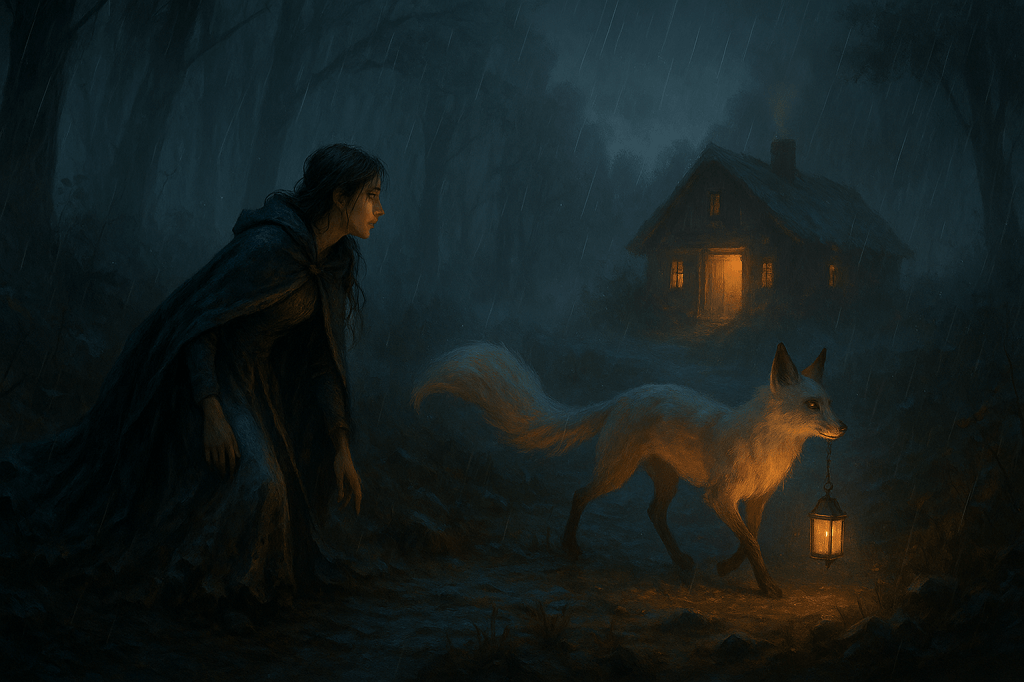
A fox, she thought at first—about the size of a hound, with a long, bushy tail and narrow, clever face. Its fur was a pale, silvery white, tipped in ember-gold at the ears and paws, as if it had walked through the last light of sunset and carried it away with it.
But no fox she had ever seen had eyes like that.
They glowed—not with the cold, hard shine of a predator in the dark, but with the same soft amber as the light it carried. And carried it did, for dangling from the end of its tail, by a thin chain that seemed made only of light, was a small lantern.
The lantern’s glow washed the fog in warm color. Its glass panes were etched with tiny, intricate runes that shifted when she tried to focus on them.
Elira stared.
The fox tilted its head, studying her in turn. Its tail swayed once, the lantern swinging gently. Then, without drama, it turned and padded away a few steps. After a moment, it stopped and looked back over its shoulder.
“Of course I finally go mad out here,” she muttered. “Why not?”
The fox waited.
Elira pushed herself, creaking, to her feet. Everything hurt. She was cold enough that the thought of movement felt impossible—and yet the idea of sitting back down in the dark and letting herself slowly freeze felt worse.
“Are you… real?” she asked.
The fox blinked slowly, as if to say: real enough.
Then it flicked its tail. The lantern chimed once like a tiny bell and flared brighter, casting a slender path of light between roots and stones.
Elira hesitated only a heartbeat longer.
“If this is a trap,” she told the fox, “I will be very irritated.”
The fox’s ears twitched. Then it turned again and slipped into the trees, lantern dancing.
She followed.
The path it wove was not one she would have chosen. At times the ground dropped away into shallow ravines and they had to pick their way along slick, narrow ledges. At others, they waded through knee-high ferns that slapped damp fronds against her legs.
Whenever she faltered, the fox would pause and look back, tail swaying in patient encouragement.
And always, the lantern light stayed just bright enough to show what lay directly before her, and no more.
“You couldn’t make it easier?” she complained, half to herself.
The fox’s ears flicked again, as if in dry amusement.
“Fine,” she muttered. “Teach the lost noble a lesson in humility. Very wise.”
Despite herself, she felt the faint ember of a laugh somewhere deep in her chest. It was small, and easily smothered, but it was there.
They walked for what felt like hours, though the forest around them slowly changed. The trees grew a little farther apart. The underbrush thinned. The bitter, icy edge of the storm wind softened, replaced by the earthy scent of wet soil and something else—smoke?
Elira sniffed the air more sharply.
Yes. Smoke. Not the wild, sprawling smoke of wildfire, but the straight, disciplined thread of a single chimney.
Hope flared so suddenly it almost hurt.
The fox veered slightly left. The mist ahead began to glow, not from the lantern’s light, but from a broader, softer brightness.
They stepped out of the trees onto the edge of a narrow dirt road. Elira blinked against the change in space. The road ran left and right, rutted with wagon tracks, puddles reflecting the dim sky.
Directly ahead, not fifty paces away, hunched a building.
It was not big; no grand inn with painted signboard and stableyard. It was a cottage, really, squatting low against the wind, its slate roof patched in places. Smoke rose from a crooked chimney. Light leaked from shutters that didn’t quite close, and from the cracks around a heavy wooden door.
The door itself bore no sign, no crest or mark.
Yet as Elira looked at it, something in her bones answered with a sensation very like recognition.
She had never seen this place before in her life.
And yet… and yet.
The fox padded to the center of the road and sat, tail curling gracefully around its paws. The lantern settled beside it, light steady.
Elira stepped up beside the creature, staring at the cottage.
“I… don’t understand,” she said quietly. “I thought there was nothing on this road for miles except—”
Except, apparently, whatever this was.
The fox looked up at her. For a moment, its gaze felt very old, older than the forest, older than the stones of her family’s hall. It wasn’t unkind. If anything, it held a sort of weary fondness, like a teacher watching a student finally grasp a simple truth.
It dipped its head once, then flicked its tail. The lantern chimed again. The sound was soft, but it carried—straight to the cottage.
The door opened.
Warm light spilled out, honey-gold and inviting. A figure stood in the doorway—broad-shouldered, apron-smudged, hair pulled back. Elira could not see their face clearly at this distance, only the outline of someone solid and real.
“Storm’s easing!” a voice called, rough with ordinary life rather than polished court. “If you’re out there, you’d best get inside before it thinks better of it.”
Elira swallowed.
Choice lay in front of her like a simple line.
Back into the forest—into cold, and fear, and her own limited understanding of the world.
Forward into something unknown that, at least for the moment, smelled of bread and fire and the soft murmur of other voices.
She glanced down.
The fox was already watching her. Lantern light painted its fur in shades of warm silver. The strange runes on the glass panes shifted again, rearranging themselves into patterns she could almost, but not quite, read.
“Is this… for me?” she asked.
The fox’s tail brushed her ankle, a brief, gentle touch. Then it rose in one fluid movement, trotted to the edge of the road, and, with a last backward look, vanished into the trees.
The lantern remained.
It did not fall.
It hung in the air for a heartbeat, then swung slowly toward the cottage door, as if anchored to a path that wasn’t entirely in this world.
Elira stood alone on the road.
Alone, except for the echo of her own whispered plea in her ears.
Show me a path that isn’t a cage.
She took a step forward.
The lantern bobbed ahead of her, lighting the way.
By the time she reached the cottage, she was shaking again, but for a different reason. The figure in the doorway stepped back to let her pass, and as she crossed the threshold, warmth wrapped around her like an embrace.
Behind her, though she didn’t see it, the lantern’s light flickered once, twice, then streamed in after her, tucking itself neatly into a hook on the beam above the door.
Its glow settled, filling the small room with a gentle, steady light that had very little to do with oil or wick.
Outside, the forest watched. The path she had taken was already fading, roots and leaves rearranging themselves over her footprints as though they had never been.
Far between the trees, a pair of amber eyes blinked once, satisfied.
The Lantern Fox turned and slipped away into the night, lantern swaying at its tail once more, searching for the next heart foolish and brave enough to ask for impossible help.
Chapter 2 – The Runaway Noble
 Maxfield Willow
Leave a comment