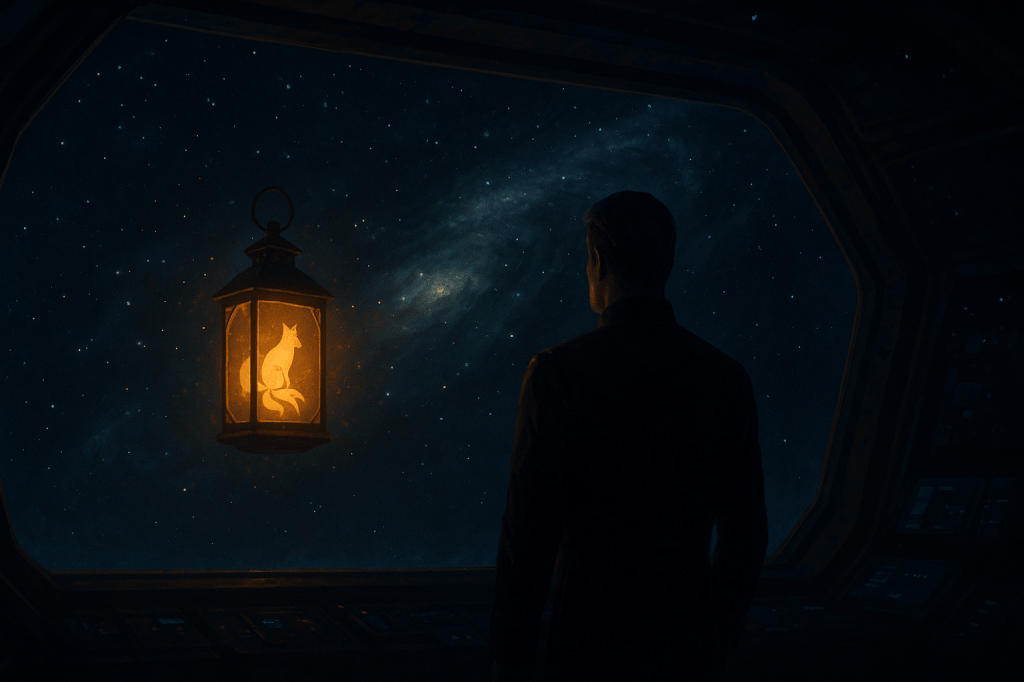
The stars had never looked so empty.
Captain Kael Arden sat alone on the bridge of the Vigilant Dawn, chin resting on his fist, while the forward viewport showed a slow drift of distant suns. To anyone else, it would have been a beautiful sight: a silver warship adrift in a sea of light.
To Kael, it felt like being trapped in an old photograph—frozen, hollow, and a little bit wrong.
The ship thrummed softly around him. Consoles glowed on standby. No crew on shift; he’d sent them all to rest. The patrol was over, the convoy safely escorted, the pirates driven off. By any metric in the Fleet logs, it had been a success.
Except for the refugee ship.
He closed his eyes, but that only made the memory sharper.
The civilian transport, battered and burning, had appeared at the edge of the system just as the pirate raiders struck the corporate freighters. His comms officer’s voice had been tight, almost pleading.
“Captain, the transport is broadcasting distress. Life support failing. They’re asking for immediate assistance.”
At the same time, Command’s orders had come through, crisp and impersonal.
“Priority Alpha: Protect assets of the Marrowline Convoy at all costs. Do not deviate.”
Assets. Not people. Not lives. Assets.
He’d hesitated. For three seconds. Maybe four. Long enough for the choice to carve itself into him like a brand.
“Helm,” he’d said at last, voice steady by sheer force of habit, “hold course. Protect the convoy.”
They’d done it. Driven off the pirates. Saved every last crate of mineral ore and corporate tech.
By the time the battle ended, the refugee ship’s signal had gone silent.
He’d ordered a course to their last known position anyway. They found only drifting debris and a hazy cloud of frozen air where the hull had finally split.
There had been no survivors.
A soft chime drew him back to the present. The ship’s chronometer ticked over another hour. Patrol route complete, course auto-plotted back toward the inner trade lanes. Toward more convoys. More orders.
More assets.
Kael stood up, pushing away from the captain’s chair like it had grown thorns.
“Computer,” he said, “cancel return course.”
A pause. Then the calm, obedient voice of the ship’s systems:
“Please state new destination.”
He looked at the map hovering in the air—systems and hyperlanes glowing in a web of cold light. Everything organised. Everything efficient.
He wanted to punch his fist through it.
Instead, he exhaled slowly. “No new destination. Hold position. Drift.”
“Confirmed. Engines to idle. Holding position.”
The stars stopped sliding. The bridge fell fully quiet, as if the ship itself were holding its breath.
Kael paced to the viewport, resting his palm against the transparent alloy. The cold seeped into his skin.
“You were supposed to be different,” he muttered to the universe at large. “We were supposed to be explorers. Pathfinders.”
That had been the dream when he was a wide-eyed academy recruit. Find new worlds. Chart the unknown. Help.
Somewhere along the way, the maps had all been filled in, and the unknowns replaced with quarterly reports.
His reflection looked back at him in the dark glass—a man in his late thirties, uniform neat, captain’s bars gleaming. A successful officer by every external measure.
Inside, he felt like the hull of that refugee ship—cracked, air bleeding out, seconds from rupture.
His hand slid down the viewport, fingers leaving a faint smear. He almost laughed; even his despair was tidy.
The laugh died before it formed.
There, on the edge of his vision, something moved.
Kael straightened, squinting into the starfield. The Vigilant Dawn was far from any beacon. There shouldn’t be anything out here but dust and distant suns.
And yet—
A faint pulse of light blinked in the dark. Then again. Not the regular rhythm of a standard nav buoy, but softer, almost… breathing.
“Computer, magnify sector 12 by 30,” Kael ordered.
The viewport obeyed, stars stretching, one patch of space zooming in until the source of the light shimmered into focus.
It was not a beacon.
Floating alone in the void was… a lantern.
Not a proper piece of ship tech, not in any database Kael knew. It looked like something pulled from an old story—a small iron-framed lantern with frosted panes, burning with a steady, warm golden flame inside. No visible power source. No thrusters. Just hanging there in the vacuum, where it absolutely shouldn’t be.
The light inside flickered, and for just a moment the shape of the glow shifted.
It became the outline of a fox—slender, four-tailed, eyes like twin embers—before flickering back to simple fire.
“What in all the hells…” Kael whispered.
His hand went to the nearest console, instinct kicking in. “Computer, scan that object. Full spectrum.”
“Analyzing,” the ship replied. “No mass signature detected. No energy signature consistent with known technology. Distance: one thousand meters off port bow. Relative velocity: zero.”
“So it’s just… there,” Kael said. “In vacuum. Glowing. With no fuel. And physics just took the night off.”
“Statement cannot be confirmed,” the computer replied, unhelpful.
The lantern pulsed again. Brighter this time.
It felt like a gaze.
He scrubbed a hand over his face. Stress. Guilt. Maybe he needed sleep.
The lantern flared, and suddenly the bridge lights dimmed, consoles flickering as if their power had been drained. The ship groaned like a living thing in discomfort.
“Warning,” the computer said, voice stuttering. “Unidentified interference impacting—”
The audio cut out.
The lantern’s glow intensified until it washed across the viewport, golden light bleeding through the alloy as though it weren’t there at all. Kael staggered back, blinking against the radiance.
“Enough!” he shouted, throwing an arm over his eyes. “If this is some kind of pirate trick—”
The world fell away.
For a heartbeat, he felt weightless, falling sideways through his own skin. Then his boots found ground again—not the metal deck of the bridge, but something rougher, older.
He opened his eyes.
He was standing on a dirt road beneath a sky he didn’t recognise.
The stars were there, but closer, sharper, as if the universe had leaned down to listen. A cool wind slid past, carrying the smells of pine and distant smoke. The hum of engines and reactors was gone; in its place came the chorus of night insects and the far-off hoot of some unseen bird.
The bridge, the ship, the viewport—gone.
In front of him, a short distance down the road, stood the lantern.
It hovered at about chest height, its metal frame unchanged, the warm flame inside steady. Now, in the open air, he could see clearly that the flame wasn’t quite a flame. It was a shape moving within the glass—a little fox wrought entirely of light, its tails flowing like sparks in a gentle breeze.
The fox tilted its head, regarding him.
Kael stared back, mouth slightly open. “Right. Definitely asleep,” he said. “Or concussed. Or dead. Or all three.”
The fox’s mouth opened in what might have been a silent yip. The lantern swayed, then drifted backwards down the road, its light spilling over the packed earth.
“Wait,” Kael said, taking an involuntary step forward. “What are you? Where am I?”
The lantern paused.
Warmth brushed against his thoughts, like the feeling of standing too close to a hearth after coming in from the cold. Along with it came a sense of gentle urgency, a tug—not on his body, but on something deeper, drawing him forward.
No words. Just invitation.
He understood it anyway.
“You want me to follow,” he said slowly.
The lantern brightened, as if in answer, then began drifting away again, further down the road.
He hesitated. “And if I don’t?”
The warmth faded for a heartbeat, replaced by a hollow ache in his chest, sharp enough to make him grimace. Then the ache shifted into a weight—his captain’s bars, heavy on his shoulders, the sound of Command’s orders replaying in his mind. The memory of twisted metal and frozen air.
He didn’t hear a voice. But the meaning was clear enough:
if you do nothing, you go back exactly as you are.
He swallowed, throat tight.
“Fine,” he said. “Lead on. But if you’re my conscience, this is a very dramatic way to say ‘we need to talk.’”
He followed.
The road wound gently through trees, their branches arching overhead. Starlight and lantern-light wove together into strange patterns on the ground. As they walked, the world shifted in subtle ways.
At first, it was only small things—the smell of the air, the texture of the earth. Then the trees thinned, and the road spilled out onto a familiar metal gangway.
Kael stopped dead.
They were aboard a ship. Not the Vigilant Dawn, but a smaller vessel from years ago—the Pioneer’s Dream, his first posting out of the academy. The hull walls gleamed with scuffs and patches, the kind that came from real exploration, not polished patrol routes. Laughter echoed faintly down the corridor.
“This is…” He reached out, fingertips brushing the bulkhead. “This was my first assignment.”
The lantern hovered at his side, casting a warm circle of light on the worn metal. The warmth against his thoughts shifted—lighter now, tinged with a kind of quiet curiosity, as if asking: remember?
He did.
They moved on, the gangway stretching, folding, changing beneath their feet as if time had become a hallway they could walk down.
He saw himself at twenty, eyes bright, talking passionately about mapping unknown systems and helping outer colonies. He saw the moment he’d volunteered for a humanitarian mission during a plague outbreak, spending sleepless nights in makeshift wards because “they needed every pair of hands.”
He felt again the raw, simple conviction that had driven him: we’re here to help.
The lantern’s presence swelled with warmth at that memory, like a hand pressed briefly over his heart in agreement.
Then the scenes shifted.
He saw the first time he’d been commended not for saving lives, but for safeguarding a shipment of experimental weapons.
“Efficient use of resources, Arden,” the admiral had said. “You made the hard call.”
The warmth thinned, cooling to something like distant starlight. Not condemnation—just contrast. A gentle, painful comparison between who he had been and who he’d become.
Scene after scene unfolded—a living archive of choices. None of them outright monstrous. Just small compromises. Orders followed without question. Tiny shifts in language: “civilians” becoming “variables,” “colonies” becoming “assets.”
With each memory, the road beneath his feet felt narrower.
Eventually, they stopped before a set of blast doors.
Kael knew these doors. He didn’t need the lantern to show him what lay beyond.
The designation engraved above them—the coordinates of the refugee ship’s last known position—might as well have been burned into the back of his eyelids.
“I know what I did,” he said quietly. “I don’t need to see it again.”
The light within the lantern dimmed, turning soft and steady, like banked coals. A weight settled on him—not crushing, but insistent. It felt like standing at the edge of a decision all over again.
He felt a nudge of emotion, not his own: reluctant courage. The feeling of opening an old wound to clean it properly, knowing it would hurt but heal cleaner.
He drew a shaky breath. “You want me to stand where I stood,” he murmured, “and actually look at it.”
The warmth pulsed once. Yes, without saying it.
“Fine,” he whispered. “Open it.”
The blast doors slid apart without a sound.
Instead of space debris and corpses, the scene beyond was frozen at the moment of his original hesitation. The Vigilant Dawn sat at the centre of the projection, under attack, pirate fire streaking past. The convoy freighters huddled behind her. And out at the edge of the system, the refugee ship burned, its distress beacon pulsing weakly.
Two course projections hung in the air—one toward the convoy, one toward the refugees.
Kael watched his own recorded self, jaw clenched, eyes on the convoy. Watched his hand lift. Heard his own voice echo through the stillness.
“Helm, hold course. Protect the convoy.”
The words stabbed through him like shrapnel.
The lantern’s glow cooled, and with it came a tightening in his chest that wasn’t quite guilt and wasn’t quite grief, but something knotted out of both. The sensation held for a moment, then shifted.
The scene blurred. The map lines rearranged themselves.
Now he saw the Vigilant Dawn darting toward the refugees instead, shields straining to hold off pirate fire while the convoy took damage but mostly escaped. The cost was higher. More wreckage, more scars. But the refugee ship stayed intact long enough to evacuate.
Another rearrangement: fighters peeled off to shield the convoy while the Vigilant Dawn itself broke toward the refugee ship, threading a narrow channel of risk between both responsibilities. Messy. Risky. Not certain. But human.
None of these had happened. The records would never show them. They were might-have-beens, not second chances.
But Kael could feel, very clearly, what the lantern was showing him: you had options. More than one. You chose the one that betrayed your own vow.
“I had other ways,” he said hoarsely. “I just… didn’t take them.”
The emotion pressing against his thoughts changed again—less sharp now, more like the ache after a long cry. Beneath it, a quiet, stubborn ember of something.
Possibility.
The visions dissolved. The blast doors faded back into the dirt road. Only Kael, the lantern, and the night remained.
He stared at the ground. “What do I do now?” he asked, voice raw. “I’m one captain. One ship. Command gives the orders. The corporations hold the leash.”
The lantern drifted closer. Warmth spread through his chest, not soft this time, but steady and firm, like the feeling of standing at attention for an oath. A memory rose, unbidden:
Himself, younger, on the observation deck of the Pioneer’s Dream, hand against the glass, whispering to the stars, If I ever have to choose between profit and people, I choose people. Every time.
The warmth flared in answer, locking that memory in place.
He didn’t hear a sentence. He didn’t have to. The meaning pressed into him as clear as any spoken phrase:
start there.
He let out a long breath.
“Start with why I took the captain’s chair,” he said slowly. “Not why they gave it to me. Why I wanted it.”
The lantern’s light danced, almost playful, and a flicker of amusement brushed his thoughts—like someone arching a brow at him for asking a question he already knew the answer to.
He barked a short, humorless laugh. “You’re saying the question isn’t ‘what can I do under their orders?’ It’s ‘what can I do with this ship and crew if I remember who I am.’”
The warmth pulsed once in agreement.
Images rose at the edge of his mind—not shown to him exactly, more like ideas nudged to the surface.
His ship refitted not as an escort for corporate convoys, but as a responder. Running rescue operations on the fringe. Smuggling food and medicine past blockades. Using every trick he’d learned protecting assets to protect lives instead.
Each image came with both a thrill and a stab of fear. Disobeying orders. Burning bridges. Maybe never seeing the inner worlds again as a free man.
The fear was his. The small, stubborn spark that flared beside it—the one that said, this is what you wanted to be—felt like it came from the lantern’s glow, fanned gently into flame.
“Why me?” he asked quietly. “Out of all the captains, all the ships. Why find me in the dark?”
The lantern’s light softened. For a moment, Kael felt a rushing impression: rows of cold, dark viewports across a thousand ships, countless faces reflected there. Some hard. Some bored. Some satisfied.
And then, his own reflection—eyes tired, jaw clenched, but with a question burning behind his gaze: What have I become?
The feeling settled around him like a cloak: because you still cared enough to ask. Because it still hurt. Because you hadn’t gone numb.
He swallowed. “So this is it,” he murmured. “You drag me out here to a road that doesn’t exist, show me every mistake, and then what? Send me back and hope I don’t fall into the same rut?”
The sensation that brushed his thoughts now was neither comfort nor scolding, but something else: a quiet hand letting go. A crossroads. A palm opening to show him that nothing was being pushed into it.
The choice, very clearly, was his.
The road beneath his feet shifted one last time. The trees and doors and corridors blurred into a wash of gold, and beyond that he thought he saw the hint of starlines again—his own stars, waiting.
He squared his shoulders.
“When I wake up,” he said, more to himself than to the lantern, “I’m changing course. I don’t know how long I’ll get away with it. I don’t know how badly it’ll go. But I’m done pretending cargo matters more than the people holding the crates.”
The lantern flared, bright and clean, like fire catching new kindling.
The warmth that flowed through him now wasn’t instruction or judgment. It felt like acknowledgement. Like someone—something—bowing in return.
Then the world tilted, gently this time, like a ship rolling on calm seas. The dirt road, the trees, the night sky—all dissolved into golden light.
The last thing he saw before everything went white was the fox of light curling its four tails around itself, ember-eyes watching him with quiet satisfaction.
He woke in his chair on the bridge of the Vigilant Dawn.
The consoles hummed. The viewport showed the same stretch of stars. The chronometer had advanced barely a minute.
The strange lantern outside was gone.
“Computer,” he said, heart still pounding, “status report.”
“All systems nominal,” the ship replied. “Awaiting navigation input.”
On the edge of the sensor display, a small icon blinked. Kael frowned and tapped it open.
A distress signal, weak but clear. A mining outpost on a barely charted world, broadcasting a plea for medical aid after a reactor leak. The coordinates were off the established trade routes—far from any convoy route, far from Command’s priorities.
He almost laughed. “Of course.”
The orders on his console were clear: hold position and await the next convoy assignment. He could follow them. Ignore the call. Let someone else deal with it—someone slower, someone less suited, some theoretical ship that might never come.
Or—
His hand moved before he’d fully thought it through.
“Computer,” he said, “set course for these coordinates.” He sent the distress call’s location to navigation. “Maximum safe burn. Inform Command we are… responding to emergency humanitarian needs.”
There would be questions. Maybe worse than questions. Court-martial threats. Loss of rank. Loss of everything he’d built in the comfortable, suffocating world of asset protection.
His heart hammered. Underneath the fear, something else stirred.
Relief.
“Confirmed,” the computer said. “Course laid in. Time to destination: twelve hours, thirty-one minutes.”
“Engage.”
The stars on the viewport stretched as the Vigilant Dawn swung about and leapt forward, engines flaring.
Kael sank back into his chair, eyes fixed on the streaking starlines. His hand, without thinking, went to his chest, as if expecting to feel the weight and warmth of a lantern there.
He found only fabric and the steady thrum of his own heartbeat.
Still, for a moment, he thought he saw a faint reflection in the viewport—four flickering tails of light, watching from the dark, before vanishing into the rushing stars.
“People before profit,” he murmured. “Let’s see if I can remember how to be that kind of captain.”
The Vigilant Dawn surged on into the unknown.
Somewhere, between the stars and the spaces between, a small, impossible fox-shaped light slipped quietly along the edges of reality, padding ahead on unseen paths, marking the way for those who had finally chosen to look up and change course.
 Maxfield Willow
Leave a comment