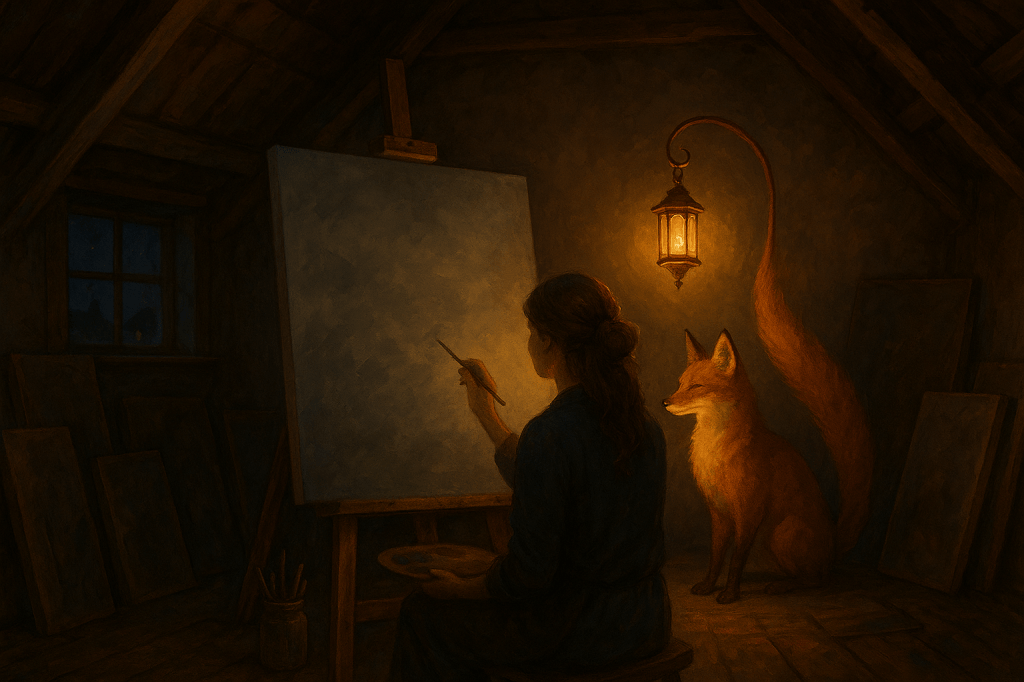
By the time the last of the storm-washed light drained from the sky, Liora had already decided she was done with painting.
Canvases leaned like gravestones against the walls of her attic studio, their surfaces half-finished and abandoned. Skies that stopped mid-dusk. Oceans that never reached the shore. Faces with eyes left blank, as if she had been unable to imagine their gaze.
She sat in the middle of it all on an old wooden stool, hands slack in her lap, staring at the one canvas still upright on the easel. It was the largest she’d ever bought, a foolish purchase from a year ago when commissions had been steady and she’d believed her art had somewhere to go.
Now it held nothing but a flat, stubborn grey.
Her brushes lay in a battered jar beside her, bristles stiff with dried paint. The jar itself—once a honey jar—still carried a faint sweetness when the room grew warm. Liora inhaled deeply, searching for that sweetness, for anything at all.
Nothing came.
The world inside her was silent.
Not the good silence of a held breath just before the first stroke of a brush.
The hollow silence after the last guest has gone home, when the house still remembers laughter but cannot replay it.
She had once painted skies that made strangers cry. That’s what the gallery owner had said, anyway. Her work hung in two small cafés and one narrow gallery that always smelled faintly of coffee grounds and old wood, and people had sent messages about “how her colors felt like standing on a hill at dawn,” or “how the clouds seemed to remember something they couldn’t say.”
Then the call had come.
Her father’s voice, broken around three words that rearranged her world:
She’s gone, Liora.
Her mother’s death had come suddenly, without warning, the way summer storms sometimes rose out of thin blue and rolled the sea to fury in minutes. There was no long illness to brace against. No time to prepare little rituals of letting go.
One day her mother was simply there, and then she was not.
The brushes felt wrong in Liora’s hand after that. Colors curdled on the palette. Every sky she tried to paint turned heavy and featureless, a bruise spreading from horizon to horizon.
Three months.
That was how long it had been.
“How long you’ve been stuck,” her father had said gently over the phone two nights ago, voice crackling with distance. “You don’t have to force it, Li. Your mum wouldn’t want that.”
“I know,” she had replied, though she didn’t.
She knew her mother had always pushed her to keep painting, to finish what she started. “The sky doesn’t stop halfway,” Mum used to say, looking over Liora’s shoulder. “Even when it’s ugly, it finishes.”
But Liora’s skies had stopped. And somewhere along the way, so had she.
Outside the attic window, the narrow seaside town was closing itself for the night. Liora’s house clung to the hill above the harbor, sloping roofs tiered below her like scales on a sleeping dragon. Streetlamps flicked on one by one, scattering puddles of light over wet cobbles. The storm that had rolled through at noon had rinsed the world clean, leaving the air sharp with salt and the faint scent of seaweed.
She turned her face away from the window.
She didn’t want clean.
Clean meant there was no trace left.
On the old workbench against the far wall, her mother’s sketchbook lay where Liora had placed it on the day of the funeral. She hadn’t opened it since. The elastic band was still looped around it, its once-springy strength now tired and slightly frayed.
Liora looked at it for a long time.
Then, with a small, exhausted sound halfway between a sigh and a groan, she slid off the stool. The floorboards creaked under her bare feet as she crossed the room.
She took the sketchbook in both hands and held it to her chest first, eyes closed.
“I can’t do this,” she whispered to the quiet studio. “I tried, Mum. I really did.”
The house didn’t argue.
The wind didn’t answer.
She set the sketchbook back down without opening it.
That was when the light changed.
It began subtly, as if a stray streetlamp below had flickered and brightened. But this glow was warmer, more concentrated. It slipped across the floor in a slow, deliberate sweep, catching motes of dust in its wake like floating sparks.
Liora opened her eyes, frowning.
At first, she assumed she’d left a candle burning. Her gaze swept instinctively toward the little cluster of candles by the window—white pillars in mismatched brass holders. Unlit. Wicks black but cold.
The light was coming from the door.
No—not from the door, but under it.
A thin line of golden radiance spilled along the threshold, pulsing gently as if in time with some far-off heartbeat.
Liora’s own heart stuttered.
The attic door was closed. She’d shut it herself when she came up hours ago, needing the separation from the rest of the house. There were no lights on in the hallway outside.
“Power surge?” she murmured, though she knew that wasn’t how power surges worked.
The glow brightened at the sound of her voice, as if pleased to be noticed.
She took a step closer.
The moment her toes brushed the edge of the light, a faint warmth touched her skin—not the dry bite of a heater or the still heat of a summer room, but a living warmth, like standing too near a campfire and feeling it breathe.
The line of light swelled, then curled inward, as if someone outside were dragging something along the crack beneath the door. Liora’s breath caught as the glow gathered and thickened, rising from the floor in a slow spiral.
The light pulled itself upward.
It twisted on an invisible axis, drawing out a slender shape: four delicate paws, a narrow body, a tail that arched and then curved forward like a question mark.
At the end of that tail hung a lantern, its frame no bigger than Liora’s thumb, made of filigree gold that seemed more suggestion than metal. Within its tiny glass panes burned a steady, gentle flame—the source of the light that filled the room.
The creature itself was fox-shaped but not entirely fox. Its fur was a soft gradient of ember hues, from deep copper at the spine to pale ash-gold along its belly and throat, as if someone had brushed firelight into its coat and left it there. Its eyes were not the amber of ordinary foxes but a muted, luminous white, threaded with faint gold.
Liora forgot how to inhale.
The lantern swayed as the fox stepped fully into the room, moving with a quiet confidence that made it seem like it had always known the path from the other side of the door. It paused in the center of the attic, nose lifting to taste the air.
The light from its lantern flowed outward and upward, brushing over the half-finished canvases and dead brushes, over the grey expanse of the large canvas on the easel. Every object it touched seemed to sharpen, lines becoming clearer, shadows softening without disappearing.
Liora’s throat worked.
“This is… new,” she managed.
The fox’s ears flicked toward her. It did not speak. It only looked at her for a long moment, head tilted ever so slightly, lantern bobbing at the tip of its tail.
The flame inside the lantern brightened, then dimmed, like a single, calm heartbeat.
Liora’s first thought was that she must have finally snapped. Grief and exhaustion had been circling in tighter loops around her mind for weeks, and perhaps now they had closed fully. Maybe this was how people broke: not with screams, but with quiet, impossible visitors.
Yet the boards felt solid under her feet, and the air still smelled of linseed oil and turpentine and sea salt. The glow wasn’t a hazy hallucination but a clean, clear radiance that left crisp-edged shadows.
The fox took a step toward the easel.
Its paw pads made no sound on the wooden floor, but the lantern chimed softly—a barely-there glassy note—as if acknowledging each movement. It stopped in front of the canvas, sat back on its haunches, and lifted its tail. The lantern swung forward, casting its light directly onto the empty grey.
The flat color quivered.
Liora’s breath hitched. She stepped closer almost without meaning to, drawn by that subtle tremor in the paint.
The fox turned its head, watching her approach with those pale, patient eyes. Up close, she could see the fine strands of fur around its muzzle, the way its whiskers caught the light and broke it into thin silver.
“You’re not real,” she whispered, though the words had no conviction. “I don’t… I don’t do hallucinations. That’s not my thing.”
The fox blinked slowly.
The lantern brightened again—and this time, the grey on the canvas split.
Not physically; there was no tearing of fabric, no flaking of dried pigment. But the color itself seemed to open, like cloud cover thinning to reveal the sky behind it. A deep blue peered through, rich as the sea just before full night.
Liora stumbled back. Her shoulder hit a stack of canvases, sending them shifting and clacking together in protest.
“Okay,” she breathed. “Okay. That’s… new.”
The fox only looked at her, then returned its gaze to the canvas.
The lantern’s flame shifted hue, a thread of warm rose lining the gold. Where that light touched the surface, the emerging blue thickened and spread, lifting and curling like mist. It rose into shapes: the beginning of clouds, the hint of stars not yet formed.
Liora’s fingers twitched.
Paint.
Brush.
She glanced toward the jar out of instinct.
The fox followed her gaze and then looked back at her, ears angling forward. It tipped its head once toward the brushes, very slightly, like someone nodding encouragement across a crowded room.
“You want me to… paint?” she asked.
The lantern flickered in a quick, bright pulse.
Liora swallowed past the lump in her throat. “I can’t,” she said, voice barely audible. “I don’t have it anymore. It’s just—” She gestured helplessly at the studio, at all the half-finished skies. “It’s gone.”
The fox rose to its feet. Its tail swayed once, slow and deliberate.
The lantern dimmed until it was only a small coal of light, then brightened again, steady and unwavering—as if to say: Not gone. Waiting.
Something in Liora’s chest gave a small, painful twist.
Her hand moved almost of its own accord. She picked up a brush—a medium round, bristles stiff until she rubbed them gently between her fingers. The ferrule clinked softly against the jar’s rim as she lifted it out. It felt wrong and familiar at the same time.
Her palette still held dried islands of color, cracked and useless. She reached for a clean one and squeezed out fresh paint mechanically: ultramarine, a touch of phthalo, a smear of Payne’s grey. Her hand hovered over the warm tones, hesitated, then reached for them as well. Just a little. Just enough.
The smell of new paint blossomed through the air.
The fox stepped aside but stayed near, lantern angled toward the palette now. Its light slid over the colors, waking tiny sparks within them—pigments seemed deeper, more themselves, as if remembering that they were once stone and earth and mineral pulled from the bones of the world.
Liora’s grip tightened on the brush. Her palm was damp.
She approached the canvas again.
Up close, the change was even more evident: the grey she’d slathered on in despair weeks ago had transformed. It was now a foundation, a muted under-sky in which hints of structure lurked. The beginnings of forms she hadn’t thought to shape.
“Is this… you?” she asked the fox.
It did not nod. It did not need to.
The lantern’s flame leaned toward the canvas like a breeze.
Liora lifted the brush.
For a moment, her hand hovered uselessly. The old terror clawed up her spine—the fear that whatever mark she made would be wrong, that she would betray what had once been effortless.
She thought of her mother standing in the doorway of this attic, hands in the pockets of her cardigan, watching without hovering.
“The sky doesn’t stop halfway,” Mum had said. “Even when it’s ugly, it finishes.”
“I don’t know how to finish this,” Liora whispered now, eyes stinging.
The fox stepped closer until its shoulder almost brushed her leg. Warmth seeped through her jeans, steady and calm. The lantern’s glow softened, feathering at the edges, blurring the hard outline of her doubt.
Somewhere beneath the weight of grief, a single, small thread of wanting stirred.
Not wanting to be brilliant. Not wanting praise or commissions or gallery shows.
Just wanting to see what this sky could become, if she let it.
Liora exhaled slowly.
The brush touched canvas.
The first stroke wobbled. Her hand was out of practice. The line of blue she laid down was thicker than she intended, darker. For a moment, panic spiked.
Then the fox’s tail brushed her ankle, light as a falling leaf.
She tried again.
Another stroke. Then another. Her wrist began to remember the arc of distant storms, the layering of cool over warm to suggest depth. The paint caught and dragged and then smoothed. Blue leaned into grey and made shadows; grey brushed against blue and softened it into something that felt like evening.
Time loosened its grip.
The fox moved with her, a quiet orbit of warm light. When her hand hesitated, the lantern’s glow would tilt toward a corner of the canvas, illuminating possibilities: a gap in the clouds, a line where horizon might break through. When she leaned in too close, losing the whole for the detail, the fox padded a few steps back, drawing the light with it so the canvas snapped suddenly into view again, full and entire.
She realized, at some point, that she was breathing differently. Without thinking, she had fallen into a steady cadence: inhale on the lift of the brush, exhale on the stroke. Her shoulders loosened. Her jaw unclenched.
The sky she painted was not one she had seen outside her window, though it carried echoes of a hundred twilight walks with her mother along the harbor. It was larger, more dreamlike, a sweep of high, thin clouds through which deep indigo bled, threaded with faint currents of rose and gold as if the sun had only just slipped away and was reluctant to let go completely.
Grief was still there, a weight in her chest. But it was no longer a wall. It was a color. A shadow that made the light real.
At some point her hand cramped and she realized how long she’d been standing. The storm-clean dark outside the window had deepened fully into night. Only the fox’s lantern and a small lamp by the door lit the room now.
Liora stepped back, breath catching.
The sky looked back at her.
It was not perfect. Some transitions were rough; a cloud formation in the upper left was muddy. But there was movement in it, a sense of wind and distance, of a world that went on far beyond the frame.
In the faint lines of light by the horizon, she could almost imagine a small hill where two figures once stood—one tall, one shorter, shoulders touching, heads tilted back to watch the stars appear.
Tears blurred her vision.
“I miss her,” she whispered.
The fox pressed its head lightly against her leg.
The lantern’s flame dimmed to a softer glow, as if bowing its head with her. Shadows pooled more deeply around the edges of the room, leaving the canvas and the two of them in a small, bright island.
More words tumbled loose now that the first had escaped.
“I thought if I tried to paint, and it was bad, it would mean…” She swallowed hard. “It would mean she really was gone. That all the things she believed about me were wrong. That I wasn’t an artist and she’d just—made a mistake.”
The fox stepped away and circled in front of her, lifting its lantern so the light fell directly on her face. It watched her with those pale, steady eyes.
In their reflection, she saw herself: hair pulled into a messy knot, cheeks flushed from painting, eyes red from crying. Not at all the composed, mysterious artist some gallery customers imagined.
But also not empty.
There was something there that the grief hadn’t hollowed out completely.
The fox’s lantern flickered—not in distress, but with a small, determined brightness. It felt like a hand squeezing hers.
Liora sniffed and laughed weakly at the absurdity of the thought.
“You’re very… opinionated for a hallucination,” she said, voice wobbling.
The fox continued to stare.
Then it turned, very deliberately, toward the workbench where her mother’s sketchbook lay. The lantern light reached across the room and settled on it, gilding the worn edges of the cover.
Liora’s stomach tightened.
“I can’t,” she said instinctively.
The fox did not move.
The light didn’t waver.
Liora looked from the fox to the sketchbook and back again. The attic’s earlier silence had changed—not gone, but different. Less like an empty house, more like a room where someone had just finished speaking and was waiting patiently for her reply.
Her feet carried her forward before her mind caught up.
She picked up the sketchbook again, fingers trembling. The elastic band resisted for a moment, then slipped free with a soft snap.
“Okay,” she whispered, mostly to herself. “Okay.”
She opened it.
The first page held one of her mother’s quick, loose sketches of the harbor: boats suggested with three lines and a shadow, water indicated by two rippling strokes, a gull reduced to a flying V. The next page was a study of hands—her own hands as a teenager, fingers stained with charcoal, posed in different angles. Notes crowded the margins in her mother’s looping script.
Don’t chase perfect. Chase honest.
Sky is not blue. Sky is everything at once.
You don’t paint what you see. You paint what you feel seeing it.
Liora’s throat closed.
Page after page, the world unfolded: cafés, faces, rain on windows, her as a child in an oversized sweater, eyes serious. Ideas for paintings that her mother had never had time to make. Little jokes jotted between sketches: Liora tripped over her own shoes today, very graceful cloud, 10/10, will sketch again.
By the time she reached the last third of the sketchbook, tears were dripping off her chin onto the paper. She wiped them away carefully, not wanting to blur the graphite.
Near the back, she found a familiar scene: the attic. Her mother had drawn it from the doorway—easel, canvases, workbench, the very stool Liora now sat on. In the corner by the window, a small, fox-like shape glowed, lantern tail held aloft.
Liora gasped.
The sketch was rough but unmistakable. The same ember-fur, the same lantern-light, captured in swift, confident lines.
Beneath it, in her mother’s handwriting:
For the days when your sky feels broken. Follow the light, love.
Her vision blurred entirely.
A soft sound broke the moment. She looked up.
The fox stood very still, watching her. In the lantern’s flame, she saw not just gold, but hints of other colors: the blue of deep skies, the rose of old sunsets, the pale silver of dawn over oceans.
“You knew her,” Liora said hoarsely.
The fox didn’t nod. It didn’t need to.
Something inside her—some tight, knotted belief that she was alone in this—loosened enough to let air through.
She pressed her palm flat against the page, covering the sketched fox, feeling the faint tooth of the paper under her skin. “I’m so tired,” she whispered. “Tired of missing her. Tired of being afraid that if I move on, it means I’m… leaving her behind.”
The fox crossed the room again and sat at her feet. It placed one paw on top of her bare toes, the weight feather-light but undeniable.
The lantern’s glow warmed her hands where they held the sketchbook.
Grief did not recede, but it shifted. It no longer felt like standing at the edge of a dropped-away world. It felt like standing between two skies: one heavy with rain, one just beginning to clear.
Maybe, she thought, moving on wasn’t the right phrase. Maybe it was moving with. Carrying someone forward in every color, every line.
She wiped her cheeks with the back of her wrist and took a slightly steadier breath.
“Okay,” she said again, to the fox, to the sketchbook, to the silent attic and the faint echo of her mother’s laughter in its beams. “I’ll keep painting. Not because I’m not broken. But because I am.”
The fox’s lantern flared—bright, warm, approving.
For a heartbeat, the attic was full of stars.
They shivered into existence across the slanted ceiling, tiny points of light that mirrored the ones on her canvas. Some clustered in familiar constellations; others traced shapes she did not know. The glow soaked into the wood, into the old beams and the nail heads, making everything look new and very old at once.
Liora laughed through the last of her tears, a sound that surprised her with how alive it felt.
When the light dimmed, the stars faded, leaving the room as it had been: cluttered, paint-scented, hers.
The fox rose.
Its lantern swung low, casting one more sweep of light across the finished sky on her canvas. The paint gleamed, still drying, still changing. A work in progress—but a sky, nonetheless. Not stopped halfway.
“Will I see you again?” Liora asked.
The fox looked over its shoulder, eyes catching the light like small moons.
The lantern’s flame pulsed one last time, bright and sure.
Then it walked toward the door. The light around it thinned and streamed downward, its body unspooling into a ribbon of gold that slipped under the threshold and was gone.
The attic felt darker without it, but not empty.
Liora stood alone in front of her painting, sketchbook still open in her hand. The town below was quiet now, harbor lights twinkling like distant boats caught in the last ropes of twilight.
Her grief was still present, a deep ache that would not vanish overnight.
But now, threaded through it, there was something else. A narrow path of light. A sense that somewhere, just beyond the moment where worlds brushed edges, a small ember-colored fox wandered with its lantern, nudging hearts back toward the skies they thought they could never finish.
She set the sketchbook gently on the workbench.
Then she turned back to the canvas, picked up her brush, and added a single new star in a corner of the painted sky—small, bright, easy to miss unless you knew to look for it.
“For you,” she whispered.
The paint caught the light from the attic lamp and held it, just a little longer than it should have.
 Maxfield Willow
Leave a comment