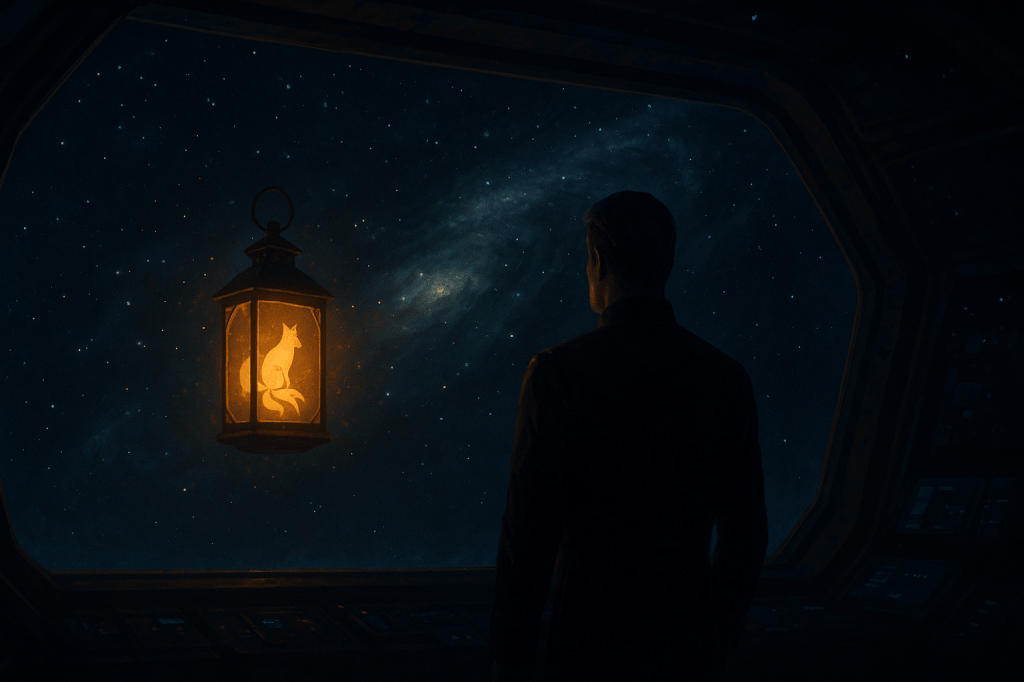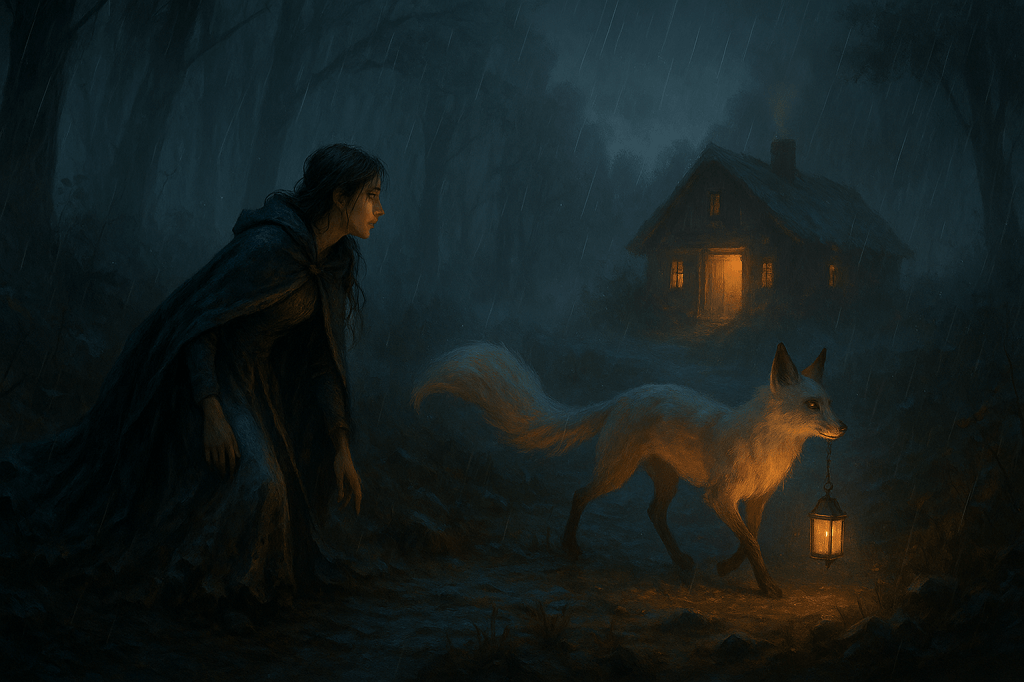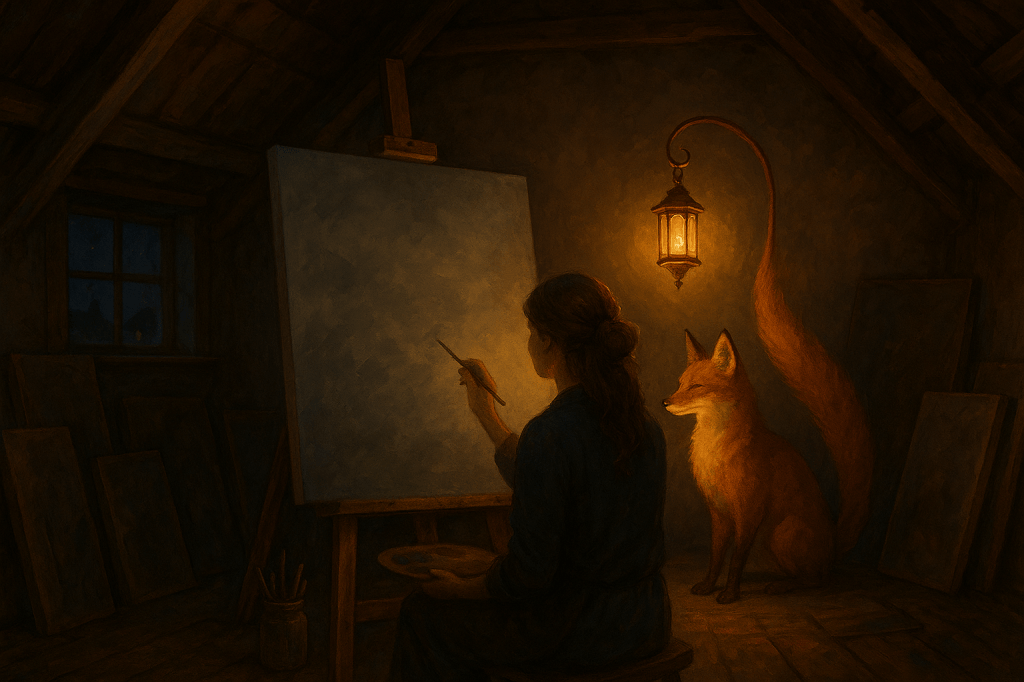
Author: Maxfield Willow

  • Chapter 10 – The Painter of Silent Skies

    Chapter 10 – The Painter of Silent Skies

    By the time the last of the storm-washed light drained from the sky, Liora had already decided she was done with painting.

    Canvases leaned like gravestones against the walls of her attic studio, their surfaces half-finished and abandoned. Skies that stopped mid-dusk. Oceans that never reached the shore. Faces with eyes left blank, as if she had been unable to imagine their gaze.

    She sat in the middle of it all on an old wooden stool, hands slack in her lap, staring at the one canvas still upright on the easel. It was the largest she’d ever bought, a foolish purchase from a year ago when commissions had been steady and she’d believed her art had somewhere to go.

    Now it held nothing but a flat, stubborn grey.

    Her brushes lay in a battered jar beside her, bristles stiff with dried paint. The jar itself—once a honey jar—still carried a faint sweetness when the room grew warm. Liora inhaled deeply, searching for that sweetness, for anything at all.

    Nothing came.

    The world inside her was silent.

    Not the good silence of a held breath just before the first stroke of a brush.

    The hollow silence after the last guest has gone home, when the house still remembers laughter but cannot replay it.

    She had once painted skies that made strangers cry. That’s what the gallery owner had said, anyway. Her work hung in two small cafés and one narrow gallery that always smelled faintly of coffee grounds and old wood, and people had sent messages about “how her colors felt like standing on a hill at dawn,” or “how the clouds seemed to remember something they couldn’t say.”

    Then the call had come.

    Her father’s voice, broken around three words that rearranged her world:

    She’s gone, Liora.

    Her mother’s death had come suddenly, without warning, the way summer storms sometimes rose out of thin blue and rolled the sea to fury in minutes. There was no long illness to brace against. No time to prepare little rituals of letting go.

    One day her mother was simply there, and then she was not.

    The brushes felt wrong in Liora’s hand after that. Colors curdled on the palette. Every sky she tried to paint turned heavy and featureless, a bruise spreading from horizon to horizon.

    Three months.

    That was how long it had been.

    “How long you’ve been stuck,” her father had said gently over the phone two nights ago, voice crackling with distance. “You don’t have to force it, Li. Your mum wouldn’t want that.”

    “I know,” she had replied, though she didn’t.

    She knew her mother had always pushed her to keep painting, to finish what she started. “The sky doesn’t stop halfway,” Mum used to say, looking over Liora’s shoulder. “Even when it’s ugly, it finishes.”

    But Liora’s skies had stopped. And somewhere along the way, so had she.

    Outside the attic window, the narrow seaside town was closing itself for the night. Liora’s house clung to the hill above the harbor, sloping roofs tiered below her like scales on a sleeping dragon. Streetlamps flicked on one by one, scattering puddles of light over wet cobbles. The storm that had rolled through at noon had rinsed the world clean, leaving the air sharp with salt and the faint scent of seaweed.

    She turned her face away from the window.

    She didn’t want clean.

    Clean meant there was no trace left.

    On the old workbench against the far wall, her mother’s sketchbook lay where Liora had placed it on the day of the funeral. She hadn’t opened it since. The elastic band was still looped around it, its once-springy strength now tired and slightly frayed.

    Liora looked at it for a long time.

    Then, with a small, exhausted sound halfway between a sigh and a groan, she slid off the stool. The floorboards creaked under her bare feet as she crossed the room.

    She took the sketchbook in both hands and held it to her chest first, eyes closed.

    “I can’t do this,” she whispered to the quiet studio. “I tried, Mum. I really did.”

    The house didn’t argue.

    The wind didn’t answer.

    She set the sketchbook back down without opening it.

    That was when the light changed.

    It began subtly, as if a stray streetlamp below had flickered and brightened. But this glow was warmer, more concentrated. It slipped across the floor in a slow, deliberate sweep, catching motes of dust in its wake like floating sparks.

    Liora opened her eyes, frowning.

    At first, she assumed she’d left a candle burning. Her gaze swept instinctively toward the little cluster of candles by the window—white pillars in mismatched brass holders. Unlit. Wicks black but cold.

    The light was coming from the door.

    No—not from the door, but under it.

    A thin line of golden radiance spilled along the threshold, pulsing gently as if in time with some far-off heartbeat.

    Liora’s own heart stuttered.

    The attic door was closed. She’d shut it herself when she came up hours ago, needing the separation from the rest of the house. There were no lights on in the hallway outside.

    “Power surge?” she murmured, though she knew that wasn’t how power surges worked.

    The glow brightened at the sound of her voice, as if pleased to be noticed.

    She took a step closer.

    The moment her toes brushed the edge of the light, a faint warmth touched her skin—not the dry bite of a heater or the still heat of a summer room, but a living warmth, like standing too near a campfire and feeling it breathe.

    The line of light swelled, then curled inward, as if someone outside were dragging something along the crack beneath the door. Liora’s breath caught as the glow gathered and thickened, rising from the floor in a slow spiral.

    The light pulled itself upward.

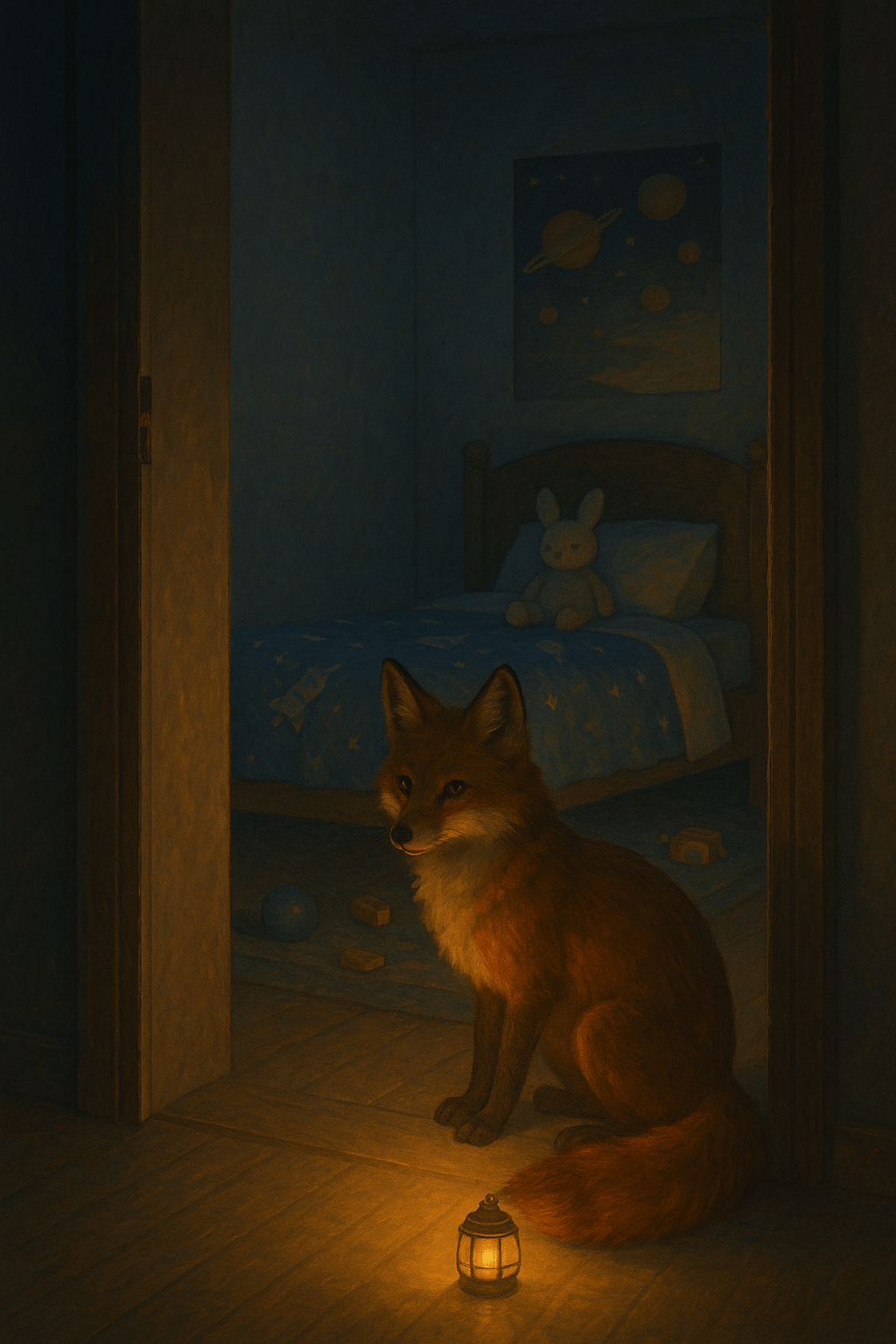
    It twisted on an invisible axis, drawing out a slender shape: four delicate paws, a narrow body, a tail that arched and then curved forward like a question mark.

    At the end of that tail hung a lantern, its frame no bigger than Liora’s thumb, made of filigree gold that seemed more suggestion than metal. Within its tiny glass panes burned a steady, gentle flame—the source of the light that filled the room.

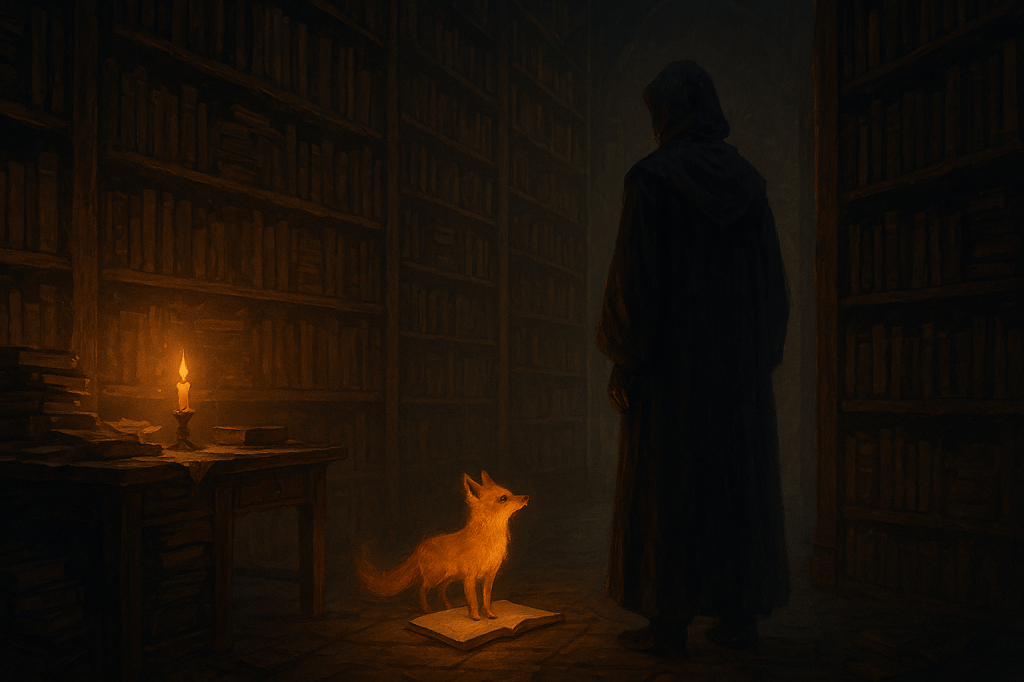
    The creature itself was fox-shaped but not entirely fox. Its fur was a soft gradient of ember hues, from deep copper at the spine to pale ash-gold along its belly and throat, as if someone had brushed firelight into its coat and left it there. Its eyes were not the amber of ordinary foxes but a muted, luminous white, threaded with faint gold.

    Liora forgot how to inhale.

    The lantern swayed as the fox stepped fully into the room, moving with a quiet confidence that made it seem like it had always known the path from the other side of the door. It paused in the center of the attic, nose lifting to taste the air.

    The light from its lantern flowed outward and upward, brushing over the half-finished canvases and dead brushes, over the grey expanse of the large canvas on the easel. Every object it touched seemed to sharpen, lines becoming clearer, shadows softening without disappearing.

    Liora’s throat worked.

    “This is… new,” she managed.

    The fox’s ears flicked toward her. It did not speak. It only looked at her for a long moment, head tilted ever so slightly, lantern bobbing at the tip of its tail.

    The flame inside the lantern brightened, then dimmed, like a single, calm heartbeat.

    Liora’s first thought was that she must have finally snapped. Grief and exhaustion had been circling in tighter loops around her mind for weeks, and perhaps now they had closed fully. Maybe this was how people broke: not with screams, but with quiet, impossible visitors.

    Yet the boards felt solid under her feet, and the air still smelled of linseed oil and turpentine and sea salt. The glow wasn’t a hazy hallucination but a clean, clear radiance that left crisp-edged shadows.

    The fox took a step toward the easel.

    Its paw pads made no sound on the wooden floor, but the lantern chimed softly—a barely-there glassy note—as if acknowledging each movement. It stopped in front of the canvas, sat back on its haunches, and lifted its tail. The lantern swung forward, casting its light directly onto the empty grey.

    The flat color quivered.

    Liora’s breath hitched. She stepped closer almost without meaning to, drawn by that subtle tremor in the paint.

    The fox turned its head, watching her approach with those pale, patient eyes. Up close, she could see the fine strands of fur around its muzzle, the way its whiskers caught the light and broke it into thin silver.

    “You’re not real,” she whispered, though the words had no conviction. “I don’t… I don’t do hallucinations. That’s not my thing.”

    The fox blinked slowly.

    The lantern brightened again—and this time, the grey on the canvas split.

    Not physically; there was no tearing of fabric, no flaking of dried pigment. But the color itself seemed to open, like cloud cover thinning to reveal the sky behind it. A deep blue peered through, rich as the sea just before full night.

    Liora stumbled back. Her shoulder hit a stack of canvases, sending them shifting and clacking together in protest.

    “Okay,” she breathed. “Okay. That’s… new.”

    The fox only looked at her, then returned its gaze to the canvas.

    The lantern’s flame shifted hue, a thread of warm rose lining the gold. Where that light touched the surface, the emerging blue thickened and spread, lifting and curling like mist. It rose into shapes: the beginning of clouds, the hint of stars not yet formed.

    Liora’s fingers twitched.

    Paint.

    Brush.

    She glanced toward the jar out of instinct.

    The fox followed her gaze and then looked back at her, ears angling forward. It tipped its head once toward the brushes, very slightly, like someone nodding encouragement across a crowded room.

    “You want me to… paint?” she asked.

    The lantern flickered in a quick, bright pulse.

    Liora swallowed past the lump in her throat. “I can’t,” she said, voice barely audible. “I don’t have it anymore. It’s just—” She gestured helplessly at the studio, at all the half-finished skies. “It’s gone.”

    The fox rose to its feet. Its tail swayed once, slow and deliberate.

    The lantern dimmed until it was only a small coal of light, then brightened again, steady and unwavering—as if to say: Not gone. Waiting.

    Something in Liora’s chest gave a small, painful twist.

    Her hand moved almost of its own accord. She picked up a brush—a medium round, bristles stiff until she rubbed them gently between her fingers. The ferrule clinked softly against the jar’s rim as she lifted it out. It felt wrong and familiar at the same time.

    Her palette still held dried islands of color, cracked and useless. She reached for a clean one and squeezed out fresh paint mechanically: ultramarine, a touch of phthalo, a smear of Payne’s grey. Her hand hovered over the warm tones, hesitated, then reached for them as well. Just a little. Just enough.

    The smell of new paint blossomed through the air.

    The fox stepped aside but stayed near, lantern angled toward the palette now. Its light slid over the colors, waking tiny sparks within them—pigments seemed deeper, more themselves, as if remembering that they were once stone and earth and mineral pulled from the bones of the world.

    Liora’s grip tightened on the brush. Her palm was damp.

    She approached the canvas again.

    Up close, the change was even more evident: the grey she’d slathered on in despair weeks ago had transformed. It was now a foundation, a muted under-sky in which hints of structure lurked. The beginnings of forms she hadn’t thought to shape.

    “Is this… you?” she asked the fox.

    It did not nod. It did not need to.

    The lantern’s flame leaned toward the canvas like a breeze.

    Liora lifted the brush.

    For a moment, her hand hovered uselessly. The old terror clawed up her spine—the fear that whatever mark she made would be wrong, that she would betray what had once been effortless.

    She thought of her mother standing in the doorway of this attic, hands in the pockets of her cardigan, watching without hovering.

    “The sky doesn’t stop halfway,” Mum had said. “Even when it’s ugly, it finishes.”

    “I don’t know how to finish this,” Liora whispered now, eyes stinging.

    The fox stepped closer until its shoulder almost brushed her leg. Warmth seeped through her jeans, steady and calm. The lantern’s glow softened, feathering at the edges, blurring the hard outline of her doubt.

    Somewhere beneath the weight of grief, a single, small thread of wanting stirred.

    Not wanting to be brilliant. Not wanting praise or commissions or gallery shows.

    Just wanting to see what this sky could become, if she let it.

    Liora exhaled slowly.

    The brush touched canvas.

    The first stroke wobbled. Her hand was out of practice. The line of blue she laid down was thicker than she intended, darker. For a moment, panic spiked.

    Then the fox’s tail brushed her ankle, light as a falling leaf.

    She tried again.

    Another stroke. Then another. Her wrist began to remember the arc of distant storms, the layering of cool over warm to suggest depth. The paint caught and dragged and then smoothed. Blue leaned into grey and made shadows; grey brushed against blue and softened it into something that felt like evening.

    Time loosened its grip.

    The fox moved with her, a quiet orbit of warm light. When her hand hesitated, the lantern’s glow would tilt toward a corner of the canvas, illuminating possibilities: a gap in the clouds, a line where horizon might break through. When she leaned in too close, losing the whole for the detail, the fox padded a few steps back, drawing the light with it so the canvas snapped suddenly into view again, full and entire.

    She realized, at some point, that she was breathing differently. Without thinking, she had fallen into a steady cadence: inhale on the lift of the brush, exhale on the stroke. Her shoulders loosened. Her jaw unclenched.

    The sky she painted was not one she had seen outside her window, though it carried echoes of a hundred twilight walks with her mother along the harbor. It was larger, more dreamlike, a sweep of high, thin clouds through which deep indigo bled, threaded with faint currents of rose and gold as if the sun had only just slipped away and was reluctant to let go completely.

    Grief was still there, a weight in her chest. But it was no longer a wall. It was a color. A shadow that made the light real.

    At some point her hand cramped and she realized how long she’d been standing. The storm-clean dark outside the window had deepened fully into night. Only the fox’s lantern and a small lamp by the door lit the room now.

    Liora stepped back, breath catching.

    The sky looked back at her.

    It was not perfect. Some transitions were rough; a cloud formation in the upper left was muddy. But there was movement in it, a sense of wind and distance, of a world that went on far beyond the frame.

    In the faint lines of light by the horizon, she could almost imagine a small hill where two figures once stood—one tall, one shorter, shoulders touching, heads tilted back to watch the stars appear.

    Tears blurred her vision.

    “I miss her,” she whispered.

    The fox pressed its head lightly against her leg.

    The lantern’s flame dimmed to a softer glow, as if bowing its head with her. Shadows pooled more deeply around the edges of the room, leaving the canvas and the two of them in a small, bright island.

    More words tumbled loose now that the first had escaped.

    “I thought if I tried to paint, and it was bad, it would mean…” She swallowed hard. “It would mean she really was gone. That all the things she believed about me were wrong. That I wasn’t an artist and she’d just—made a mistake.”

    The fox stepped away and circled in front of her, lifting its lantern so the light fell directly on her face. It watched her with those pale, steady eyes.

    In their reflection, she saw herself: hair pulled into a messy knot, cheeks flushed from painting, eyes red from crying. Not at all the composed, mysterious artist some gallery customers imagined.

    But also not empty.

    There was something there that the grief hadn’t hollowed out completely.

    The fox’s lantern flickered—not in distress, but with a small, determined brightness. It felt like a hand squeezing hers.

    Liora sniffed and laughed weakly at the absurdity of the thought.

    “You’re very… opinionated for a hallucination,” she said, voice wobbling.

    The fox continued to stare.

    Then it turned, very deliberately, toward the workbench where her mother’s sketchbook lay. The lantern light reached across the room and settled on it, gilding the worn edges of the cover.

    Liora’s stomach tightened.

    “I can’t,” she said instinctively.

    The fox did not move.

    The light didn’t waver.

    Liora looked from the fox to the sketchbook and back again. The attic’s earlier silence had changed—not gone, but different. Less like an empty house, more like a room where someone had just finished speaking and was waiting patiently for her reply.

    Her feet carried her forward before her mind caught up.

    She picked up the sketchbook again, fingers trembling. The elastic band resisted for a moment, then slipped free with a soft snap.

    “Okay,” she whispered, mostly to herself. “Okay.”

    She opened it.

    The first page held one of her mother’s quick, loose sketches of the harbor: boats suggested with three lines and a shadow, water indicated by two rippling strokes, a gull reduced to a flying V. The next page was a study of hands—her own hands as a teenager, fingers stained with charcoal, posed in different angles. Notes crowded the margins in her mother’s looping script.

    Don’t chase perfect. Chase honest.

    Sky is not blue. Sky is everything at once.

    You don’t paint what you see. You paint what you feel seeing it.

    Liora’s throat closed.

    Page after page, the world unfolded: cafés, faces, rain on windows, her as a child in an oversized sweater, eyes serious. Ideas for paintings that her mother had never had time to make. Little jokes jotted between sketches: Liora tripped over her own shoes today, very graceful cloud, 10/10, will sketch again.

    By the time she reached the last third of the sketchbook, tears were dripping off her chin onto the paper. She wiped them away carefully, not wanting to blur the graphite.

    Near the back, she found a familiar scene: the attic. Her mother had drawn it from the doorway—easel, canvases, workbench, the very stool Liora now sat on. In the corner by the window, a small, fox-like shape glowed, lantern tail held aloft.

    Liora gasped.

    The sketch was rough but unmistakable. The same ember-fur, the same lantern-light, captured in swift, confident lines.

    Beneath it, in her mother’s handwriting:

    For the days when your sky feels broken. Follow the light, love.

    Her vision blurred entirely.

    A soft sound broke the moment. She looked up.

    The fox stood very still, watching her. In the lantern’s flame, she saw not just gold, but hints of other colors: the blue of deep skies, the rose of old sunsets, the pale silver of dawn over oceans.

    “You knew her,” Liora said hoarsely.

    The fox didn’t nod. It didn’t need to.

    Something inside her—some tight, knotted belief that she was alone in this—loosened enough to let air through.

    She pressed her palm flat against the page, covering the sketched fox, feeling the faint tooth of the paper under her skin. “I’m so tired,” she whispered. “Tired of missing her. Tired of being afraid that if I move on, it means I’m… leaving her behind.”

    The fox crossed the room again and sat at her feet. It placed one paw on top of her bare toes, the weight feather-light but undeniable.

    The lantern’s glow warmed her hands where they held the sketchbook.

    Grief did not recede, but it shifted. It no longer felt like standing at the edge of a dropped-away world. It felt like standing between two skies: one heavy with rain, one just beginning to clear.

    Maybe, she thought, moving on wasn’t the right phrase. Maybe it was moving with. Carrying someone forward in every color, every line.

    She wiped her cheeks with the back of her wrist and took a slightly steadier breath.

    “Okay,” she said again, to the fox, to the sketchbook, to the silent attic and the faint echo of her mother’s laughter in its beams. “I’ll keep painting. Not because I’m not broken. But because I am.”

    The fox’s lantern flared—bright, warm, approving.

    For a heartbeat, the attic was full of stars.

    They shivered into existence across the slanted ceiling, tiny points of light that mirrored the ones on her canvas. Some clustered in familiar constellations; others traced shapes she did not know. The glow soaked into the wood, into the old beams and the nail heads, making everything look new and very old at once.

    Liora laughed through the last of her tears, a sound that surprised her with how alive it felt.

    When the light dimmed, the stars faded, leaving the room as it had been: cluttered, paint-scented, hers.

    The fox rose.

    Its lantern swung low, casting one more sweep of light across the finished sky on her canvas. The paint gleamed, still drying, still changing. A work in progress—but a sky, nonetheless. Not stopped halfway.

    “Will I see you again?” Liora asked.

    The fox looked over its shoulder, eyes catching the light like small moons.

    The lantern’s flame pulsed one last time, bright and sure.

    Then it walked toward the door. The light around it thinned and streamed downward, its body unspooling into a ribbon of gold that slipped under the threshold and was gone.

    The attic felt darker without it, but not empty.

    Liora stood alone in front of her painting, sketchbook still open in her hand. The town below was quiet now, harbor lights twinkling like distant boats caught in the last ropes of twilight.

    Her grief was still present, a deep ache that would not vanish overnight.

    But now, threaded through it, there was something else. A narrow path of light. A sense that somewhere, just beyond the moment where worlds brushed edges, a small ember-colored fox wandered with its lantern, nudging hearts back toward the skies they thought they could never finish.

    She set the sketchbook gently on the workbench.

    Then she turned back to the canvas, picked up her brush, and added a single new star in a corner of the painted sky—small, bright, easy to miss unless you knew to look for it.

    “For you,” she whispered.

    The paint caught the light from the attic lamp and held it, just a little longer than it should have.
  • Chapter 9 – The Platform Between

    Chapter 9 – The Platform Between

    Rian always chose the same bench.

    Not the one under the departure board, with its flickering lights and cracked vinyl, and not the newer metal seats near the café, polished and practical. No, Rian chose the old wooden bench under the high arched window, where the plaster had cracked into faint riverways and the world outside blurred behind streaks of rain or frost.

    It was the bench where they’d last sat together.

    The station had changed in the years since—new kiosks, a different coffee place, digital screens where there had once been clacking boards—but that bench stayed. People hurried past it without looking, as if the peeling varnish made it invisible.

    Rian suspected they came here for much the same reason.

    The departure board hummed and shuffled. Announcements crackled overhead.

    “Platform two, the 18:40 service, delayed by approximately—”

    Rian tuned it out.

    The ticket lay between their fingers, flimsy and already soft at the edges from years of being folded and unfolded. Same date. Same destination printed on the front. Same train that never actually came for them.

    It was a ritual now. Every year, on this day, Rian bought the ticket and came to the bench and sat, as if time might apologize and rewind.

    People flowed around them: commuters with tired shoulders, families juggling luggage and sticky hands, couples leaning in close and laughing into each other’s coats. A little pang tugged at Rian’s chest, familiar and dull. Envy, grief, habit—all tangled.

    The station clock ticked on.

    Outside, the evening pressed against the high windows, a heavy dark softened by the yellow halos of streetlights. Distant thunder muttered. The air smelled like wet stone and old coffee.

    The anniversary storm, Rian thought. There had been one that night, too.

    They closed their eyes, just for a moment, and the memory came as easily as breathing.

    It had rained harder that night. The kind of sharp, stinging rain that made the streets shine like spilled ink. Leora had arrived late, hair soaked, curls plastered to her forehead, coat dripping on the station tiles.

    “You look like a half-drowned cat,” Rian had teased, because that was easier than admitting how their hands shook with relief.

    “And you,” Leora had answered, cheeks flushed, “look like someone who’s about to run away with a genius.”

    “Arrogant, aren’t we?”

    “Confident,” she’d said, grinning. “There’s a difference.”

    They’d been leaving. Both of them. One suitcase each, passports and letters and a train that would take them to the city where Leora’s scholarship waited and Rian’s job offer held a door open. A different life, one not carved by the small-town expectations that had wrapped around them like vines.

    One train. One chance. One shared seat on the future.

    And then the announcement had crackled overhead. The words had seemed entirely disconnected, at first, like someone else’s bad news.

    “All services east of Redbridge are suspended. Repeat, all services east of Redbridge are suspended due to—”

    The rest blurred into static.

    Emergency. Flooding. Tracks washed out. Bridges unsafe. The route was closed, indefinitely. No trains coming. No trains going.

    Leora had stared up at the board, shoulders slowly curling inward as if the rain itself had pressed down.

    “We’ll go tomorrow,” Rian had said quickly. “Or next week. It’s fine. We’ll get there.”

    But Leora had already been shaking her head. “My deadline,” she’d whispered. “The scholarship. I have to check in on campus before the term starts or I lose it. The visa window…” Her eyes filled. “I needed this train, Rian.”

    They’d gone home that night in a shared taxi that smelled of damp wool and frustration. The next day, all routes were still closed. Flights were cancelled. Roads washed out. Every path out seemed to snag on some impossible knot of timing and bureaucracy.

    “Maybe it’s a sign,” Rian’s mother had said, too brightly. “Not everything is meant to be.”

    Rian had bitten back a reply and walked away.

    By the time the waters receded, the window had closed. The university’s email had been brisk and apologetic. The scholarship was gone.

    Leora’s path had narrowed overnight. No city. No research program. No far-off lab filled with whiteboards and equations and the soft hum of machines. She stayed, because there were bills, and her father’s shop needed help, and the family was not rich in anything but stubbornness.

    “It’s fine,” she’d said finally, weeks later, sitting on this same bench. “Really. It’s not your fault. It’s not anyone’s fault.”

    But Rian had seen the crack in her voice, the way her fingers twisted her scarf.

    Fate, the older women at the market called it. Bad luck. God’s will. A storm that chose the wrong night.

    Whatever name it had, it had cleaved their shared path in two.

    Years later, that split still echoed.

    Rian opened their eyes. The station swam back into focus.

    The ticket lay in their palm, accusingly blank.

    They should stop coming here, they knew. Friends had said as much. Time to move on. Time to let go. Time, time, time—as if it were a thing you could simply set down like an old jacket.

    But every year, when the air started to taste like wet autumn and the leaves skittered along the pavement like nervous mice, something in Rian pulled them back to the bench, to the maybe that had never happened.

    I could have tried harder, they thought. Found a car. A bus. Called someone. Something.

    They didn’t say it out loud—it felt too much like admitting guilt to a jury—but the thought stayed, a small, sharp stone in the shoe of their heart.

    “Last call for the 18:12 service to—”

    The announcements rolled on.

    Rian rubbed their thumb along the edge of the ticket, then glanced around the station, not really seeing—

    And paused.

    There was a fox on the platform.

    For a heartbeat, Rian assumed it was a dog. There were always a few animal stories about the station—strays, cats, that one pigeon that had learned to ride the train for crumbs. But this was no dog. It was too slender, too delicate, its ears pricked sharp and its tail a shifting arc of fur that looked almost like smoke.

    It stood near the far pillar across the tracks, paws side by side on the yellow line. Dangerous, Rian thought automatically. Silly animal. The trains—

    The thought died as the fox turned its head.

    Its eyes caught the light and reflected gold, not the flat silver of animal eyes in headlights, but a deep, embered glow that made the hairs on Rian’s arms rise.

    Something else glowed, too.

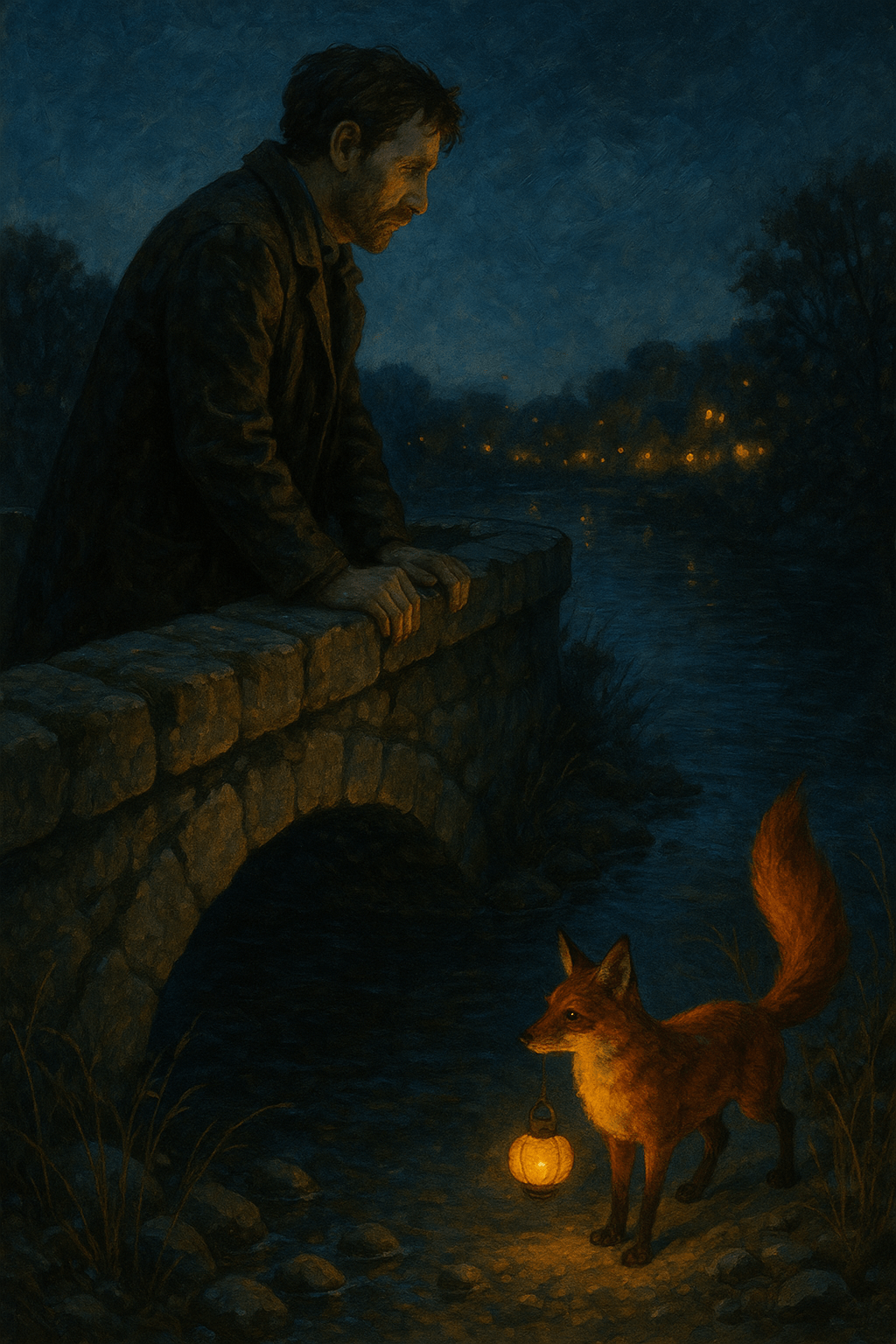
    At the tip of the fox’s tail hung a small, golden lantern.

    It shouldn’t have been possible; nothing should have been hanging there. But the lantern swayed gently as if caught in a wind that the station did not feel, casting a soft, warm light that pooled around the fox in a circle on the platform floor.

    Rian blinked, sat up straighter, and then did the only reasonable thing: they looked around to see if anyone else had noticed.

    No one had.

    A woman scrolled on her phone near the coffee stand. A man argued with a ticket machine. Children bounced from tile to tile, invisible to the adults and, apparently, to whatever impossible creature stood across the tracks.

    The fox watched Rian steadily.

    Its lantern brightened, just a fraction, a deeper pulse of light.

    Rian’s fingers tightened around the ticket. Their heart gave a short, startled kick.

    They had never seen this fox before. And yet… there was something about it that made the word stranger feel wrong. As if they were looking at an old story they had once heard and half-forgotten, suddenly stepped out of the page.

    The fox took a step forward.

    Its paws did not clack on the tiled floor. They made no sound at all.

    The lantern swung, and the light along the rails broke into long, soft lines.

    “Okay,” Rian whispered under their breath. “Clearly I didn’t eat enough today.”

    The fox tilted its head at them. Lantern-light slid across the bench, catching on the white rectangle of the ticket in Rian’s hand. For an instant, the text on the paper gleamed and shifted, as if the ink didn’t quite want to hold its shape.

    Rian’s throat went dry.

    “This is a dream,” they told themselves quietly. “Or I finally snapped.”

    The fox, unconcerned with their assessment of mental health, stepped off the opposite platform and onto the tracks.

    Rian’s breath caught. “Hey—!”

    But the rails did not spark or bite. The fox walked between them as if the ground were just ground and not iron and gravel and danger. Lantern light spilled around its paws, washing the oil stains in honey-gold. For a moment, the rails themselves seemed less like metal and more like lines drawn on paper.

    Right beneath the central crossing, where the two tracks briefly met, the fox paused.

    The lantern bobbed up, warmth intensifying until the air shimmered.

    With a soft sound like a candle being blown out in reverse, a third line appeared between the rails. A narrow path of stone where there had been nothing moments before, running straight across and under Rian’s bench.

    The fox followed it, as if this had always been the most obvious thing to do.

    By the time it stepped up onto Rian’s side of the tracks, the path looked as real as the station floor itself. The lantern’s glow dimmed again to a gentle steady light.

    The fox padded right up to the edge of Rian’s boots and sat.

    Close, Rian thought wildly. Too close. They could see individual hairs on its muzzle now, the slight damp at the tips from the evening air. The lantern at its tail gave off a warmth that was not quite heat; it felt more like the way a good memory felt when you wrapped your hands around it.

    The fox looked up at them, eyes molten gold.

    Rian realized they’d been holding their breath and let it out in a ragged laugh.

    “Right,” they said hoarsely. “Of course. Magic fox. Lantern. Secret stone path. Why not.”

    The fox’s ears flicked, as if amused.

    It glanced pointedly at the hand clutching the ticket, then back to Rian’s face.

    As gestures went, it was so human it hurt.

    “You want my ticket?” Rian asked before they could stop themselves. “Sorry, I don’t think this train stops in fairyland.”

    The fox did not dignify that with a reaction, but its gaze dropped again to the ticket. Then, slowly, it stood, turned, and trotted a few steps along the stone path that now led away from the bench and along the platform’s edge.

    After a few strides, it paused and looked back, lantern swinging like an invitation.

    Rian stared.

    Somewhere above, an announcement droned about delays and apologies. A suitcase wheel rattled as someone hurried past. The everyday noises of the station washed over the moment like rain on wax paper, unable to properly soak in.

    The path glowed faintly where the lantern’s light brushed it.

    It did not exist a few minutes ago, Rian thought.

    Neither did this fox.

    Neither did…

    They swallowed.

    Leora would have followed, a small voice whispered in the back of their mind. Leora had always leaned toward the impossible with bright-eyed curiosity. What’s the worst that could happen? she would have said, laughing. We get a story out of it.

    Rian had been the cautious one. The planner. The one who had double-checked tickets and scanned weather reports and believed that if they were careful enough, fate couldn’t get a proper grip.

    They looked down at the ticket in their hand.

    It crinkled faintly.

    “All right,” Rian said softly. “One story, then.”

    They stood.

    The station did not so much as flicker. No music swelled. No one gasped. The fox simply waited, tail-lantern glowing, until Rian’s boots touched the first stone of the conjured path.

    Warmth flowed up through the soles of their shoes, a pulse that matched the beat of their heart with uncanny precision.

    Then, quite without ceremony, the world shifted.

    It wasn’t a big shift. Not at first.

    The station walls stayed where they were. The high arch of the ceiling held. The departure board continued to scroll names and numbers. But the colors… they deepened. The shadows between the pillars thickened and softened at once, like velvet instead of cold concrete.

    The murmur of voices grew distant, as if someone had closed a door somewhere.

    Rian glanced over their shoulder.

    The bench where they had been sitting still stood beneath the cracked window. But the people were pale now, faintly translucent, movements slightly slowed, like reflections seen through moving water.

    The fox flicked its tail and walked on.

    Rian followed, heart pounding in their throat.

    The stone path cut across the platform and slipped through a narrow service door that Rian was fairly certain had never been there before. It looked older than the rest of the station, its wood darkened by age and its brass handle worn dull by countless hands.

    The lantern light pooled on the threshold.

    The fox pushed it open with a practiced nudge of its shoulder.

    On the other side, there was no maintenance corridor. No smell of cleaning supplies, no electrical hum.

    There was a hallway.

    Not a station hallway, either. Stone beneath Rian’s feet, worn smooth by time. Walls lined with niches where lanterns similar to the fox’s hung, unlit, waiting. The air tasted like old tea and the faintest hint of woodsmoke.

    Rian hesitated.

    The door behind them had already drifted shut. Its edges blurred, the way things seen just before waking blurred. When they laid their palm against it, the wood felt insubstantial, like pressing on the surface of a painting.

    “You have got to be kidding me,” they muttered.

    The fox, a few paces ahead, glanced back, eyes glowing in the dimness. It gave a small chuff. Not a bark, exactly. More like the sound of a log shifting in a fire.

    Then it turned and padded on.

    “I’m coming, I’m coming,” Rian said, and their voice echoed down the hallway, swallowed by its belly.

    They followed.

    Lanterns along the walls flickered to life as the fox passed, one by one. Their light was gentle, more like the glow of embers than the harshness of bulbs. As each lamp woke, the niches behind them seemed to deepen, showing brief impressions of doorways, windows, archways—

    And scenes.

    Rian slowed as the first one resolved into clarity.

    Behind the hanging lantern: a street bench. Not this bench, but close enough. A different station, perhaps, or a park. A figure sat there, shoulders hunched, hands clasped, much like Rian themselves had sat countless times.

    Leora.

    Rian’s breath caught.

    She looked just as she had on the night of the storm—hair damp and curling around her face, scarf twisted in nervous fingers, eyes fixed on a point far away. The glow of the lantern illuminated her profile.

    “Leora,” Rian whispered, reaching out.

    Their fingers met glass.

    The niche was an alcove, not an opening. The scene behind it shimmered when Rian’s fingertips brushed it, like water disturbed by a pebble.

    Leora did not look up.

    Rian pressed their palm fully against the glass now, heart climbing into their throat. “Leora,” they said louder. “Leora, can you—”

    The fox’s lantern light flared, drawing Rian’s gaze.

    It stood a few paces ahead, watching them. Its eyes softened, gaze flicking between Rian and the alcove.

    There was no accusation there. Only a quiet understanding. A reminder.

    This is not a door, the fox’s posture seemed to say. Just a window.

    A moment, distilled.

    Rian swallowed hard and lifted their hand away.

    “Okay,” they murmured. “All right.”

    They kept walking.

    Each lantern they passed lit up a different fragment. In one, Leora stood at a workbench, tools laid out neatly, her brows furrowed in concentration. In another, she laughed with a child on her shoulders, spinning in a circle. In another still, she argued animatedly with someone Rian didn’t recognize, gesturing with a pencil, whiteboards crowded with equations behind her.

    Some scenes could never have happened. Not with the way their lives had gone.

    Or maybe they were glimpses of the lives she’d wanted, branching paths that had never been.

    Rian’s chest ached.

    They wanted to stop at each lantern, to drink it in, to commit every impossible version of Leora to memory. At the same time, each alcove felt like pressing on a bruise.

    The fox walked at a steady pace. It didn’t rush them, but it didn’t linger, either.

    Rian followed, breathing in slowly through their nose and out through their mouth, the way they’d been taught in the kind of group where people said things like stages of grief and closure with kind eyes.

    At last, the hallway opened into a broad, circular space.

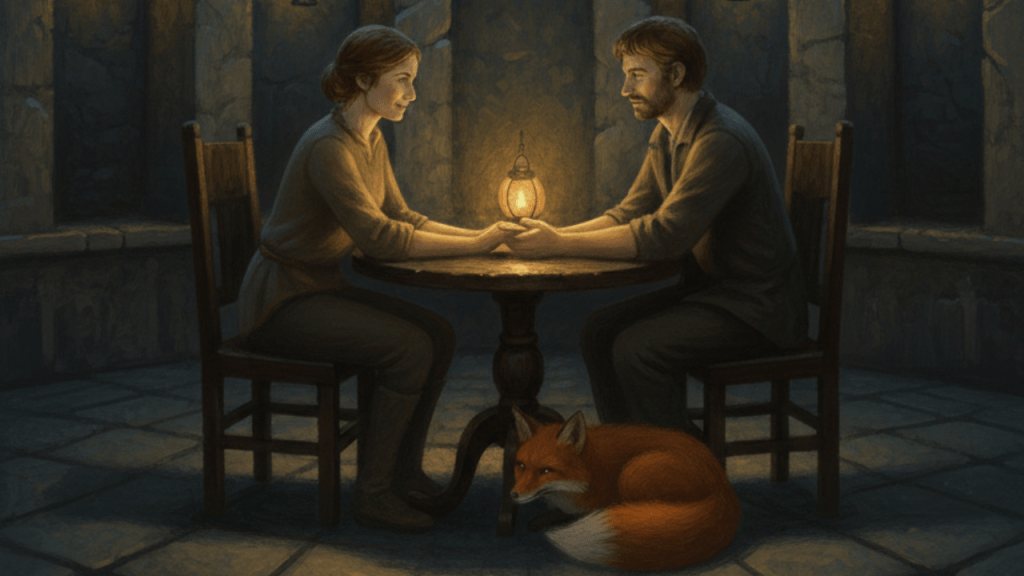
    The ceiling was lost in shadow, beams arching overhead like the ribs of a great wooden ship. In the center of the room stood a single table and two chairs. One chair was empty.

    The other held Leora.

    Not a memory. Not a shadowy variant in a niche.

    She sat with her elbows on the table, hands wrapped around a mug that sent up a faint ribbon of steam. The golden light from the fox’s lantern brushed the side of her face, picking out the tiny scar near her lip, the one she’d gotten trying to open a bottle with her teeth once.

    She looked older than Rian remembered. Just a little. Lines at the corners of her eyes that hadn’t been there before. But her mouth was still soft, and her eyes—

    Her eyes were fixed on Rian with a mix of wonder and something like apology.

    Rian stopped dead. The stone path beneath their feet seemed to sway.

    “Leora,” they breathed.

    Her name tasted like honey and salt.

    Leora smiled. It was a small thing, tremulous and genuine. “Hey,” she said quietly.

    Her voice reached Rian as clearly as if she’d been standing next to them in the station, not… wherever this was.

    “That’s not—” Rian shook their head. “You’re—this isn’t possible.”

    “It’s not supposed to be,” Leora agreed. She glanced at the fox, who had settled near the table, tail-curled. The lantern’s light flickered, warm and steady. “But I’ve learned that ‘supposed to be’ doesn’t mean much here.”

    “Here?” Rian echoed.

    Leora looked around, taking in the vaulted ceiling, the ring of unlit lanterns overhead. In one shadowed corner, Rian thought they saw the faint outline of a sign, hanging crookedly as if not yet finished. Something about its shape stirred a memory they couldn’t quite place—of stories about a tavern at the edge of everything, a door that only opened for the lost.

    “This is… somewhere between,” Leora said softly. “A waiting room. A crossroads. I don’t really have the right word. But he—” she nodded at the fox “—found me when I needed it most.”

    Rian’s throat closed.

    “When you…” They couldn’t say died.

    Leora spared them having to. “When the river took the car,” she said gently. “When the bridge fell. I didn’t suffer. I promise.”

    Images flickered unbidden: flooded roads, news reports, a bridge twisting like a broken rib. The phone call at 3 a.m. The numbness that followed, thick and choking and unreal.

    “And you,” Leora added, eyes shining, “have been sitting on that bench for years.”

    Rian flinched. “You saw?”

    “Not every time.” A small, fond smile. “But enough.”

    She gestured to the empty chair.

    Rian’s legs carried them forward before their brain caught up. They sank into the seat, fingers wrapping around the edge of the table to stop their hands from shaking.

    Up close, Leora was so vivid it hurt. The tiny freckle near her eye. The way her hair had always refused to be entirely tamed. The small crack in one front tooth from when she’d fallen off a bike at ten.

    “What is this?” Rian whispered. “Some kind of… second chance?”

    Leora’s gaze softened. “No,” she said, and the word was both knife and balm. “Not that. Our paths split that night, Rian. We don’t get that train back.”

    Rian’s eyes blurred.

    “But,” Leora continued, “we never got to say goodbye properly. The river took that too. And you’ve been carrying that… unfinishedness around so long it’s dug a groove in you.” She reached across the table.

    Her fingers brushed Rian’s hand. Warm. Solid.

    Rian’s breath hitched.

    “So I asked,” Leora murmured. “I asked if I could see you, just once more. To tell you… it’s okay to step out of that groove.”

    Rian shook their head, words tumbling.

    “I should have done more. I should have pushed us to find another way out that night, or convinced you to leave earlier, or—”

    “Rian.” Leora’s voice cut through the rising storm like a clear bell.

    They fell silent.

    Leora’s eyes held theirs, steady and kind and stubborn in the way they’d always been. “You can tie yourself in knots over what-ifs,” she said, “until you can’t move at all. But we didn’t control the storm. Or the bridge. Or how quick the river would rise. We were two people with suitcases and a shared dream. We did what we could with what we knew.”

    Her thumb stroked over their knuckles, grounding.

    “Fate didn’t punish us,” she said. “The world is just… messy. Sometimes cruel. But I don’t want your memory of me to be a chain that keeps you in that station.”

    Rian blinked, tears spilling over.

    “What do you want it to be?” they whispered.

    Leora’s smile tilted. “A door,” she said. “That you can open when you need to, to remember that someone loved you fiercely once. Not a cage you sleep in every year.”

    “Easy for you to say,” Rian muttered, trying for humor and failing.

    Leora huffed a small, real laugh. “Oh, you think it’s easy for me? I had to watch you eat those terrible station sandwiches for three anniversaries before you switched cafés.”

    Despite everything, a strangled chuckle escaped Rian.

    “There it is,” Leora murmured. “I missed that.”

    They sat in silence for a time, the kind that existed only between people who had shared too many mornings and late nights to count.

    Rian found themselves tracing the grain of the tabletop. “Are you… happy?” they asked finally, hating how childish they sounded.

    Leora’s gaze grew distant, soft. “It’s different here,” she said slowly. “Not happy like we imagined, not labs and shared flats and arguing over thermostat settings. But there is rest. There are stories. There are… other travelers.” Her eyes flicked toward that half-seen sign in the shadows again, the one that almost looked like a fox’s silhouette. “I’m not alone. And I’m not… stuck.”

    She looked back at Rian.

    “But you are,” she said gently. “Every year, sitting on that bench with your ticket to nowhere.”

    “I don’t know how not to be,” Rian admitted, voice cracking. “Everyone says ‘let go’ like it’s just… opening your hand. But every time I try, it feels like I’m betraying you. Like I’m making peace with the universe killing you for being late to a train.”

    Leora’s hand tightened on theirs.

    “You’re not betraying me by living,” she said, each word deliberate. “You’d be betraying me if you didn’t.”

    Rian’s vision blurred entirely.

    “Hey,” Leora said softly, squeezing their fingers. “Remember what I said on that bench, when the scholarship email came?”

    Rian sniffed. “You said a lot of things. Most of them rude about bureaucrats.”

    “That too.” Her eyes crinkled. “But I also said… the world is bigger than one path.”

    The words rose up from somewhere deep in Rian’s memory, worn smooth by time.

    “‘If this one closed, we’ll find another,’” they murmured.

    Leora nodded. “You still can,” she said. “I can’t walk it with you. Not in the way we planned. But I’d rather you walked it with someone, or someones, or even alone and curious, than kept circling that platform, waiting for a train that doesn’t go anywhere.”

    Something in Rian’s chest, wound tight for years, gave a painful, trembling shudder.

    “What if I forget you?” they whispered. “Not all at once, but… bit by bit. The way people fade. I’m already not sure if your scarf that night was blue or green.”

    “Green,” Leora said, without hesitation. “The one your aunt said made me look ‘too clever for my own good.’”

    Rian huffed a wet laugh.

    “You’ll forget some things,” Leora said matter-of-factly. “That’s how minds make room. But the shape of us? The way we looked at each other when we thought no one noticed? That’s carved a groove in you that doesn’t vanish. It may soften. It may stop hurting every time you touch it. But it doesn’t erase.”

    She leaned forward.

    “And if you ever worry you’re forgetting too much,” she added, “you can just tell someone new about me. About us. That’s another kind of remembering.”

    Rian closed their eyes.

    A breath in. The faint scent of tea and woodsmoke. The warmth of Leora’s hand.

    A breath out. The weight of years on that bench.

    When they opened their eyes again, the fox was watching them steadily, tail-lantern glowing. In that golden light, they saw not just this room, but the echo of a hundred other spaces where someone sat with grief and a choice.

    “What do I do?” Rian asked, voice small.

    Leora smiled, and it was the smile she’d worn the first time she’d said I love you over a shared carton of cheap noodles.

    “You stand up,” she said. “You walk back through that station. You throw away that ticket. And the next time someone asks if you’re free on this date, you say ‘yes’ instead of ‘sorry, I have plans with a ghost.’”

    Rian snorted despite themselves.

    Leora’s thumb brushed away a tear on their cheek. “You’re allowed to be happy again,” she whispered. “It doesn’t cancel what we were. It honors it.”

    Rian nodded, because anything else would have dissolved them into pieces.

    Leora squeezed their hand one last time and then, very gently, let go.

    “Time’s weird here,” she said. “If you look back on that bench and it feels like it was only a blink… that’s okay.”

    “Will I see you again?” Rian blurted.

    Leora’s eyes softened. “That’s not for me to promise,” she said. “There are doors I don’t control. But if some fox with a lantern decides you need another nudge someday…” She glanced down, and the fox’s ears twitched in what might have been amusement. “Well. I won’t be far.”

    Rian wanted to memorize her—the tilt of her head, the warmth in her eyes, the exact cadence of her voice. But the more they tried to hold on, the more the edges of the room seemed to glow, as if the light itself were gently nudging them toward the path.

    The fox rose, lantern brightening.

    “I love you,” Rian said, the words coming out in a rush, because there were never enough times to say them.

    Leora’s smile was bright and sure and so utterly her that Rian felt something inside them go still, in the best way.

    “I know,” she said. “Now go.”

    The lantern’s light swelled.

    Rian stepped back onto the station platform as if from a shallow pool, the air of the ordinary world closing around them with a rush of familiar sounds and smells.

    The stone path under their feet faded, becoming once more just scuffed tile. The service door, when they glanced back, was nothing but a blank stretch of wall marked with an out-of-order vending machine.

    People moved at normal speed. The announcements continued as if there had been no interruption at all.

    “Platform three, the 18:40 service is now approaching—”

    Rian stood there for a moment, swaying, like someone adjusting to solid ground after a long time at sea.

    In their hand, the ticket crinkled.

    They looked down.

    The text was clear and solid again. Same date. Same destination.

    But across the corner, in the tiniest handwriting, a new line had appeared. It was barely more than a suggestion, a shimmer of ink.

    The world is bigger than one path.

    Rian stared at it until their vision blurred.

    When they looked up, the fox was standing in the middle of the platform, watching them. Its lantern glowed warm and steady.

    “Thank you,” Rian whispered.

    The fox dipped its head once, almost formally, then turned. As it walked, its lantern light dimmed, and with each step, it grew less substantial. By the time it reached the far pillar, it was little more than a streak of gold.

    Then it was gone.

    Just the station remained. Just the bench under the cracked window, the departure board, the commuters, the coffee smell.

    Rian’s chest ached, but it was… different now. The pain had lost one of its sharpest edges, like a thorn sanded down. Beneath it, something else stirred—small and scared and stubborn.

    They walked back to the bench.

    Their body remembered the way, the steps worn in by years of repetition. But this time, they did not sit. They stood in front of it, looking down at the worn wood.

    “Thank you too,” they murmured. “For holding me when I needed it.”

    The bench, unsurprisingly, did not answer.

    Rian took a breath.

    Then, with hands that still shook a little, they walked to the nearest trash bin.

    The ticket felt heavy. Heavier than paper had any right to be.

    “This is going to feel awful,” they told Leora, wherever she was. “Just so you know.”

    They smiled, a crooked, watery thing.

    Then they dropped the ticket into the bin.

    For a second, the tiny printed letters caught the light and shone. Then they vanished, buried beneath coffee cups and old wrappers. The world did not crack. No thunder rolled. No ghostly hand reached out to snatch the ticket back.

    Rian’s heart, however, did something strange. It hurt, and then, like a joint finally slid back into place, it eased.

    They stood there, hand still hovering over the bin, breathing.

    “Okay,” they said softly. “All right.”

    Their phone vibrated in their pocket.

    They pulled it out, thumb swiping on autopilot, and saw a message near the top of their notifications. A friend from work, someone who had patiently invited them to trivia nights and movie marathons and small board game evenings for months, always met with the same: Sorry, that’s the night I visit the station.

    Hey, no pressure, but we’re doing board games tonight if you’re free. We could really use your terrible geography knowledge on our team.

    Rian stared at the message.

    Then they typed, slowly, deliberately.

    I’m free.

    Where and when?

    Three dots appeared almost immediately.

    7pm at the café across from the station. You know the one. You sure?

    Rian glanced at the bench one last time.

    “Yeah,” they whispered.

    Their fingers moved.

    I’m sure. See you there.

    They slid the phone back into their pocket and started toward the exit. The station doors hissed open, and the cool evening air rushed in, smelling of wet stone and a future that was, at last, not entirely shaped by absence.

    Far above, clouds bruised the sky, but in a gap between them, a single star flickered.

    If anyone had been looking closely, they might have sworn that, just for a heartbeat, its light shivered gold, like a lantern swinging at the tip of a fox’s tail.

    Then it settled, quiet and constant, as someone stepped out of a long-held grief and onto a new, unwritten path.

  • Chapter 8 – The Soldier Who Wouldn’t Come Home

    Chapter 8 – The Soldier Who Wouldn’t Come Home

    The war had ended three months ago.

    That was what the posters said, anyway—peeling on brick walls, flapping on lamp posts, fluttering over the market like tired flags.

    Teren ran his fingers over one of them, tracing the bold letters announcing Peace Declared as if they belonged to someone else’s story.

    Behind him, the town breathed like a single vast creature. Laughter spilled from taverns and doorways, thin music threaded through the streets, and somewhere a drum beat slow and steady, calling people to celebration.

    Teren’s heart answered with a different rhythm entirely: too fast, then too slow. Like a soldier out of step with the rest of the line.

    He turned away from the poster and the noise. Away from the smell of roasting meat and spilled ale. Away from the steady, inevitable drum that reminded him of marching—of boots in mud, of shouted orders, of the hollow thump of bodies hitting the ground.

    He shoved his hands into his coat pockets and walked until cobblestones gave way to packed earth, and the lamps thinned and then vanished.

    He didn’t bother watching where he was going.

    He had already been lost for a very long time.


    The night at the edge of town was cold, and honest about it. No music, no laughter—just the rasp of dry grass, the creak of bare branches, the hiss of the river dragging itself over stones.

    Teren followed the sound of water. It had always helped, once. Long before the uniform. Long before the weight in his chest.

    He came to the old stone bridge, the one that arched over the Blackwater like a crooked spine. Moss grew between its blocks, and lichen shaved years from its surface.

    He leaned against the rough stone, listening to the river and to the faint drumbeat of celebration carried faintly from behind him.

    You should be there, he told himself. Your name’s on the wall. You came back. You’re one of the lucky ones.

    His jaw clenched until his teeth ached.

    “Lucky ones,” he whispered into the dark, the words bitter and small. “Tell that to Jorran.”

    The name landed between him and the river like a stone.

    Jorran’s laugh, Jorran’s hand on his shoulder, Jorran’s eyes turning surprised and then empty. Teren squeezed his eyes shut, but the images were etched on the inside of his eyelids. He could see them whether he wanted to or not.

    He had pulled so many men back behind the line. He had dragged bodies, living and dead, through mud and smoke. That was what he had been good at: hauling, carrying, enduring.

    Except that one time. The one that mattered.

    He pressed the heels of his hands into his eyes until colors sparked against the darkness.

    When he pulled his hands away, something else was there.

    A light—a small one—hung in the air a short distance down the riverbank. Not high like a lantern on a pole. Low, close to the ground, as if someone had dropped a candle and forgotten it.

    It flickered once, twice.

    Then it moved.

    Teren straightened, frowning. The light bobbed along the edge of the reeds, weaving between stones with a peculiar deliberate grace. It did not sway like something carried by a person. It glided, bright and steady, at the height of a child’s eyes.

    “…Hello?” he called, because habit and training had taught him to announce himself, even when he wanted to vanish.

    The light paused.

    Then it turned toward him.

    For a second, nothing else existed. Just the river’s hiss, the distant thud of celebratory drums, and that small, unwavering glow.

    It brightened, just a little, as if answering.

    Teren swallowed. He had seen strange things on the field—flares, tracer fire, the red bloom of artillery across the horizon—but none of them had ever made the air feel like this: sharp and thin, like a breath held too long.

    “Right,” he muttered to himself. “Either I’m tired enough to be seeing lights… or someone actually needs help.”

    The second thing hurt less than the first, so he chose it.

    He slid down the slope from the bridge, boots skidding on damp earth. The light retreated a pace, just enough to stay out of reach, then waited like a patient guide.

    “Fine,” Teren said under his breath. “Lead on, then.”

    The light bobbed once, as though it understood.

    And moved.


    At first he thought it was a lantern, suspended by some trick of wire. But as he drew nearer, he saw the shape behind it.

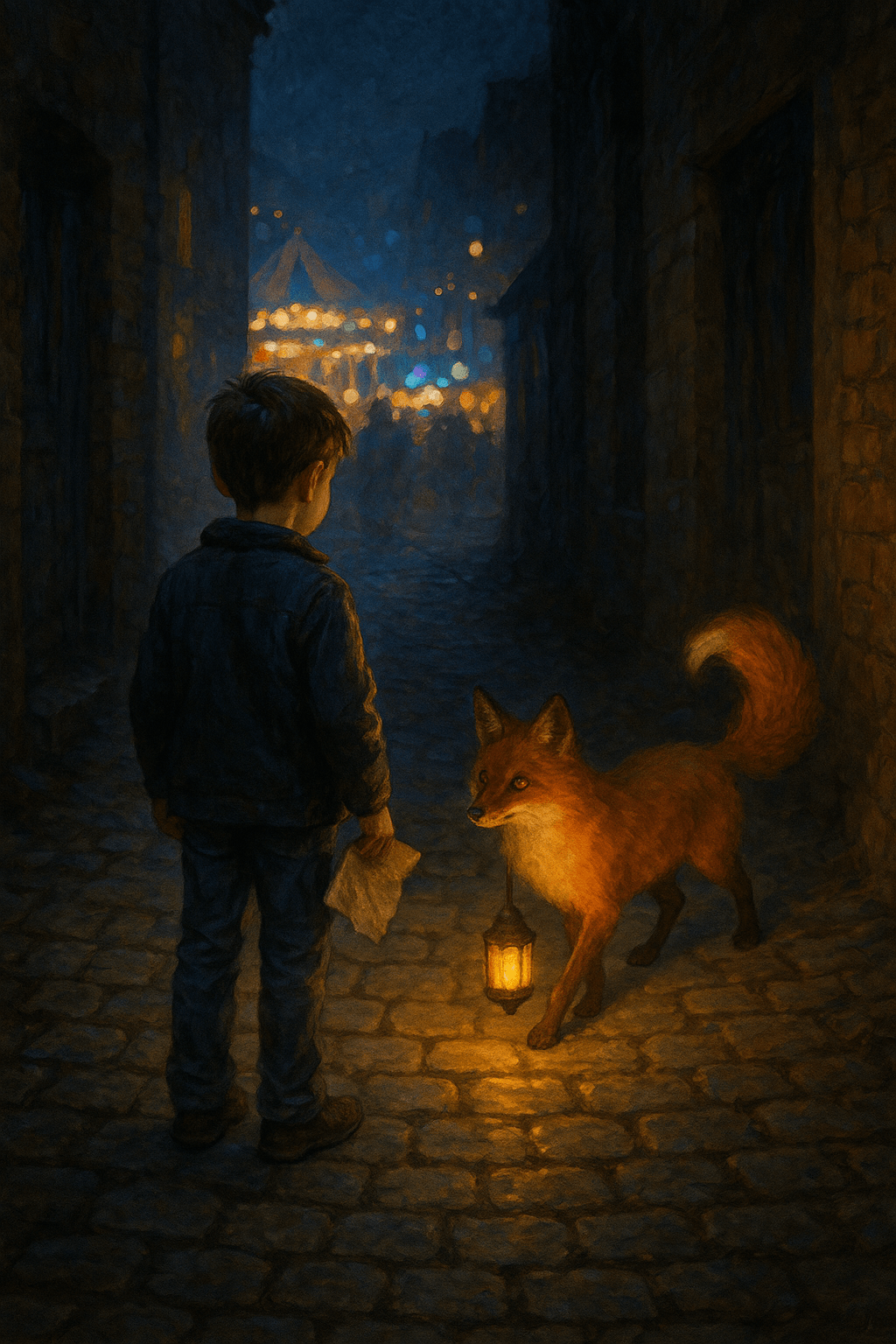
    A fox, no larger than any that skulked on the edge of fields—except for the way its fur caught the night, ember-bright along its back and cheeks, and the way its tail curved upward like a hook.

    From the tip of that tail, a lantern hung. Not iron and glass, but a globe of soft golden flame, contained and impossible, suspended without chain or handle.

    The creature watched him with eyes like polished amber. Its paws were silent on the earth. The lantern’s glow warmed his face, cutting the chill.

    Teren stopped, breath caught halfway.

    The fox tilted its head, studying him the way a scout studies a stranger at the edge of camp.

    “I’m… I’m not drunk,” Teren said to it, mostly to convince himself. “And I’m not asleep.”

    The fox blinked once, very slowly.

    Then it turned and trotted along the riverbank, pausing only when it realized he wasn’t yet moving.

    It looked back, lantern swaying gently. The light caught the deep lines etched into his face, the few silver threads starting at his temples, the tiredness pulling down his shoulders.

    “This is ridiculous,” he muttered.

    He followed.


    The river narrowed and deepened to his right, a black ribbon in the night. To his left, the land rose in uneven humps and tangled bushes, dotted with the skeletal remains of summer’s trees.

    The fox led him along a path he would have sworn wasn’t there whenever he’d walked this way by day. The ground underfoot was too smooth, the turns too natural, like worn stone in the threshold of an old doorway.

    The lantern’s glow chased the worst of the shadows away, but Teren’s mind filled them in easily enough.

    A figure slumped against a broken wall. The faint shape of a rifle. The echo of someone calling his name through smoke.

    He dragged in a breath. The air here smelled of damp earth and fallen leaves, tinged with something else—oak smoke, maybe, and the ghost of spilled ale. It prickled at the back of his memory in a way that made him more uneasy than comforted.

    “Where are you taking me?” he asked the fox, knowing he wouldn’t get an answer.

    He was right. No voice answered. The fox just kept moving, tail-lantern swaying side to side in a calm, patient arc, the light laying down a narrow line for him to walk.

    He realized after a while that he could no longer hear the town.

    No drums. No laughter. No music.

    Just the river, and the sound of his own breath, and the faint, soft click of the fox’s paws on stone.

    They crested a low rise, and the world spilled open.


    The clearing below them should not have been there.

    Teren knew this stretch of land. Or thought he did. By day it was nothing more than scrub and a few gnarled trees, good for nothing but giving children a place to dare each other to climb.

    Now, though—

    Now the clearing held ghosts.

    Not the translucent, whispering kind. These were made of memory and shape.

    He saw a field churned to mud, pitted with craters. He saw torn banners whipping in a wind he could not feel. He saw the silhouettes of men and women in armor and in patched jackets, some kneeling, some standing, all watching something near the center of the space.

    His own breath fogged in front of him. He could smell cordite, and blood, and wet wool. His stomach lurched.

    “No,” he said. “No. We don’t come back here. I did my time.”

    The fox’s lantern brightened, its glow widening until it brushed the edge of the vision below. The shapes sharpened. One of them moved in a way that hit Teren like a fist to the chest.

    Wide shoulders. Lopsided gait. The way the man pushed his hair back with two fingers when he was trying to think.

    Jorran.

    Teren’s throat closed.

    He stood frozen on the edge of the rise, watching his younger self—mud-streaked, eyes too wide—running toward the sound of gunfire, shouting Jorran’s name. Watching Jorran turn, relief breaking across his face.

    Then the sharp, bitter crack of a shot. The way Jorran’s body jerked, then folded like someone had cut his strings.

    Teren staggered back a step, fingers digging into his hair. It felt like the first time all over again. Weightless, stunned, unable to move fast enough as his memory-self dove for Jorran, hands pressing uselessly against the spreading red.

    “I know how this ends,” he rasped.

    The fox padded to his side, close enough that its fur brushed his trousers. The lantern swung forward, spilling warm light over the scene below, softening the edges of the worst of it.

    The vision did not stop. It played on—his frantic hands, the medics arriving too late, the wild, pointless scream he never remembered making until someone told him later.

    And then, as abruptly as a curtain falling, the sound dropped away.

    The figures in the clearing froze. Jorran lay still on the ground, eyes half-open, expression caught midway between surprise and something else.

    Teren realized he was breathing like he’d run a mile. His fingers hurt where nails dug into palms.

    The fox stepped forward.

    It did not speak. It did not explain.

    It simply walked down the slope, light steady, until it reached the still form of Jorran in the frozen memory. It circled once, twice, then looked up at Teren, lantern casting long shadows across the ground.

    Come, the gesture said. Not in words, but in the way its body angled, the way the light pooled in a path between them.

    He didn’t want to.

    He wanted to turn around, to walk back to the bridge, to pretend he had never seen any of this.

    But he had been running from this exact moment for so long that his legs knew the path without him. They remembered the feel of mud and blood and the weight of his friend’s body.

    He walked down into the clearing.

    With every step, the ghosts grew less solid, like they were made of mist. The sounds did not come back. Only the soft chime of the lantern flame and the whisper of dry grass against his boots.

    He reached Jorran’s side and dropped to his knees. His fingers hovered over the same place they had pressed once, long ago, trying to keep a heart beating that had already decided to stop.

    The body beneath his hand was not real. His palm passed through fog and left it unruffled.

    Teren’s chest hurt anyway.

    “I tried,” he said, voice cracking. “I tried. I swear to you, I—”

    He had said those words in his head so often that they had become a rhythm, a litany. They had never escaped his mouth before now.

    “I should have been faster. I should’ve pulled you back sooner. I should’ve seen the sniper. I should have—”

    The words tangled, choked. His shoulders shook.

    The fox sat, folding its legs neatly beneath it. The lantern swayed gently, casting a circle of gold that pushed the worst shadows further back.

    It watched him without judgment. Without pity. Just presence.

    Somewhere in the silence, the drumbeat from town tried to intrude, but it sounded very far away.

    After a long time, Teren scrubbed his face with the heel of his hand. His eyes felt raw. His ribs ached like he’d been in a fight.

    “I don’t know how to do this part,” he admitted, not sure who he was talking to. The fox. Jorran. The river. Himself. “They told us how to march. How to shoot. How to stitch a man up and send him back out. Nobody ever told us how to come home.”

    The fox’s lantern flared, then narrowed, as if breathing.

    Jorran’s frozen face softened very slightly, the rigid lines easing. Perhaps it was a trick of the light. Perhaps not.

    Teren reached out, hand shaking, and set his fingers lightly against the outline of his friend’s shoulder. The fog of the memory rippled under his touch.

    “I’m sorry,” he whispered. “You shouldn’t be here in my head like this, stuck on the worst day. You deserved better.”

    The words felt strange and heavy. As they left his mouth, the clearing seemed to exhale.

    The ghosts in the distance blurred further, dissolving into shadows that looked more like trees than soldiers. The churned mud smoothed into earth, dotted with hardy grass. The smell of smoke thinned, replaced by damp leaves and distant rain.

    Jorran’s outline shimmered.

    “Rest,” Teren said. His voice was steadier now. “You did your part. You can… you can stand down, all right? I’ll carry the rest.”

    Something loosened beneath his sternum, a knot he hadn’t known had a beginning.

    The figure at his feet dissolved like breath on a mirror.

    The clearing was just a clearing again.

    Teren sank back on his heels, chest rising and falling. The fox came to his side, brushing lightly against his arm. The lantern’s glow settled, no longer flaring bright, just a steady, warm presence at the edge of his vision.

    “Is this what you do?” he asked it quietly. “You drag people back through their nightmares and… sit with them until it hurts less?”

    The fox’s ears flicked. It tilted its head as if considering his question, then turned away, tail swinging.

    There was more to see.


    The path out of the clearing led upward, through thinner trees. The fox took a different route than the one they had used to enter; Teren was almost sure of it. The land didn’t match any map in his mind.

    They crested another hill, higher than the last. Here, the night sky opened fully above them, pierced by hard white stars. The river’s voice was faint now, distant but still loyal.

    At the top of the hill stood a single stone.

    It was not a grave marker, not exactly. No name had been carved into it. Moss clung to its base, and lichen painted pale sigils across its face. But there was a hollow in the earth before it, as if people had stood there before and wept, and their tears had worn a small depression into the ground.

    The fox padded to the stone and sat, lantern shining against its weathered surface. It looked back at Teren.

    He understood.

    “I don’t even have his tags,” he said, throat thick again. “They sent them to his family. I don’t… I don’t have anything of his.”

    Except memory, and guilt, and the way Jorran had made terrible jokes when everyone needed them most.

    He reached into his coat pocket anyway, more out of habit than hope. His fingers brushed something metal.

    He frowned, pulling it out.

    It wasn’t Jorran’s tags, no. But it was a small disc of dull steel, stamped with Teren’s own number and name. A spare he’d kept without thinking, because that was what soldiers did.

    He weighed it in his palm, the metal slick and cold with sweat.

    “You want me to leave this?” he asked the fox.

    The lantern’s glow brightened fractionally, catching the stamped letters, turning them momentarily gold.

    He snorted softly. “You’re very free with other people’s belongings, you know that?”

    Still, his feet carried him forward. He knelt before the stone. The earth there was softer than it should have been, welcoming.

    He turned the disc over once, thumb brushing his own name.

    Then he pressed it into the moss at the base of the stone.

    “For Jorran,” he said. “And for everyone else who stayed, when I didn’t.”

    It felt like confession. Like surrender. Like laying down a rifle he’d been carrying far too long.

    The fox rose and circled the stone, tail lantern tracing a slow ring of light around it. For a heartbeat, Teren saw other shapes at the stone’s base: bits of ribbon, a button, a feather, a child’s carved toy horse. Offerings from other people, on other nights.

    Then the image was gone, as if it had never been.

    The wind shifted.

    On that wind came music—not the rough tavern songs from town, but something lower and warmer. A fiddle, maybe, and the murmur of voices, and the clink of mugs on wood.

    Teren turned, heart stuttering.

    Far below the hill, where there should have been only trees and the far edge of town, a glow pulsed.

    It was not the sharp yellow of gas lamps or the thin blue of electric light. It was a deep, steady amber, like the heart of a fire that had been burning for a very long time.

    He could see the suggestion of a roofline, the faint outline of door and windows. Smoke rose from a chimney that faded into the stars. For a moment, he swore he saw a sign swinging above the doorway, catching the light in a way that suggested painted metal and old wood.

    He leaned forward, squinting.

    The details refused to resolve. Every time he thought he caught hold of them, they slid out of focus, like a half-remembered dream.

    He could hear laughter, though. Not the raucous, brittle kind. The rich, quiet sort people make when they are finally safe.

    His chest ached with a surprising, almost painful desire to be inside that light. To feel warmth at his back and a solid mug in his hands, and to sit with others who understood what it cost to keep standing.

    He took a step down the hill.

    The fox stepped gracefully in front of him, blocking the path.

    It didn’t growl. Didn’t bare its teeth.

    It simply looked up at him, lantern reflecting in its eyes, and shook its head—just once.

    Not yet.

    Teren swallowed.

    “Not for me, then?” he asked, voice rough.

    The fox blinked slowly. The distant glow pulsed, just for a heartbeat, as if in answer. The music curled around his ears, a promise more than a presence.

    Then, like a candle snuffed under a cupped hand, it vanished.

    The hillside below was only dark again. Trees and shadows. Ordinary night.

    Teren stood very still.

    The fox touched its nose lightly to his knuckles. The lantern’s warmth soaked into his skin, sinking up his arm, settling somewhere beneath his ribs.

    The place that had been all stone and ache was… not empty now. But different. Like a room where the furniture had been rearranged, and you weren’t entirely sure where everything stood, only that there was breathing space again.

    “Right,” he said after a moment, scrubbing at his face. “Right. I hear you.”

    He looked down at the stone one last time, at the disc half-hidden in the moss.

    “I’ll go home,” he promised Jorran, and the stone, and the quiet fox, and himself. “Properly, this time.”

    The fox’s lantern dipped in a small, solemn bow.


    The path back to the bridge felt shorter.

    They walked in silence. The night seemed to have softened—still cold, still wide, but less like a set of teeth waiting to close and more like a cloak settled around his shoulders.

    By the time the murmur of the town reached his ears again, the drumbeat no longer sounded like marching. It sounded like dancing. Like hearts finding a common rhythm, instead of grinding against each other.

    They reached the slope below the bridge. The stones were slick with river mist. Teren climbed up first, then turned back.

    The fox stood at the bottom, golden lantern reflected in the dark water.

    “Will I remember this?” Teren asked.

    He already knew the answer. He had heard stories, growing up—half-remembered tales told in winter about lights that led the lost through snowstorms and fog, about a fox with a lantern on its tail that guided people where they needed to go.

    Sometimes people said they dreamed it all later. Sometimes they swore they had simply walked, and walked, and walked, and found themselves exactly where they needed to be, with no memory of the in-between.

    The fox’s lantern dimmed slightly, its edges softening. The air around it shimmered.

    “Yeah,” he said. “All right. Maybe that’s for the best.”

    He hesitated, then added, “Thank you. For… sitting with me. For not making me do it alone.”

    The fox’s ears flicked. For an instant, the lantern brightened again, so bright it threw his shadow long across the bridge stones.

    Then the glow collapsed inward, like fire curling around itself.

    When his eyes cleared, the fox was gone.

    Only the ordinary night remained. The river. The bridge. The faint call of someone laughing, carried from town.

    Teren looked at his hand.

    His knuckles were warm, as if a small coal had been pressed there and then removed. When he closed his fist, the warmth settled deeper, a quiet ember inside his chest.

    He turned toward the town.

    The posters would still be on the walls. His name would still be on the plaque. The taverns would still be loud. People would clap him on the back and tell him he was a hero, and some part of him would still flinch.

    But for the first time since he’d stepped off the transport, he felt like the road ahead led somewhere other than back to that moment in the mud.

    He walked toward the lights.

    Behind him, unnoticed, a tiny glimmer flickered once at the edge of the trees—like a fox’s lantern, watching, waiting, ready for the next broken heart that needed help finding its way home.

  • The Day of Steel

    The Day of Steel

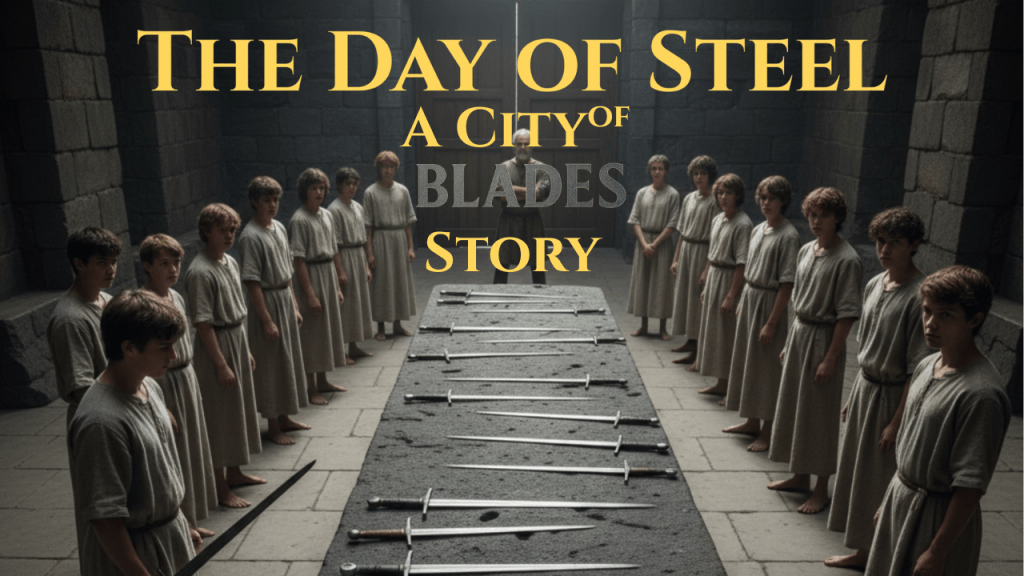
    In the City of Blades, childhood did not end with celebration.
    There was no feast, no speech, no marker cut into stone to remember the day. People woke, worked, argued, trained, and bled exactly as they had the day before.


    Only those who had reached their sixteenth year were expected elsewhere.


    The Hall stood just off one of the older thoroughfares, half-sunk into the bedrock. Most citizens passed it daily without looking. It was not impressive from the outside—thick doors, worn stone, no sigils or banners to draw the eye.


    It did not need them.


    Those approaching the Hall came without escort. Parents did not attend. Friends did not gather. This was not something meant to be witnessed.


    Inside, the air was cool and dry, carrying the faint scent of oil and old metal. Sound behaved differently here. Footsteps echoed too long, then faded abruptly, as if swallowed.
    The candidates entered together.


    Bare feet on stone. Undyed robes that marked no district, no trade, no family. Some stood rigid, others restless. A few stared openly at the floor, following the familiar path worn smooth by centuries of crossings.


    Every citizen of the City of Blades had stood here once.
    No one spoke.


    At the center of the Hall lay the table.


    It was a single slab of dark stone, wide enough to require a conscious step to reach. Its surface bore scratches that were not decorative—marks left by steel set down without ceremony, by hands that had trembled or been careless or simply tired.
    On the table lay the swords.


    They were arranged with practical spacing, hilts aligned, points angled safely away from the edge. None were new. None were ornate. Each bore signs of maintenance and use: grips darkened by sweat, edges honed thin, guards worn smooth where thumbs had rested.


    They were the City’s blades.


    Not personal weapons. Not symbols of status. Tools entrusted to citizens who were no longer considered defenseless.


    A single Master stood near the wall—not overseeing, not instructing. Merely present, as stone pillars were present.
    When everyone had entered, the doors closed.


    The sound was final but not dramatic.


    The Master spoke.


    “Today marks your first day carrying steel.”


    No preamble. No explanation.


    “In the City of Blades, this is not a privilege. It is an expectation.”
    He paused, allowing the words to settle.


    “You will approach the table when you are ready. You will take a sword. You will leave with it.”


    That was all.


    No order was imposed. No names were called. The City trusted habit more than authority.


    After a moment—long enough to feel uncomfortable—someone stepped forward.


    A boy from the outer districts. Broad-shouldered. Confident. He reached for a heavier blade without hesitation, lifted it, adjusted his grip with an instinctive movement learned through years of practice with weighted wood.


    He nodded once, satisfied, and stepped away.


    Others followed.


    Some crossed the Hall quickly, as if eager to escape its quiet. Others slowed near the table, suddenly aware of the number of eyes—not watching, but present. The stillness made the smallest movement feel amplified.


    Hands hovered.


    Fingers curled, then withdrew.


    A few candidates lifted a blade, felt the weight, and set it back down without embarrassment. This was expected. The City did not rush steel.


    When it was Tarin’s turn, he realized his breathing had changed.
    Shorter. Shallower.


    He crossed the Hall deliberately, aware of the cold stone under his feet, the faint hum in his ears that came from standing in a place older than memory.


    Up close, the swords seemed smaller than he’d imagined. Less heroic. More honest.


    He reached for one almost out of reflex—and stopped.
    He didn’t know why. Nothing was wrong with it. It simply didn’t feel like something he wanted beside him every day.


    He tried another. This one pulled his wrist at an angle he didn’t like. He imagined training with it, correcting for it, compensating.
    He set it down.


    The third sword was plain. Shorter than some. Longer than others. Its grip was worn smooth, shaped by use rather than design.
    When he lifted it, his body adjusted without conscious effort. His stance shifted. His shoulders relaxed.


    Not because it was perfect.


    Because it was workable.


    He stood there longer than necessary, blade held low, feeling its weight—not imagining combat, not imagining glory, but imagining routine. Carrying it through crowded streets. Setting it beside his bed. Cleaning it after training.


    Living with it.


    That was when the realization came—not sudden, not dramatic.
    This was not a moment of becoming something new.


    It was the quiet acknowledgment that something had already changed.


    Tarin stepped away from the table.


    Around him, others were doing the same. Some held their swords carefully, unsure where to rest their hands. Others already moved as if the weight were familiar.


    When the last blade was taken, the Master spoke again.
    “You may go.”


    No closing words. No instruction.


    The doors opened.


    Sound rushed back in—voices, metal, the endless motion of the City of Blades. The candidates paused briefly on the steps, blinking against the daylight, blades unfamiliar at their sides.
    They were not warriors.


    They had not been tested.


    But they were no longer unarmed.


    And in the City of Blades, that knowledge followed you everywhere.

  • Chapter 7 – The Empty Doorway

    Chapter 7 – The Empty Doorway

    (The Grieving Parent)

    The hallway light had been burned out for months.

    Mara liked it that way. Darkness made it easier to walk past the door without looking at the little brass plaque with the chipped paint and the sticker in one corner that read Super Explorer.

    The door stayed closed. The door stayed closed because if she opened it, the room would be different. It would be full of dust instead of laughter, stale air instead of the scent of crayons and sticky fruit snacks. As long as it was closed, the picture in her mind stayed the same: a small bed with space-ship sheets, a stuffed rabbit slumped on the pillow, a crooked poster of planets on the wall.

    She carried her mug from the kitchen—lukewarm tea she’d forgotten to drink—past the door like she did every night. One, two, three, four… She counted the steps between her bedroom and the nursery without meaning to. Her hands knew this path even when her mind didn’t want to.

    Halfway past, she stopped.

    There was light under the door.

    Not the thin, sickly orange from the streetlamp outside, sneaking in through old curtains. This was warm and soft and golden, like candlelight trapped in honey, breathing with a slow, gentle pulse.

    Mara’s first thought was short circuit. The wiring in the house was old. Maybe something had finally caught—a lamp left plugged in, a nightlight she’d forgotten to unplug that afternoon. Her chest tightened. She couldn’t bear the thought of that room burning, of losing the last shape of it.

    She set her mug on the floor with a clink she barely heard and pressed her palm to the door.

    Warm. But not hot.

    The knob was cool, smooth under her fingers. She turned it, expecting the creak she’d heard a thousand times.

    The door opened without a sound.

    The nursery was exactly as she’d left it the day she’d shut it for the last time.

    Tiny bed. Space-ship sheets. Stuffed rabbit on the pillow, one ear folded over. Crayon drawing taped to the wall, corners curling. The mobile above the bed hung still, tiny wooden moons and stars frozen mid-orbit.

    And in the middle of the worn rug, curled like a sleeping ember, was a fox.

    Its fur was the color of late autumn leaves kissed by fire—russet and gold and a deeper, coal-dark red along the spine. Its ears were tipped in soot-black, and its paws seemed dusted with ash. Its eyes, half-lidded, reflected the light that swung gently from the lantern hanging from its tail.

    That lantern was the source of the glow. It was small and round, made of panes of glass that might once have been clear, now stained in warm amber. A simple metal frame held it together, worn and dented as if it had crossed a great many roads. Inside, an unseen flame smoldered: not bright enough to hurt the eyes, but so warm that the shadows on the walls shivered and softened.

    Mara stood in the doorway, fingers gripping the frame so hard her knuckles ached.

    “…What,” she whispered, “are you?”

    The fox lifted its head. The lantern on its tail swung, casting sleepy arcs of gold across the ceiling. For a heartbeat, the mobile above the bed seemed to turn, the carved moons catching the light as if moved by some invisible breeze.

    The fox didn’t speak. It simply watched her, ears pricked forward, eyes calm and deep and impossibly old.

    “I’m dreaming,” Mara muttered. Her voice sounded wrong in the small room—too big, too sharp. She hadn’t spoken in here since the funeral. “This is… this is some kind of grief hallucination. I’ve finally snapped.”

    The fox blinked slowly, then unfolded itself from the rug in one sinuous motion. Its paws made no sound on the floor. Tiny paw pads pressed little crescents into the dust, and where it stepped, the dust seemed to retreat, leaving faint, clean prints that faded as the lantern light passed.

    It padded across the room toward the small dresser where a row of toys sat like patient guardians. Little plastic astronauts. A wooden car. A stuffed bear with one eye missing. A stack of picture books.

    The fox paused by a faded blue ball with a chipped silver star painted on the side.

    Mara’s breath caught. “Niko’s ball,” she said, before she could stop herself. The name slid out and hung in the air, heavy and bright, like a star that had forgotten how to fall.

    The lantern brightened.

    For a moment, the light flared around the ball, wrapping it in a soft halo. The golden glow thickened, deepened, until shadows seemed to peel away from the corners of the room, drawn toward that one point.

    Mara saw, not with her eyes but with the aching space behind her ribs, a flash of motion: small hands flinging the ball too hard down the hallway, giggles spilling after it. Niko’s socked feet skidding on hardwood. “Again, Mama! Again!”

    She shut her eyes. The memory pressed at her, sharp and tender.

    When she opened them, the fox had the ball in its mouth, the lantern on its tail swaying gently. It turned toward her, head tilted, as if asking a question.

    “I can’t,” she whispered. “I can’t do this. I can’t—”

    The fox brushed past her in the doorway, fur whispering against her leg. Warmth radiated from it, not hot like fever, but like holding your hands over a hearth on a winter night. The lantern grazed the frame as it passed, and for a heartbeat, Mara thought she saw soot-dark paw prints dancing along the wood, circling the door like a small, patient orbit.

    The fox padded into the hallway. It paused, looking back over its shoulder, lantern swinging gently.

    An invitation.

    Mara found herself following before she decided to move.

    Out of the nursery. Down the hall with its familiar creaks and small scars in the paint. Past the bathroom where she’d sat on the floor and sobbed into a towel so no one would hear. Past the coat closet with the bright yellow rain jacket still hanging inside, too small now for anyone.

    The house was strange in the lantern light. The familiar lines of furniture blurred at the edges. The framed photos on the walls seemed deeper somehow, the faces inside them more alive. Mara caught glimpses as she passed—Niko at three with ice cream on his chin, Niko at four holding up a lopsided snowman—but the fox never stopped, and neither did she.

    It led her to the front door.

    “You want to go outside?” she asked, voice brittle. “It’s… it’s the middle of the night.”

    The fox sat back on its haunches, ball at its feet, lantern swaying softly. It looked at the door, then at Mara.

    Her hand shook as she worked the deadbolt. The outside world felt too big, too loud, too indifferent these days. She went out only when she had to: work, groceries, appointments where strangers said words like processing and stages and acceptance.

    The latch clicked. Cold air slipped in around the edges, smelling of damp pavement and distant woodsmoke.

    The fox slipped through the opening as soon as she cracked it, tail lantern swinging like a private star. Mara hesitated on the threshold.

    The porch steps fell away into darkness. Streetlights flickered far off, their usual harsh glare dimmed and softened by the fox’s glow. The houses opposite looked… quieter, somehow, their edges blurred like watercolor. The world felt both more solid and less real, like stepping into a photograph you’d looked at too often.

    Mara drew a ragged breath and stepped outside.

    The fox trotted down the walk, paws leaving faint smudges of light on the concrete that faded with each step. The night seemed to bend around it, sounds muffled. No hum of distant cars. No sirens. Just the soft brush of fox fur, the faint clink of glass as the lantern swayed, the sound of her own breathing.

    They turned down the street.

    The way the lantern lit the sidewalk was strange. It didn’t simply push the darkness away; it carved a small, moving bubble of warmth in which each crack in the concrete, each fallen leaf, each weed pushing through the edges was illuminated with almost reverent care.

    They walked past the closed corner store. Past the bus stop where she used to wait with Niko, his small hand tucked in hers, his backpack always a little too big. A gust of wind stirred the advertisement poster there, and for a second she thought she saw a different picture entirely: a wooden sign with a fox etched into it, a lantern hanging beneath, swaying in a wind that didn’t touch this street.

    She blinked, and the image was gone. Just a smiling actor holding a paper cup of coffee remained.

    The fox looked back once, as if checking she’d seen it.

    “Where are we going?” Mara murmured, even though she knew it wouldn’t answer.

    The fox padded on.

    They reached the park.

    The gate—old, chipped green metal—stood slightly ajar. The fox slipped through the gap without slowing. Mara swung the gate wider with a dull squeal of hinges, flinching at the sound cutting through the softened night.

    Inside, the park was empty. The swing set stood in a row like waiting question marks. The slide gleamed faintly. The sandbox was a pale smudge in the earth, ringed by tiny abandoned footprints that belonged to no one now.

    This was the last place she’d been with Niko before—

    She drew in a breath so fast it hurt and clutched at the ache in her chest.

    The fox walked to the middle of the playground and set the blue ball down. The lantern brightened, stretching shadows long and thin across the grass. The slide’s metal seemed to catch the light like a blade; the chains of the swings glowed softly, each link outlined in gold.

    For a moment, the park wasn’t empty.

    In the lantern’s radiance, Mara saw quick hands grabbing at the swing chains, saw short legs pumping, heard a laugh like a bell. She saw herself from the outside, pushing, saying “Higher? You’re brave, little comet,” and Niko’s answering shout: “I’m not little!”

    But there was no body in the swing now. Just wind gently rocking the chains, squeaking quietly.

    The lantern dimmed again, returning the park to hollow stillness.

    Mara sank onto the nearest bench. The wood was cold under her, damp from earlier rain. Her hands trembled in her lap. Tears blurred the lantern’s glow into a soft smear of gold.

    “It’s not fair,” she whispered. “He should still be here. He should— he should be running. He should be…” Her throat closed.

    The fox stepped closer.

    Without ceremony, it hopped up onto the bench beside her, light lantern tail resting along the back. The warmth from its body seeped into her side, into the stiff, locked muscles between her ribs. It pressed its head gently against her arm, as if nudging her to look up.

    She did.

    Beyond the playground, past the last row of trees, there was something that hadn’t been there before.

    At first, she thought it was mist. A silver ribbon hanging in the air, just above the ground. Then the lantern light reached it, and the shape resolved: stepping stones hovering over a water that reflected no stars, stretching out into a blank darkness that didn’t feel empty, exactly. Just… beyond.

    The nearest stone was only a few paces away.

    Mara’s pulse thundered in her ears. “Is that…?”

    She couldn’t finish the thought. The words felt dangerous, as if saying them would drag her forward or shatter the fragile, impossible moment.

    The fox slid off the bench and padded to the edge of the water-that-was-not-water. The lantern brightened, casting rings of light across the surface. It rippled not like a lake, but like memory—scenes disturbed by the tiniest disturbance.

    Mara saw baby fingers curling around her thumb. The first time Niko had pointed at the moon. A sticky kiss on her cheek, a weight on her shoulder as he fell asleep against her.

    She stood up slowly.

    Her legs felt like they belonged to someone else. She took one step. Then another. Each footfall echoed more loudly than it should have, like footsteps in a church.

    The fox waited by the first stone.

    “I can’t follow him,” Mara whispered, realization cutting through the fog in her mind like a cold wind. “I know. I know I can’t. It’s not my time.”

    The fox’s lantern flickered, acknowledging. It looked at the stone, then at her, ears tilted forward, patient.

    She understood, then, what it was asking.

    Not to follow. Just to come close enough to say what she’d never let herself say. To admit what she kept folded like a secret in the dark spaces between her heartbeat.

    Her whole body shook. She wrapped her arms around herself, fingertips digging into her sleeves.

    “I don’t know how,” she said.

    The fox took one small step, placing its forepaws on the first stone.

    The lantern flared once, bright and steady. The warmth rushed over her like a breath from a door just opened onto a room that had been closed too long.

    Mara stepped forward.

    Her foot touched the stone. It was neither wet nor dry, neither warm nor cold. It simply was, solid and real under her weight. The water beside it—if it was water—stilled, reflecting only the lantern’s glow and something else, far off: the blurred suggestion of a small hand waving from beyond the last visible stone.

    She didn’t try to see more. She was afraid that if she did, she would never step back.

    The fox leaned against her leg, anchoring her here, in this one step of the bridge between worlds.

    “Niko,” she said.

    His name rang out into the not-water, into the dark, into the hollowed-out space inside her. She hadn’t said it out loud in weeks. Not alone. Not without someone there to pat her hand and tell her she was being “so strong.”

    “I’m so sorry,” she choked. “I’m so sorry I couldn’t— I didn’t— I should have…” The words tumbled over each other and fell away, useless.

    The lantern’s light flickered in time with her breath. With each shuddering inhale, it swelled. With each stuttering exhale, it dimmed, then steadied again, as if matching her, refusing to let her disappear into the dark.

    “I love you,” she forced out. The words came out ragged, broken. “I love you, and you’re not here and it hurts and I don’t know who I am without you, and I feel so guilty every time I laugh because it feels like leaving you behind, and I don’t know how to carry all this and still go on, but I—”

    Her voice cracked. Tears blurred everything into gold and black.

    “And I will,” she whispered. “I will go on. I’ll keep going. I’ll carry you with me. Not like this—” She gestured vaguely toward the dark park, the locked hallway, the closed door waiting at home. “Not frozen. Not stuck. I’ll try to live. For both of us. Somehow.”

    The words didn’t fix anything.

    They didn’t bring him back. They didn’t erase the silence that would always echo where his laugh had been.

    But they did something small and important.

    The lantern’s flame surged, shooting a thin, bright beam over the water. It struck the farthest visible stone and shattered into a thousand tiny embers that drifted slowly back toward her, falling not into her hands, but into her chest, sinking without heat or pain.

    The weight inside her shifted.

    Grief was still there, but the sharpest edge dulled, wrapped in something gentler. Not acceptance—she wasn’t ready for that word—but an admission that the love didn’t have to be a locked door, that it could be a lantern she carried forward, light leaking through the cracks.

    The fox stepped back off the stone, leaving her there.

    It looked up at her, eyes reflecting not only the lantern’s glow, but the faint light that had kindled behind her own.

    Then, with a small, decisive shake of its fur, it turned and padded back toward the playground.

    Mara wobbled as she stepped off the stone. The world felt too heavy and too light all at once.

    When she glanced back, the water and stones were gone.

    Only the field stretched behind the playground, damp and dark and ordinary. The night noises crept back in: a distant car, a dog barking somewhere, the whisper of leaves.

    The fox waited by the gate, tail lantern dimmed to a quiet ember.

    Mara followed it home.

    The streets were the same, and not. The bus stop was just a bus stop again, though for a moment she thought she heard the faint clatter of mugs and the low murmur of voices, as if there were a warm room just out of sight somewhere beyond the glass—somewhere travelers rested before moving on. If such a place existed, she thought, the fox would know the way.

    Back at the house, she paused on the front step.

    The porch light she’d never replaced was still dead. Only the lantern lit the chipped paint, the worn welcome mat, the hairline cracks in the stairs. The fox paused by the threshold, looking back at her.

    “I don’t want to close his door anymore,” she heard herself say. “Not like a tomb. And I don’t want to keep it frozen, either.”

    Her hand moved to the doorknob.

    Inside, the hallway felt different. Not because anything had changed, but because she had. The darkness was the same, but it no longer felt like a wall; it felt like a canvas waiting for the smallest mark.

    The fox padded straight to the nursery and sat before the open door.

    For the first time since that awful day, Mara stepped into the room with the lights off and didn’t flinch.

    She went to the bed and picked up the stuffed rabbit, its fur worn thin in patches, one eye slightly loose in its socket. She hugged it to her chest and inhaled dust and faint, lingering traces of laundry soap.

    “I’ll keep this,” she said softly.

    The fox’s lantern brightened in approval.

    She moved slowly, carefully. She opened the blinds a little, letting the first thin threads of dawn sneak in. She cracked the window an inch to let the stale air breathe. She righted the picture on the wall that had been hung crooked for months.

    She didn’t pack anything yet. That would come later. Not today, and maybe not tomorrow. But the room was not sealed anymore. Not a reliquary. Not a wound she refused to look at. Just a room, filled with memories and quiet and light.

    By the time the sky outside had paled to soft grey, the fox was curled again on the rug. Its eyes were closed, but the lantern still glowed faintly, a drowsy coal.

    Mara knelt beside it.

    She didn’t try to pet it. Somehow, that felt like the wrong kind of touch, too casual for whatever it was. Instead, she bowed her head slightly, as if standing at the threshold of a sacred place.

    “Thank you,” she whispered, voice hoarse but steadier. “For… walking me there. And back.”

    The fox’s ears twitched. The lantern brightened one last time, flaring gently, filling the room with a light that smelled faintly of woodsmoke, autumn leaves, and something else she couldn’t name—a hint of distant music, of clinking cups, of laughter in a place between storms.

    When the brightness faded, the rug was empty.

    No fox. No lantern. No soot-prints on the floor.

    Just the early morning light creeping across the space-ship sheets, touching the edges of a room that had been caught in the same moment for too long.

    Mara stood in the doorway, hand on the frame.

    For months, she had closed this door to keep the pain contained. Now, she left it open. She walked down the hall to her own room, found a small nightlight in the drawer beside her bed—a cheap plastic fox she’d bought on impulse years ago and never used—and plugged it into the socket by the nursery.

    The little fox glowed with a gentle amber light.

    It wasn’t the same as the lantern’s glow. But it was enough to keep the hallway from being completely dark.

    On her way back to bed, she thought she saw, just for an instant, the tip of an ember-bright tail disappearing around the corner, as if some small, weary traveler were stepping through a door that opened onto a road no map could show.

    Mara smiled, the expression strange and stiff on her face, as if unused muscles were trying a familiar shape again.

    “Wherever you’re going,” she murmured into the quiet house, “may your lantern never go out.”

    Somewhere, in a place between worlds and waking dreams, a fox with ember-colored fur trotted along a path made of thresholds and crossroads. Its lantern swayed, gathering stories of broken hearts and the small, brave ways they mended. And though Mara did not yet know it, her story would hang there, too, like a warm light in a window that helped guide others home.

  • Chapter 6 – The Prophet Who Could No Longer See

    Chapter 6 – The Prophet Who Could No Longer See

    By the time the bells stopped ringing, the prophet had already stopped listening.

    Once, the sound of them meant something—a pattern in the echoes, a rhythm in the sway of the ropes, little threads he could follow into glimpses of tomorrow. People used to climb the hill just to ask him what the bells meant.

    Now they just rang because it was evening and that was what bells did.

    He sat alone on the temple steps, cloak wrapped tight against the cold, staring at the worn grooves carved by years of feet and weather. A crooked staff lay across his lap. The top of it had once held a crystal that shimmered in starlight. Now it was bare wood, splintered where the stone had cracked and fallen away.

    “Nothing,” he murmured, rubbing his thumb along the break. “Empty sky. Empty dreams. Empty head.”

    The lamps along the path below flickered on, one by one, as the acolytes moved through the courtyard. He could hear them whispering, careful-soft, the way people do when they’re afraid their words might shatter something fragile.

    He didn’t blame them. He’d shattered it himself.

    The last vision he’d spoken aloud had been wrong.

    He had stood here, on this same step, and told the gathered crowd that the river would rise and swallow three streets if they did not leave their homes. They had packed their lives into carts and baskets and crates, herded children and animals up the hill, and waited in the temple, watching the river below.

    The waters stayed where they were supposed to stay.

    For three days, the village camped in the temple halls, huddled between incense smoke and carved stone, waiting for the disaster that never came.

    When they finally went home, they did not look up at the hill.

    And the bells that had once sounded like prophecy just sounded like bronze.

    Now, when he closed his eyes to listen, the silence inside his own skull felt louder than any warning he’d ever spoken.

    “I can’t see,” he whispered, though there was no one there to hear. “Not the old way. Not any way.”

    He might have gone on sitting there until the cold crept all the way into his bones—if the light at the edge of the courtyard had behaved the way light usually does.

    Instead of brightening steadily with the lamps, one spot at the base of the hill flared, dimmed, and flared again, like someone cupping a flame and then opening their hand.

    He frowned and straightened, squinting.

    There, just beyond the last carved stone lantern, something small and fox-shaped stepped into view.

    At first he thought he was looking at one of the temple cats catching the fireglow, but this light was wrong for that. It didn’t reflect off fur; it seemed to spill from it.

    The creature’s coat was ember-brown, tipped with brighter orange where the fading daylight caught it. From the end of its tail hung a small lantern, no bigger than a teacup, casting out a warm, golden glow that made the nearby shadows lean away.

    The prophet blinked hard and then blinked again.

    The fox remained.

    “You’re late,” he told the air, because old habits die slower than faith. “Visions usually come before I give up.”

    The fox tilted its head. The little lantern on its tail swung, sending rings of soft light across the stones.

    It didn’t speak. There was no booming voice, no echo of some distant god curling around the corners of his thoughts. There was only the seeable, solid fact of a small fox with a light tied to its tail, watching him with eyes the same color as its lantern.

    “You’re real, then,” he said slowly. “Or I’ve gone properly mad.”

    The fox padded closer. Its paws made no sound on the worn stone. At the foot of the steps, it paused, looked at him, then turned away and started down the path that led away from the temple, toward the terraced fields and the ravine beyond.

    The lantern’s light tugged the darkness along behind it like a long black cloak being peeled back.

    The prophet hesitated.

    He had ignored one false vision and lived with the shame of being wrong. Now something that looked like it had walked out of a story stood in front of him, offering nothing—no words, no promises—just a path lit a few steps at a time.

    He could stay, with his broken staff and his broken certainty.

    Or he could stand up.

    His knees complained when he pushed himself to his feet. The bells finally stopped ringing behind him, leaving the world strangely bare. He took up his staff, feeling the splintered top bite his palm, and followed.

    “Fine,” he muttered as he limped down the steps. “If you’re a dream, at least you’re a new one.”


    The temple lamps grew fainter behind them. Ahead, the lantern-tail painted low walls and dry grass in gold and amber. The fox never rushed, never slowed, moving with that effortless, patient trot that wild things have when they know exactly where they’re going.

    “Do you know where you’re going?” the prophet asked after a while, half to himself. “Because I don’t.”

    The fox’s ears flicked but it gave no other answer.

    They left the main road almost immediately, cutting across a fallow field where the stubble scratched at the prophet’s boots. He stumbled once when his foot caught on an old root hidden in the dark, and his temper flared up sharp and quick.

    “This is ridiculous,” he snapped. “I’m too old to be chasing lights. I’m not some wide-eyed apprentice waiting for my first omen. I’m a—”

    The word prophet caught in his throat like a stone.

    The fox stopped. The lantern’s glow reached only to the tips of the prophet’s boots. Beyond that, the night swallowed the world whole. Crickets chirped. Somewhere far off, a dog barked twice and then thought better of it.

    Slowly, the fox turned, looking back at him.

    Its eyes were not accusing. They weren’t anything that simple. They just were, with the steady, quiet attention of something that has watched storms rise and fall and knows that temper is smaller than lightning.

    The prophet let out a breath he hadn’t realized he’d been holding.

    “I don’t know what I am,” he admitted.

    The lantern brightened. Just a little. Enough to reach his hands, to paint his broken staff in gentle gold.

    He swallowed.

    “…All right,” he said more softly. “Lead on.”

    The fox turned and trotted down into the ravine.


    The path grew steeper and less certain. Dirt turned to loose stone. Shrubs scratched at his cloak. Once or twice he heard the rattle of pebbles sliding into unseen depths.

    “Wonderful,” he muttered. “Follow a strange fox into a dark gully. Very wise. This is exactly the sort of decision people come to the temple to avoid making.”

    But he kept going.

    The lantern-light never stretched more than a few strides ahead. He could not see where the path ended, only where his next step landed. All the wild maps his mind used to draw—branching futures, weight of choices, the way one word could spool out into a dozen consequences—refused to appear.

    Step. Staff. Breath.

    The world shrank to that.

    At the base of the ravine, a thin stream whispered over stones. The fox leapt lightly across. The prophet followed more slowly, boots slipping on moss-slick rock. His foot plunged into the cold water and he hissed, half from the shock and half from the old ache in his bones.

    The fox paused on the opposite bank, looking back as if weighing whether he would turn around.

    He didn’t. Not yet.

    They climbed again on the far side, up through a tangle of roots and old, broken shrines. The statues here were different from the ones at the temple above—rougher, older, worn faceless by rain and time. People had stopped coming down this way generations ago, if they had ever come at all.

    At one crumbling altar, covered in moss and half-choked by a fallen tree, the fox halted so abruptly that the prophet nearly walked into it.

    “What?” he asked, catching himself. “What is this place?”

    The fox stepped aside. The lantern’s light fell directly on the cracked stone bowl at the altar’s center.

    Inside it lay fragments of glass and crystal—sharp, glittering shards that caught the lantern-glow and scattered it in a dozen directions. Some pieces were clear, some smoky, some faintly colored, like slices of frozen dawn.

    The prophet stared.

    “I know you,” he whispered, reaching out.

    His broken staff trembled in his hand.

    Once, long ago, when he was young and the world was full of possibilities instead of questions, this had been his altar. This ravine had been his secret place, where he had first learned to quiet his thoughts enough to notice the way the world hummed underneath ordinary sound.

    He’d shattered the crystal himself when his first terrible vision came true, convinced that no one should have to see what he’d seen. He’d thought breaking the tool would break the sight.

    He’d been wrong. The visions had come anyway. The crystal had been forgotten.

    Until his last prophecy failed.

    Until the river did not rise and the people stopped asking and the silence in his head became more frightening than any disaster he could imagine.

    “I thought I was beyond this,” he said, voice rough. “Beyond hiding in ravines and talking to strangers and asking the dark what it wants from me.”

    The fox hopped up onto the altar. Its paws did not disturb the glass fragments. The lantern at its tail swayed over the shards, and each one flashed with a different small reflection.

    Here, a sliver of the sky turning bruised-purple over a field. There, the shine of water on stone. In another piece, so small he had to lean close to see it, a slice of village street lit by lanterns… people laughing, holding cups, their faces indistinct but warm.

    He reached toward that shard, then hesitated.

    His hand shook.

    “I was wrong,” he whispered. “Once. I trusted what I saw, and it hurt people. What if I pick up the wrong piece again? What if I only ever see the pieces that scare me?”

    The fox’s gaze didn’t flinch, didn’t soften.

    It simply waited.

    The prophet swallowed. The night pressed close around them, full of its own quiet breathing. Somewhere above, the temple bells hung heavy and still, their ringing a memory now.

    He thought of all the years he had tried to drag certainty out of a sky that had never promised him any. Of the way people’s shoulders loosened when he told them, “It will be all right,” even when he hadn’t been sure. Of the terrible relief in their eyes when he warned them of something they avoided.

    He thought of the river that had not risen, and the way he had sat with that failure like a stone in his chest, as if one wrong glimpse meant he had no right to look at all.

    “Maybe,” he said slowly, “maybe they were wrong to think I could see everything. And maybe I was wrong to let them.”

    His fingers closed around the small shard with the laughing, lantern-lit street.

    It was cool against his skin. For a heartbeat, he felt something—not a voice, not a command. Just a sense of warmth, of a room somewhere that did not exist yet, where lost travelers set down their burdens and thawed their hands beside a fire that never quite went out.

    He did not know where it was. He did not know when.

    He only knew that, someday, it would matter.

    The knowledge did not slam through him like a thunderbolt. It settled in his chest like an ember, fragile but real.

    He slipped the shard into a pouch at his belt.

    “Fine,” he said to the fox. “I’ll try again. But differently this time.”

    The lantern brightened. The fox hopped lightly off the altar and started up the path out of the ravine, tail swaying, light bobbing.

    The prophet followed.


    By the time they climbed back to level ground, his legs ached and his breath came short. The village lay below them like a scattering of stars, small lanterns glowing in windows and along streets. Further off, the dark line of the river curled like a sleeping serpent.

    He had expected to feel the old pull—the urge to scan the sky, to sift the wind, to search for cracks in the pattern where disaster might creep in.

    Instead, all he felt was… tired. And, quietly beneath the tired, a thin thread of something like relief.

    The future did not rise up in his mind in blazing clarity. No sudden storms bloomed in his thoughts. No hidden wars marched across the back of his eyes.

    There was just the next step.

    And the next.

    And the little circle of fox-light on the grass.

    They walked along the ridge until the path narrowed to a cliff edge. Below, the ravine they’d climbed out of dropped away into darkness. Ahead, there was no more ground, just air and night.

    The fox stopped.

    The lantern on its tail swung lazily over the drop. The prophet could see nothing beyond that thin halo of light. The world might as well have ended there.

    “I can’t walk where there isn’t a path,” he said, the old panic curling quick in his stomach. “Show me where it goes. Just this once. Just so I know it is there.”

    The fox looked back at him.

    Then, without a sound, it stepped off the edge.

    The prophet gasped and lurched forward, hand outstretched, as if he could catch the little creature by its tail. But the fox did not fall. Its paws met something unseen. The lantern light shivered… and held.

    Where there had been only darkness a moment before, its glow now revealed a narrow ledge of stone, hugging the cliff face. A path, thin and precarious, but a path all the same.

    “Oh,” he breathed.

    The fox took another step, and another, light bobbing. Each time, just a little more of the ledge appeared, far enough ahead to place a foot, never far enough to see where it ended.

    The night swallowed everything beyond that soft, golden circle.

    The prophet stood at the edge, heart pounding.

    “This is what it’s like for them,” he realized. “For everyone who ever asked me what was coming. They don’t get to see it the way I thought I did. They only ever get this much. A few steps. A small light.”

    He looked down at his hands, at the old scars from ink and candle burns and broken glass. At the faint shimmer of the shard in his pouch.

    Maybe… the question had never been, What is the future?

    Maybe it had always been, How do we walk when we can’t see it?

    The fox paused, halfway along the invisible ledge, and sat down. It did not look impatient. It simply waited, tail curled around its feet, lantern swinging in the open air.

    The prophet laughed then, quietly and a little shakily.

    “All right,” he said. “I understand.”

    He stepped out over the edge.

    For a heartbeat, his stomach dropped. Then his boot met stone.

    Solid. Narrow. Real.

    The world beyond the light remained utterly black, a velvet nothing. If he looked too far ahead, his balance wavered. So he stopped trying. He put his attention where the light was—the next step, and the next, and the feel of the ledge under his feet.

    He could not see where the path led. He walked anyway.

    His fear didn’t vanish. It moved. It settled into his chest beside that ember of warmth, both of them glimmering quietly together.

    Halfway across, the wind shifted. A smell drifted past him—smoke and cinnamon and something sweet, like honey warming over a hearth. For a moment, carried on the breeze from nowhere at all, he heard the low murmur of voices and the soft clink of cups.

    A room, he thought. Somewhere. Somewhen. Lit by lanterns that never quite went out.

    Then the wind changed again and it was gone.

    He stepped onto solid ground.

    When he turned, the ledge was disappearing behind him, swallowed piece by piece by the dark. The fox hopped lightly back onto the grassy ridge at his side, as if it had simply been crossing a street.

    They stood together for a while, looking back at the invisible path.

    “I used to think I was meant to see everything,” he said at last. “Every danger. Every blessing. Every twist in the road. Maybe my vision breaking wasn’t punishment. Maybe it was… mercy.”

    He smiled, small and slow.

    “Maybe this is enough. A light for the next few steps. A reminder that there is still a way forward, even when I can’t see the whole of it.”

    The fox bumped its head softly against his leg. The lantern brushed his cloak, leaving a faint warmth behind like a hand pressed to his side.

    “Thank you,” he said.

    He did not ask where it had come from. He did not ask where it was going next. For the first time in a long time, he did not ask what would happen tomorrow.

    He knew what he would do when he walked back down the hill.

    He would stand on the temple steps—not as a man who claimed to know every turn of fate, but as someone who had walked a narrow path with only a small light. He would tell the people the truth:

    That no one could see everything.

    That fear did not vanish just because you named it.

    That sometimes, the bravest thing you could do was take the next step without knowing where the path ended.

    And that somewhere, in some not-yet-built place between roads and rivers and worlds, there was a door that would one day open onto warmth and music and rest.

    He did not know how he knew that.

    He only knew that when he slipped his fingers into the pouch at his belt, the little shard of glass there pulsed once against his skin, like a heartbeat.

    When he looked down again, the fox was already moving.

    Back along the ridge.

    Back past the silent bells.

    Back toward whatever corner of the world held the next person lost enough to follow a small, golden light into the dark.

    The prophet watched until the glow of its lantern melted into the other lights of the night, indistinguishable from stars and windows and dreams.

    Then he turned toward the temple and began to walk, step by careful step, trusting the path beneath his feet—even when he could see only a little way ahead.

  • Chapter 5 – The Child at the Edge of the World

    Chapter 5 – The Child at the Edge of the World

    (The Lost Path)


    By the time anyone realized Eli was missing, the fairground had already become another world.

    Daylight drained out of the sky in streaks of pink and copper, and all the coloured lights along the booths seemed too bright, too loud, as if someone had turned the whole evening up a notch. Voices blurred into a single rolling roar. Music from three different rides tangled into something that wasn’t quite a song.

    Eli stood in the middle of it, small and alone, clutching the crumpled corner of a map he’d been so proud to carry.

    “Stay by us,” Mum had said.

    “Don’t wander off,” Dad had added.

    And he hadn’t meant to. He’d only stepped aside to see the wooden dragon on the carousel up close, just for a second, because its emerald eye had seemed to be looking right at him. Then the crowd surged, somebody bumped his shoulder, and when he turned around his parents were gone.

    Not “a few steps away, scanning the crowd.”
    Not “right there if he just pushed through.”

    Gone.

    He tried to do what they’d told him. Go back to where you last saw us. Stay put and we’ll come find you.

    Except “where he’d last seen them” no longer existed.

    The booth with the stuffed bears was now selling glass stars. The truck with the hot chocolate had somehow become a tiny stage where a magician pulled scarves from nowhere. Even the path under his shoes looked wrong, the gravel crunching into something finer, smoother, more like the pressed stone of an old street.

    His heart thudded in his ears.

    “Dad?” he called, voice swallowed by the fair. “Mum?”

    No answer. Just the cheer from a ride spinning somewhere out of sight, and the distant crack of fireworks test-firing.

    He swallowed the hot knot in his throat. He was nine, almost ten. Too old to cry about getting separated. Too old to be scared of the dark that was rolling in like a slow wave over the horizon.

    The map in his hand fluttered. He looked down at it, hoping for a miracle.

    The bright lines of rides and food trucks and exits had smudged. The little icon of a smiling fox advertising “Funnel Cakes!” had stretched impossibly long, its tail curling around the edge of the paper like it was trying to slip away.

    He blinked hard.

    The fox lifted its head.

    Not on the paper. In front of him.

    Lantern-light bloomed where there had been nothing a heartbeat ago. A small shape stepped out of a crack between two stalls that shouldn’t have been large enough for anything bigger than a cat.

    The fox’s fur was the colour of embers at midnight, dark at the roots, burning brighter toward the tips. Its eyes were molten amber, reflecting the fairground lights and something deeper beneath. A lantern hung from its tail, light swaying gently, casting little ripples of gold across the gravel.

    Eli forgot how to breathe for a moment.

    The fox tilted its head, studying him. No one else seemed to notice it. People drifted past, laughing, brushing close enough that Eli had to edge aside, but no one glanced down at the glowing creature at his feet.

    “Hey,” he whispered, because it felt wrong to raise his voice. “Are you—are you real?”

    The fox didn’t answer. It simply stepped closer until the lantern light wrapped around Eli’s shoes and soaked into his jeans and skin, warm as a hand around his fingers.

    The panic loosened its grip on his chest, just a little.

    A soft gust of warm air rustled his hair, smelling faintly of woodsmoke and something sweet, like toasted sugar. For a moment he could hear—beneath the roar of the fair—another sound entirely: low conversation, clink of mugs, the murmur of a hearth.

    Then it was gone, as if someone had turned down a volume slider inside his head.

    The lantern fox turned away and trotted a few steps, then glanced back over its shoulder. The lantern on its tail swung, a gentle beckoning.

    Eli looked over his shoulder, in case some sensible grown-up had appeared to take charge.

    No one.

    He was lost. The exits kept moving. The map had turned strange.

    And yet… he wasn’t alone.

    He took a careful step toward the fox.

    It waited.

    Another step. Another. The fairground around them seemed to blur at the edges, booths stretching a little taller, lights smearing into long streaks of colour. Each step away from where he’d been felt like walking off the edge of something familiar and into a picture book you weren’t supposed to fall into.

    “Where are we going?” he muttered.

    The fox’s ears twitched. It didn’t speak, but the lantern flared a fraction brighter, as if answering: Somewhere you need to be, not somewhere you expect.

    They slipped between two stalls that had not been there a moment before: one selling glass bottles that glowed softly from inside, the other hung with wind chimes that made no sound. People moved past like shadows, a little slower now, a little less distinct.

    Eli realized the noise had changed. The roar of the fair had softened, receding like tidewater. He could hear his own breathing again, and the faint pad of the fox’s paws.

    Ahead, the chaos of booths and rides thinned. A narrow lane appeared, cobbled stones pressed into the earth, running away into the deepening dusk. Old brick walls rose on either side, patched and mismatched, doors tucked between them where no doors should have been.

    This wasn’t part of the fairground. This wasn’t part of his town at all.

    He stopped. “This… this isn’t right.”

    The fox stopped too, turning back toward him. For the first time, it closed the distance between them completely and pressed its forehead lightly against his knee.

    Heat poured through the fabric of his jeans, spreading up into his chest. Not burning, but a deep, steady warmth that seemed to push out the cold knot of fear. Images flickered at the edges of his thoughts: a little boy at a different crossroads, a woman on a ship staring at too many stars, a man in a forest with no path… all of them wrapped in the same lantern glow.

    Then, clearer than any of those, he saw his mother’s face as she’d looked at him earlier that day when he’d made a joke about “getting lost on purpose so no one could make him do chores.” She’d laughed, but her eyes had softened in that way they did when she was worried and trying not to show it.

    “Never on purpose,” she’d said, ruffling his hair. “You belong with us, you hear? If you ever feel lost, you yell loud enough for me to find you.”

    Eli’s throat tightened again, but now it wasn’t only fear; something else tangled there too. Regret. The sudden sharp knowledge that he had wished, just a little, to disappear. To step sideways from all the bickering and noise and rules.

    The fox leaned back, watching him.

    “I didn’t really mean it,” he whispered. “I don’t want to vanish. I just… I don’t like it when they fight. Or when they’re tired and forget I’m there.”

    The lantern’s light shifted, shadows tucking themselves neatly away, as if the world were listening politely. The fox turned and padded down the lane.

    This time, Eli followed without hesitation.

    The further they went, the more the air changed. The sharp scent of frying food faded, replaced by cool stone and distant rain, even though the sky above remained clear. The cobbles under his shoes were damp and old, moss peeking between them. The buildings on either side leaned inward like they were listening in.

    Doors lined the alley. Some were plain wood. Others had carvings: waves, leaves, stars, symbols Eli couldn’t name. A few were cracked open, warm light seeping through.

    They passed one doorway where voices murmured, fragments of words curling out into the lane.

    “…thought I’d lost it all, but then…”

    “…found my way back…”

    “…a lantern, like a fox’s tail, of all things…”

    Eli slowed, peering through the thin gap. For a heartbeat he saw a room that could have been in any storybook tavern: low beams, a stone hearth with fire painting the room in amber, people in travelling cloaks and modern jackets both, gathered around chipped mugs. A sign hung over the hearth, emblazoned with the stylized outline of a fox wrapped around a lantern.

    His heart gave a little jump of recognition, though he couldn’t have said why.

    The fox brushed against his leg, drawing him on. When he looked back at the doorway, the crack had closed. The sign over the hearth was gone, as if it had never been.

    “Was that… a pub?” he asked, reflexively. “Like in old movies?”

    The fox didn’t answer, but the lantern’s glow shivered with something like amusement.

    They walked on until the alley opened up into a small square.

    It wasn’t big—more like the space in the middle of four old houses that had agreed to share a backyard. A dry fountain stood at its center, stone basin carved with little foxes chasing one another’s tails. The world beyond the square was a haze, as if someone had forgotten to finish painting it.

    The lantern fox padded to the fountain and hopped gracefully onto its rim. It turned to face Eli and lowered its tail so the lantern hung just above the basin.

    Light spilled down like liquid.

    Water rose to meet it.

    At first it was empty, clear. Then shapes surfaced beneath the glow: waves of colour, fragments of moving scenes.

    He saw himself, only minutes ago, standing by the wooden dragon, map in hand. He watched as a knot of teenagers pushed past, watched his parents carried away on the tide of bodies, unaware he had stopped. He saw his own face, a little stubborn, a little curious, as he stepped toward the dragon instead of clinging to Mum’s sleeve.

    “It’s my fault,” he whispered.

    The fox’s ears flicked. The light in the lantern dimmed, and the image shifted.

    Now he saw his parents. Not from his eyes this time—from somewhere above. His mother’s face was pale, lips pressed tight as she scanned the crowd, calling his name. His father spoke to the nearest staff member, gesturing sharply, trying very hard not to look as scared as he was.

    They circled the fair, again and again, their paths looping, almost touching the spot where Eli had stood and then missing it by a single step, a single breath, as if the fairground itself were twisting to keep them apart.

    He watched his mother’s shoulders shake once when she thought his father wasn’t looking, saw his father’s jaw clench as he pretended not to notice.

    The knot in Eli’s throat loosened into something else entirely.

    “They’re… they’re looking so hard,” he said. “I thought…”

    He had thought, in a small, secret part of himself, that maybe if he disappeared they would shrug eventually and keep going, like when a toy broke and no one had time to fix it. But this—this frantic searching, this fear—this was something else.

    The lantern fox lifted its head slightly. The scenes in the water folded and collapsed like pages turning.

    Eli saw flashes of other people then, only glimpses: a figure on a cliff-edge, staring into fog; a woman in a starship corridor with panels flickering; a scholar surrounded by books and yet completely lost. In each picture, the fox’s lantern light gleamed somewhere close, never forcing, only offering.

    Then the fountain went still. The water lay flat as glass, reflecting only the lantern above.

    Eli stepped closer until he could see his own face in the surface. Freckles, wide eyes, hair sticking up in three directions. He looked small. He also looked… present. Solid. Like he belonged here, in this strange in-between square, at least for a moment.

    “I don’t want to disappear,” he said quietly, more to himself than to the fox. “I want to go home. Even when it’s noisy. Even when they’re tired. I want to be where they are.”

    The fox hopped down from the fountain. The lantern swung close to Eli’s chest, brightening until he had to squint. Warmth wrapped around his ribs, his heart, like someone was fastening a button deep inside him that had come undone.

    He felt, clearly and simply, a sense of agreement.

    Then the world tilted.

    The square, the fountain, the doors around it—all stretched away like reflections sliding off glass. Lantern light became the sharp glare of the fairground bulbs. The damp cobbles under his shoes turned back into gravel dusted with dropped popcorn.

    He staggered, catching his balance.

    He stood exactly where he’d first realized he was alone: between the game booth and the carousel. The dragon still circled, its emerald eye shining. The map in his hand was just a map again, crumpled and slightly sweaty.

    But the warmth in his chest remained.

    “Eli!”

    His mother’s voice cracked over the noise, raw and sharp. He spun.

    She shoved through the crowd, hair a mess, jacket half-zipped, Dad close behind her. The moment she saw him, she broke into a run. He thought he’d be in trouble, or at least scolded, but instead she crashed into him in a hug that knocked the breath out of his lungs.

    “Oh thank God,” she whispered against his hair. “Oh, Eli, we couldn’t find you, everything kept looking the same, I thought—”

    His father’s hand landed on his shoulder, squeezing hard enough to hurt in a good way. “You alright, kiddo?” His voice was rough. “You hurt? You scared us half to death.”

    “I’m okay,” Eli said, the words muffled by his mother’s jacket. He swallowed. “I was… lost. Really lost. But…”

    He hesitated. How did you explain cobbled alleys and silent tavern doors and a fox made of lantern light?

    He pulled back enough to look up at them. “I’m sorry,” he said instead. “For the joke earlier. I don’t want to get lost on purpose. I want to stay with you. Even when everything’s… kinda loud.”

    His mother’s eyes filled, a complicated mix of relief and guilt and love. His father ruffled his hair, too hard, the way he always did when he didn’t know what else to do.

    “We’re going home,” his dad said. “Fair’s over for us tonight.”

    Eli nodded, slipping one hand into his mother’s and one into his father’s, anchoring himself left and right. For a moment, walking between them felt like the safest place in the universe.

    As they headed toward the exit, he glanced back over his shoulder.

    Between two stalls, where the shadows pooled thickest, a small shape moved. A tail tipped with light curled briefly into view, the lantern swinging in a slow arc. The fox’s eyes met his across the distance—warm, watchful, amused.

    Eli smiled, a quick, fierce little smile that felt too old for his face and exactly right at the same time.

    “Thank you,” he whispered.

    The fox dipped its head once. Behind it, for the barest heartbeat, he thought he saw a door outlined in warm gold, and beyond it the glow of firelight on old beams and the suggestion of a sign shaped like a fox coiled around a lantern.

    Then the crowd shifted. A man walked between them, pushing a stroller. When he passed, the door and the fox were gone. Only the ordinary dark remained.

    Except, of course, it wasn’t entirely ordinary anymore.

    Eli walked out of the fairground holding his parents’ hands, the warmth of lantern light still tucked under his ribs like a secret. The world felt a little bigger than it had that morning—stranger, maybe—but also kinder.

    Somewhere, not yet fixed in any one place, a tavern waited to be fully real, its hearth ready, its doors not quite settled on which street they belonged to. For now, it lived in glimpses and echoes and the paths the lantern fox walked.

    Eli didn’t know that. Not yet.

    He only knew that when he closed his eyes on the backseat ride home, the darkness wasn’t empty. It was filled with the soft glow of a lantern swinging in time with his breath, keeping pace with the beat of his heart, leading on—quietly, patiently—whenever he felt lost.

  • Chapter 4 – The Scholar Who Forgot the Question

    Chapter 4 – The Scholar Who Forgot the Question

    Serin did not notice the sun had gone down again.

    The light in the tower study was always the same now: tired candles guttering in iron brackets, the faint amber glow of charmed globes long past their prime, the grey smear of evening through the narrow window slit. Day and night had blurred into one long, ink-stained hour.

    Pages covered the desk. Pages covered the chair beside the desk. Pages had colonized the floor, spilling in drifts around the legs of shelves that were themselves sagging under the weight of more pages.

    Serin stared at the latest sheet, the ink still damp.

    The Convergence of Liminal Topographies: A Taxonomy.

    It said nothing else. No text, no argument, no spark. Just another impressive-sounding title, written in neat, controlled hand.

    Serin set the quill down and realized, with a sudden hollow swing in their chest, that they did not know what they had meant to write under it.

    The word “Convergence” had once meant something exciting. It had tasted like thunder on their tongue, like the edge of a discovered map. Now it was just one more stone in a long wall of words they no longer believed.

    They dragged both hands over their face. Their fingers smelled of old ink and tallow.

    “What was the question?” Serin whispered to the empty room.

    The tower answered with creaks and the muffled sigh of the wind between stones.

    Somewhere above, a book shifted on a shelf with a soft scrape. Dust sifted down in lazy spirals.

    Serin ignored it. They forced their gaze back to the page and tried to drag up the thread of thought.

    Thin places. Crossroads that didn’t fit on maps. Doors that only opened once.

    They’d chased those ideas for years. Collected stories of vanishing roads and wayhouses that appeared only in storms. Interviewed travelers who swore they had drunk with strangers from other eras. Wound those accounts into theories fine enough to impress committees.

    In all that time, with all those treatises and lectures and citations, the feeling underneath—the aching, childlike certainty that there had to be a place where lost people could go and rest—had been buried under footnotes.

    “What did I want to know?” Serin asked the air, and this time their voice cracked.

    A candle near the window guttered, flared—then went out completely.

    The brief darkness that followed was deeper than it had any right to be.

    Serin blinked, waiting for their eyes to adjust. The other candles still burned, but their light felt narrow and thin, as if something just beyond the circle of illumination had thickened.

    Another sound from higher up in the room. A slow, grinding shift, as if a shelf that had not moved in years was suddenly reminded that gravity existed.

    Serin frowned and half-rose from the chair.

    “Not now,” they muttered, to the shelf or the tower or themselves, they weren’t sure. Fatigue hung from their limbs like chains. “Tomorrow. I’ll… I’ll fix it tomorrow.”

    Something fell.

    It was not the soft flutter of a single volume slipping from its place. It was the heavy, meaty thump of a book that had no business coming down from that height unless pushed by a determined hand.

    It landed near Serin’s boots, rebounded once, and lay splayed open on the floor.

    Serin stared at it for a few seconds, brain sluggish. Then they sighed.

    “All right,” they said, and pushed themselves to their feet.

    Their knees complained. Their spine popped. They shuffled around the desk, avoiding teetering stacks of paper with the unconscious grace of long practice.

    The book that had fallen was an ugly thing: a bound miscellany of old lectures and committee notes, thick with marginalia. Its spine was cracked, its corners chewed. It lay open on a page that held nothing but an ink blot and the faint, ghostly impression of erased writing.

    Beyond it, in the shadow beneath the nearest shelf, something watched Serin.

    At first they thought it was just the way the candlelight hit the darkness—two glints like coins or drops of dew. Then the glints blinked.

    Serin went very still.

    From the deeper dark, a shape stepped forward: small, low to the ground, the size of a fox. Its fur was the color of autumn leaves and cinders, except that no fur should catch the light like that. It shimmered faintly, as if lit from within by a hidden lantern.

    Long ears pricked forward. A fine-boned muzzle, whiskers catching light in silver filaments. A tail, full and sleek, the tip glowing brighter than the rest, like a coal banked in ash.

    Serin’s breath hitched. Their mind went scrambling uselessly through catalogues of known spirits and illusions.

    The creature tilted its head. In the reflected candlelight of its eyes, Serin saw their desk: papers, abandoned quill, cold tea, and—jutting out from a precarious stack—a battered little notebook with a cracked leather cover.

    The fox’s gaze lingered on the notebook.

    It did not speak. It did not make a sound at all. Its tail tip brightened, just enough to draw Serin’s eye, then dimmed.

    Serin swallowed.

    “You shouldn’t be here,” they said, more to see what the creature would do than from any belief that it would listen. “This tower is warded. The library—”

    The fox stepped daintily over the fallen book, ignoring it completely. Its paws disturbed no dust. It walked right past Serin, crossing the floor with the casual, unhurried confidence of something that had been here before and would, with or without permission, be here again.

    It leapt lightly onto the chair beside the desk, then onto the desk itself, where it threaded its way between stacks of pages without so much as stirring a crumb.

    Serin’s heart pattered against their ribs. They followed on stiff legs.

    “Careful,” they blurted, as the creature passed near a tower of notes balanced on the edge of the inkstand. “Those are— I mean, I spent—”

    The fox ignored the warning. Of course it did. It had never asked to be included in Serin’s priorities.

    It reached the battered notebook and paused. For a moment, its outline blurred; the inner light pulsed gently, like someone cupping a lamp and then slowly revealing it again.

    Serin stood on the other side of the desk, pulse thudding, hands pressed flat to the wood as if to steady them.

    The fox lowered its head and nudged the notebook. Not enough to send it flying—just enough to shift it by a finger-width, to make it undeniably the center of the scene.

    Then it looked up at Serin.

    Those eyes were not human. They were too clear, too old. But in them Serin saw a reflection that hurt: a younger version of themselves, ink-smudged and bright-eyed, clutching that very notebook like a treasure.

    Serin let out a shaky breath and reached.

    The leather was dry and cracked under their fingers. The little tie strap broke as soon as they pulled, but the book opened willingly.

    The first page held a title written in an untidy hand that had never imagined a committee’s red ink:

    Questions No One Has Answered Yet.

    Serin’s throat tightened.

    The pages beyond were full of scrawls and sketches. No elegant structure, no polished thesis. Just bursts:

    • Why do the same stories appear in different lands?
    • Where do lost roads go when they vanish?
    • Is there a place where people who don’t fit anywhere else can rest?
    • A drawing of a tavern at a crossroads, lanterns hanging from its eaves, tiny foxes playing in the yard. Above the door, something like a signboard, left unfinished, as if the younger Serin hadn’t decided what to call it yet.

    The memory hit like sunlight through a long-shuttered window.

    They had been young when they wrote these. An apprentice in a drafty dormitory, half-frozen fingers gripping a cheap quill, staying up by contraband candlelight to record every question that wouldn’t leave them alone. The world had felt wide and strange, full of holes where impossible light leaked through.

    They had not been interested in tenure or reputation then. Only in finding that place—the one from the stories. The welcoming room between storms.

    Now they were here, in a tower filled with proofs and procedures, and they could not even remember why the word “Convergence” had once made their heart race.

    Serin’s eyes stung. They blinked hard, breath coming short.

    “You…” They looked up at the fox. “Did you bring this? Did you—”

    The fox had not moved. It sat with its front paws neatly together, tail wrapped around them, ears forward. The light inside it burned soft and steady.

    It blinked once, slowly. Then it turned its head toward the shelves.

    When Serin did not move, the fox hopped down, its paws silent on the desk, and—without knocking over a single page—leapt to the floor. It trotted toward the nearest aisle between towering bookcases, its glowing tail trailing a faint afterimage.

    At the threshold of the aisle, it looked back over its shoulder.

    Serin felt the invitation as clearly as if it had spoken.

    Their gaze flicked back to the notebook. They hesitated only a moment before tucking it into the inside pocket of their robe, close to their chest.

    Then, heart pounding in a way that had nothing to do with deadlines or appointments, they followed.

    The aisle between the shelves was not especially long. It had never been especially long.

    Now it stretched.

    The further Serin walked, the more the world narrowed to the smell of parchment and ink, to the soft gleam of fox-light ahead. The tower walls fell away; the ceiling climbed until the shelves vanished into shadow.

    They looked back once.

    The study was still there, a warm square of light and cluttered safety. But it seemed small now, like a painting on distant stone, not a place one could easily step back into.

    The fox trotted on.

    Shelves loomed higher. Some of the books here were familiar: monographs Serin had read or cited, treatises that had occupied whole seasons of their life. Others were strange, bound in materials they did not recognize, titles in scripts that pricked at the edges of their memory.

    They reached a junction where the aisle split in two.

    Without slowing, the fox veered left.

    Serin started after it—then stopped, struck by a peculiar detail on the right-hand path.

    There, row upon row, were identical books. Same color, same size, same stamped lettering on every spine. Only the titles shifted:

    The Convergence of Liminal Topographies: A Taxonomy.
    The Convergence of Liminal Topographies: A Reappraisal.
    The Convergence of Liminal Topographies: Collected Lectures.
    Supplemental Addenda to the Convergence of Liminal Topographies.

    And on, and on, and on.

    Each spine bore Serin’s name, growing larger with each new variant, while the subtitles shrank into cramped, illegible script.

    The nearest copy shuddered. Without any visible force, it slid from its place and fell at Serin’s feet, bouncing once on the floorboards that should have been stone.

    The cover snapped open.

    There was nothing inside.

    Blank pages, edge to edge. Not even a publisher’s mark.

    Serin felt sudden nausea. They backed away a step.

    The fox had paused at the corner, looking back. The light in its fur dimmed, as if they had turned down the wick of an unseen lamp. It stood there, watching, until Serin tore their gaze from the empty book and stumbled after it.

    The aisle twisted.

    They passed another run of shelves, these labeled in a script that seemed to shift whenever Serin tried to read it: Impact Metrics, Committee Minutes, Grant Justifications. The books here were heavy as bricks. Some bore chains instead of titles.

    Serin’s shoulders hunched.

    They had thought they were walking away from that burden.

    The fox’s path turned again, and suddenly the narrow corridor opened into a circular room Serin had never seen before.

    It should not have existed inside the tower. The dimensions were wrong; the proportions made their skin prickle.

    A round reading table stood in the middle, surrounded by shelves rising like the walls of a well. High above, no ceiling—just a dim haze.

    Six chairs ringed the table.

    Five of them were occupied.

    Serin froze on the threshold, breath catching in their throat.

    They were all Serin.

    Nearest on the left sat a child, legs too short to comfortably reach the floor, boots scuffed and ink on their nose. Their hair stuck up in an unruly mess; their eyes burned with a feverish brightness. The battered notebook lay open in front of them, half full of sketches of crossroads and a tavern under strange stars, its name left blank.

    Next to the child, an older apprentice version hunched over field notes, cloak still dusted with road grit, fingers tapping eagerly as if they could barely keep up with the stories spilling from their memory. A little wooden fox charm dangled from their belt.

    Beside them, a young scholar in fresh robes argued with someone invisible across the table, hands slicing the air, eyes hard with the sharp-edged certainty of the newly published.

    The fourth Serin was middle-aged, shoulders starting to stoop, ink stains ground into their cuffs, lips pressed thin. Letters of refusal and “regrets to inform” surrounded them like fallen leaves.

    The fifth was the one Serin recognized too well: present-day, hollow-eyed, a smear of candle soot on one cheek, staring at a blank page under a title that had lost its meaning.

    The sixth chair stood empty.

    The fox walked into the room, paws soundless on the floor. It hopped onto the table with an ease that paid no mind to the ghost-selves seated there.

    None of the other Serins looked up. They flickered, slightly transparent, like reflections in disturbed water.

    The fox moved slowly around the circle.

    It passed the older scholar, whose fingers trembled from too much coffee and too little sleep. The light under its fur dimmed as it went by, the air seeming to grow colder.

    When it reached the youngest Serin—the child with the notebook—it paused.

    The little Serin’s hand, holding a stub of a quill, hovered over the page. Their lips moved as they whispered words only they could hear. The notebook lay open to a drawing: a door with a lantern above it, and beside the door, the outline of a fox, hastily sketched but unmistakable.

    The fox lowered its head and touched the drawn fox with the tip of its nose.

    For a heartbeat, the ink lines glowed.

    The child Serin looked up, eyes wide. For the first time, one of the echoes saw something beyond its own memory. Their gaze met the real Serin standing in the doorway.

    Accusation. Longing. Disbelief. All of it flickered there at once.

    Serin’s chest felt too small.

    “I didn’t—” they rasped, though there was no breath to carry those words across time. “I just… I thought I had to… I had to make it respectable. Serious. No one listens if—”

    The child’s mouth moved. Their voice did not reach Serin’s ears, but the shape of the words did.

    Then why did you stop asking?

    The air shuddered.

    One by one, the other echoes blurred. The field scholar dissolved into a flurry of leaves, the ambitious lecturer into drifting pages, the middle-aged worrier into thin smoke. The present-day echo lingered longest, a hollow specter at the sixth chair, then folded inward and vanished.

    The chairs sat empty.

    Only the fox remained on the table, tail curled around its paws.

    It looked at Serin.

    For a long, ringing moment, nothing moved.

    Then the shelves around the room shifted.

    Labels seared themselves into being along their edges, changing even as Serin watched:

    Published Works became Proof I Deserve to Exist.

    Committee Decisions became Fear of Being Cast Out.

    Field Notes became Lives I Chose Not to Stay With.

    Questions became Why I Started.

    Serin swayed where they stood. The notebook in their pocket felt like it weighed as much as the tower.

    “I don’t want to be here anymore,” they whispered. “Not like this.”

    The fox stood.

    It padded to the edge of the table and leapt down, landing without a sound. As it walked toward Serin, its fur brightened, until the room seemed lit mostly by that inner glow. It brushed against Serin’s leg, the touch warm through the fabric of their robe.

    For the first time in years, Serin felt something inside them loosen. Not entirely—there were still knots, still grief—but something gave.

    The fox turned away and walked to the far side of the round room, where there had been only more shelves.

    Now there was a doorway.

    No—two.

    The first stood to the left: a stout, perfectly ordinary door of dark wood, brass handle polished by imaginary hands. Above it, neatly carved, was a plaque:

    TENURE & SECURITY.

    Behind its frosted panes Serin saw the suggestion of a tidy office: a desk, a window, the vague movement of people who would ask the same questions, year after year. Everything was softened, safe, slightly blurred, as if the world beyond were wrapped in cotton.

    The second “door” was nothing but a simple wooden frame standing alone. Beyond its threshold, there was no wall—only darkness pricked by a low, reddish light. The smell of woodsmoke drifted through, threaded with the savour of something cooking and the faint brightness of citrus and spice.

    Somewhere in that unseen space, voices rose and fell. Laughter here, a murmur there—never quite distinct, as if heard through a wall of rain or across a long, echoing hall. It felt like overhearing a life Serin had not yet lived, stories circling a place their research had tried to describe but never quite reached.

    The fox padded up to the plaque over the left-hand door.

    It stretched, set one delicate forepaw on the word SECURITY, and dragged its claws across the carved letters.

    They blackened at once. Cracked. Flaked away like burnt paper. The frosted glass behind them clouded, whatever lay beyond sinking into a dull, undifferentiated grey.

    The fox dropped back to the floor and shook its paw once, as if flicking away ash.

    Then it walked to the bare wooden frame and sat just inside the threshold, half its body swallowed by shadow, half outlined in that warm, unseen glow. Its tail-tip burned brighter, a small, steady star.

    Serin let out a breath that bordered on a laugh and a sob at once.

    “I’ve spent fifteen years chasing the safest answer to every question,” they said hoarsely. “And now you want me to walk into a door with no name.”

    The fox did not nod. It did not speak.

    It simply watched them and gave one slow, deliberate sweep of its tail against the frame, the gentle tap as clear as any answer.

    Serin slid a hand into their robe and drew out the battered little notebook.

    It felt smaller here. More honest.

    They flipped to the last blank page.

    The words came easier than they had on any title page in years:

    Proposal: To find the place where lost paths meet, and to listen.

    No methods. No committee-friendly phrasing. Just the old question, put back in its proper place.

    They tore the page out and folded it once, twice, until it fit neatly in their palm. Then they tucked it into their inner pocket alongside all the earlier, messier questions.

    The paper crinkled against their chest.

    “All right,” Serin whispered. “No plaque. No guarantees.”

    They stepped past the door marked TENURE & SECURITY without touching its handle.

    The closer they came to the empty frame, the clearer the other scents became: damp stone after rain; smoke curling from some great unseen hearth; yeast and spice; metal and leather; a faint bite of something like apple and something like pine. It smelled like stories. It smelled, absurdly, like the little drawing in the notebook had been trying to remember.

    On the very edge of the threshold, fear tightened around Serin’s ribs.

    “What if I’m nothing, out there?” they asked the space between. “What if all I am without these books is… no one at all?”

    The fox stood.

    It pressed its shoulder firmly against Serin’s leg, not pushing, only grounding. The warmth of it bled through fabric and skin. For a moment, Serin could feel its heartbeat—a quick, sure rhythm, utterly unconcerned with committees or titles.

    Then the fox stepped forward and passed through the frame.

    For a heartbeat, the light inside its fur flared, filling the doorway with a glow like lanterns seen through mist. Shadows of beams, tables, hanging shapes—bottles, charms, a signboard with some small fox-shaped emblem—sketched themselves in the brightness and vanished again before they resolved.

    Serin took a breath that tasted of smoke and unknown places, and followed.

    The tower, the shelves, the circular room, the safe door with its half-burnt plaque—they did not fall away so much as fold, like pages closing. For an instant, Serin walked between one step and the next, between inhale and exhale, balanced on the thin edge of choice.

    Their foot came down on something that was not the library floor.

    Stone, perhaps. Or worn wood. The surface was solid under their boot.

    Warmth washed over them. Voices swelled, still indistinct but closer now. Light—not the steady, sour light of study lamps, but something softer, alive with flicker and movement—pressed against their closed eyelids.

    Serin did not open their eyes yet.

    They rested a hand over the pocket where the folded page lay and, for the first time since they could remember, allowed themselves to stand in the not-knowing without flinching.

    The fox’s presence brushed against their awareness like the lift of a tail around their ankles. An invitation. A promise.

    Somewhere ahead, just beyond the reach of their senses, a room waited that countless stories had circled around but never quite named.

    “Where lost paths meet,” Serin murmured.

    The words slipped into the warm air and vanished.

    When they opened their eyes, whatever lay beyond the frame belonged to another story—and another chapter.

    Behind them, the tower of empty titles and forgotten questions was gone.

    Ahead, in the unseen place the fox had led them to, the next lost path was already on its way.

  • Chapter 3 – The Disillusioned Captain

    Chapter 3 – The Disillusioned Captain

    The stars had never looked so empty.

    Captain Kael Arden sat alone on the bridge of the Vigilant Dawn, chin resting on his fist, while the forward viewport showed a slow drift of distant suns. To anyone else, it would have been a beautiful sight: a silver warship adrift in a sea of light.

    To Kael, it felt like being trapped in an old photograph—frozen, hollow, and a little bit wrong.

    The ship thrummed softly around him. Consoles glowed on standby. No crew on shift; he’d sent them all to rest. The patrol was over, the convoy safely escorted, the pirates driven off. By any metric in the Fleet logs, it had been a success.

    Except for the refugee ship.

    He closed his eyes, but that only made the memory sharper.

    The civilian transport, battered and burning, had appeared at the edge of the system just as the pirate raiders struck the corporate freighters. His comms officer’s voice had been tight, almost pleading.

    “Captain, the transport is broadcasting distress. Life support failing. They’re asking for immediate assistance.”

    At the same time, Command’s orders had come through, crisp and impersonal.

    “Priority Alpha: Protect assets of the Marrowline Convoy at all costs. Do not deviate.”

    Assets. Not people. Not lives. Assets.

    He’d hesitated. For three seconds. Maybe four. Long enough for the choice to carve itself into him like a brand.

    “Helm,” he’d said at last, voice steady by sheer force of habit, “hold course. Protect the convoy.”

    They’d done it. Driven off the pirates. Saved every last crate of mineral ore and corporate tech.

    By the time the battle ended, the refugee ship’s signal had gone silent.

    He’d ordered a course to their last known position anyway. They found only drifting debris and a hazy cloud of frozen air where the hull had finally split.

    There had been no survivors.

    A soft chime drew him back to the present. The ship’s chronometer ticked over another hour. Patrol route complete, course auto-plotted back toward the inner trade lanes. Toward more convoys. More orders.

    More assets.

    Kael stood up, pushing away from the captain’s chair like it had grown thorns.

    “Computer,” he said, “cancel return course.”

    A pause. Then the calm, obedient voice of the ship’s systems:

    “Please state new destination.”

    He looked at the map hovering in the air—systems and hyperlanes glowing in a web of cold light. Everything organised. Everything efficient.

    He wanted to punch his fist through it.

    Instead, he exhaled slowly. “No new destination. Hold position. Drift.”

    “Confirmed. Engines to idle. Holding position.”

    The stars stopped sliding. The bridge fell fully quiet, as if the ship itself were holding its breath.

    Kael paced to the viewport, resting his palm against the transparent alloy. The cold seeped into his skin.

    “You were supposed to be different,” he muttered to the universe at large. “We were supposed to be explorers. Pathfinders.”

    That had been the dream when he was a wide-eyed academy recruit. Find new worlds. Chart the unknown. Help.

    Somewhere along the way, the maps had all been filled in, and the unknowns replaced with quarterly reports.

    His reflection looked back at him in the dark glass—a man in his late thirties, uniform neat, captain’s bars gleaming. A successful officer by every external measure.

    Inside, he felt like the hull of that refugee ship—cracked, air bleeding out, seconds from rupture.

    His hand slid down the viewport, fingers leaving a faint smear. He almost laughed; even his despair was tidy.

    The laugh died before it formed.

    There, on the edge of his vision, something moved.

    Kael straightened, squinting into the starfield. The Vigilant Dawn was far from any beacon. There shouldn’t be anything out here but dust and distant suns.

    And yet—

    A faint pulse of light blinked in the dark. Then again. Not the regular rhythm of a standard nav buoy, but softer, almost… breathing.

    “Computer, magnify sector 12 by 30,” Kael ordered.

    The viewport obeyed, stars stretching, one patch of space zooming in until the source of the light shimmered into focus.

    It was not a beacon.

    Floating alone in the void was… a lantern.

    Not a proper piece of ship tech, not in any database Kael knew. It looked like something pulled from an old story—a small iron-framed lantern with frosted panes, burning with a steady, warm golden flame inside. No visible power source. No thrusters. Just hanging there in the vacuum, where it absolutely shouldn’t be.

    The light inside flickered, and for just a moment the shape of the glow shifted.

    It became the outline of a fox—slender, four-tailed, eyes like twin embers—before flickering back to simple fire.

    “What in all the hells…” Kael whispered.

    His hand went to the nearest console, instinct kicking in. “Computer, scan that object. Full spectrum.”

    “Analyzing,” the ship replied. “No mass signature detected. No energy signature consistent with known technology. Distance: one thousand meters off port bow. Relative velocity: zero.”

    “So it’s just… there,” Kael said. “In vacuum. Glowing. With no fuel. And physics just took the night off.”

    “Statement cannot be confirmed,” the computer replied, unhelpful.

    The lantern pulsed again. Brighter this time.

    It felt like a gaze.

    He scrubbed a hand over his face. Stress. Guilt. Maybe he needed sleep.

    The lantern flared, and suddenly the bridge lights dimmed, consoles flickering as if their power had been drained. The ship groaned like a living thing in discomfort.

    “Warning,” the computer said, voice stuttering. “Unidentified interference impacting—”

    The audio cut out.

    The lantern’s glow intensified until it washed across the viewport, golden light bleeding through the alloy as though it weren’t there at all. Kael staggered back, blinking against the radiance.

    “Enough!” he shouted, throwing an arm over his eyes. “If this is some kind of pirate trick—”

    The world fell away.

    For a heartbeat, he felt weightless, falling sideways through his own skin. Then his boots found ground again—not the metal deck of the bridge, but something rougher, older.

    He opened his eyes.

    He was standing on a dirt road beneath a sky he didn’t recognise.

    The stars were there, but closer, sharper, as if the universe had leaned down to listen. A cool wind slid past, carrying the smells of pine and distant smoke. The hum of engines and reactors was gone; in its place came the chorus of night insects and the far-off hoot of some unseen bird.

    The bridge, the ship, the viewport—gone.

    In front of him, a short distance down the road, stood the lantern.

    It hovered at about chest height, its metal frame unchanged, the warm flame inside steady. Now, in the open air, he could see clearly that the flame wasn’t quite a flame. It was a shape moving within the glass—a little fox wrought entirely of light, its tails flowing like sparks in a gentle breeze.

    The fox tilted its head, regarding him.

    Kael stared back, mouth slightly open. “Right. Definitely asleep,” he said. “Or concussed. Or dead. Or all three.”

    The fox’s mouth opened in what might have been a silent yip. The lantern swayed, then drifted backwards down the road, its light spilling over the packed earth.

    “Wait,” Kael said, taking an involuntary step forward. “What are you? Where am I?”

    The lantern paused.

    Warmth brushed against his thoughts, like the feeling of standing too close to a hearth after coming in from the cold. Along with it came a sense of gentle urgency, a tug—not on his body, but on something deeper, drawing him forward.

    No words. Just invitation.

    He understood it anyway.

    “You want me to follow,” he said slowly.

    The lantern brightened, as if in answer, then began drifting away again, further down the road.

    He hesitated. “And if I don’t?”

    The warmth faded for a heartbeat, replaced by a hollow ache in his chest, sharp enough to make him grimace. Then the ache shifted into a weight—his captain’s bars, heavy on his shoulders, the sound of Command’s orders replaying in his mind. The memory of twisted metal and frozen air.

    He didn’t hear a voice. But the meaning was clear enough:

    if you do nothing, you go back exactly as you are.

    He swallowed, throat tight.

    “Fine,” he said. “Lead on. But if you’re my conscience, this is a very dramatic way to say ‘we need to talk.’”

    He followed.

    The road wound gently through trees, their branches arching overhead. Starlight and lantern-light wove together into strange patterns on the ground. As they walked, the world shifted in subtle ways.

    At first, it was only small things—the smell of the air, the texture of the earth. Then the trees thinned, and the road spilled out onto a familiar metal gangway.

    Kael stopped dead.

    They were aboard a ship. Not the Vigilant Dawn, but a smaller vessel from years ago—the Pioneer’s Dream, his first posting out of the academy. The hull walls gleamed with scuffs and patches, the kind that came from real exploration, not polished patrol routes. Laughter echoed faintly down the corridor.

    “This is…” He reached out, fingertips brushing the bulkhead. “This was my first assignment.”

    The lantern hovered at his side, casting a warm circle of light on the worn metal. The warmth against his thoughts shifted—lighter now, tinged with a kind of quiet curiosity, as if asking: remember?

    He did.

    They moved on, the gangway stretching, folding, changing beneath their feet as if time had become a hallway they could walk down.

    He saw himself at twenty, eyes bright, talking passionately about mapping unknown systems and helping outer colonies. He saw the moment he’d volunteered for a humanitarian mission during a plague outbreak, spending sleepless nights in makeshift wards because “they needed every pair of hands.”

    He felt again the raw, simple conviction that had driven him: we’re here to help.

    The lantern’s presence swelled with warmth at that memory, like a hand pressed briefly over his heart in agreement.

    Then the scenes shifted.

    He saw the first time he’d been commended not for saving lives, but for safeguarding a shipment of experimental weapons.

    “Efficient use of resources, Arden,” the admiral had said. “You made the hard call.”

    The warmth thinned, cooling to something like distant starlight. Not condemnation—just contrast. A gentle, painful comparison between who he had been and who he’d become.

    Scene after scene unfolded—a living archive of choices. None of them outright monstrous. Just small compromises. Orders followed without question. Tiny shifts in language: “civilians” becoming “variables,” “colonies” becoming “assets.”

    With each memory, the road beneath his feet felt narrower.

    Eventually, they stopped before a set of blast doors.

    Kael knew these doors. He didn’t need the lantern to show him what lay beyond.

    The designation engraved above them—the coordinates of the refugee ship’s last known position—might as well have been burned into the back of his eyelids.

    “I know what I did,” he said quietly. “I don’t need to see it again.”

    The light within the lantern dimmed, turning soft and steady, like banked coals. A weight settled on him—not crushing, but insistent. It felt like standing at the edge of a decision all over again.

    He felt a nudge of emotion, not his own: reluctant courage. The feeling of opening an old wound to clean it properly, knowing it would hurt but heal cleaner.

    He drew a shaky breath. “You want me to stand where I stood,” he murmured, “and actually look at it.”

    The warmth pulsed once. Yes, without saying it.

    “Fine,” he whispered. “Open it.”

    The blast doors slid apart without a sound.

    Instead of space debris and corpses, the scene beyond was frozen at the moment of his original hesitation. The Vigilant Dawn sat at the centre of the projection, under attack, pirate fire streaking past. The convoy freighters huddled behind her. And out at the edge of the system, the refugee ship burned, its distress beacon pulsing weakly.

    Two course projections hung in the air—one toward the convoy, one toward the refugees.

    Kael watched his own recorded self, jaw clenched, eyes on the convoy. Watched his hand lift. Heard his own voice echo through the stillness.

    “Helm, hold course. Protect the convoy.”

    The words stabbed through him like shrapnel.

    The lantern’s glow cooled, and with it came a tightening in his chest that wasn’t quite guilt and wasn’t quite grief, but something knotted out of both. The sensation held for a moment, then shifted.

    The scene blurred. The map lines rearranged themselves.

    Now he saw the Vigilant Dawn darting toward the refugees instead, shields straining to hold off pirate fire while the convoy took damage but mostly escaped. The cost was higher. More wreckage, more scars. But the refugee ship stayed intact long enough to evacuate.

    Another rearrangement: fighters peeled off to shield the convoy while the Vigilant Dawn itself broke toward the refugee ship, threading a narrow channel of risk between both responsibilities. Messy. Risky. Not certain. But human.

    None of these had happened. The records would never show them. They were might-have-beens, not second chances.

    But Kael could feel, very clearly, what the lantern was showing him: you had options. More than one. You chose the one that betrayed your own vow.

    “I had other ways,” he said hoarsely. “I just… didn’t take them.”

    The emotion pressing against his thoughts changed again—less sharp now, more like the ache after a long cry. Beneath it, a quiet, stubborn ember of something.

    Possibility.

    The visions dissolved. The blast doors faded back into the dirt road. Only Kael, the lantern, and the night remained.

    He stared at the ground. “What do I do now?” he asked, voice raw. “I’m one captain. One ship. Command gives the orders. The corporations hold the leash.”

    The lantern drifted closer. Warmth spread through his chest, not soft this time, but steady and firm, like the feeling of standing at attention for an oath. A memory rose, unbidden:

    Himself, younger, on the observation deck of the Pioneer’s Dream, hand against the glass, whispering to the stars, If I ever have to choose between profit and people, I choose people. Every time.

    The warmth flared in answer, locking that memory in place.

    He didn’t hear a sentence. He didn’t have to. The meaning pressed into him as clear as any spoken phrase:

    start there.

    He let out a long breath.

    “Start with why I took the captain’s chair,” he said slowly. “Not why they gave it to me. Why I wanted it.”

    The lantern’s light danced, almost playful, and a flicker of amusement brushed his thoughts—like someone arching a brow at him for asking a question he already knew the answer to.

    He barked a short, humorless laugh. “You’re saying the question isn’t ‘what can I do under their orders?’ It’s ‘what can I do with this ship and crew if I remember who I am.’”

    The warmth pulsed once in agreement.

    Images rose at the edge of his mind—not shown to him exactly, more like ideas nudged to the surface.

    His ship refitted not as an escort for corporate convoys, but as a responder. Running rescue operations on the fringe. Smuggling food and medicine past blockades. Using every trick he’d learned protecting assets to protect lives instead.

    Each image came with both a thrill and a stab of fear. Disobeying orders. Burning bridges. Maybe never seeing the inner worlds again as a free man.

    The fear was his. The small, stubborn spark that flared beside it—the one that said, this is what you wanted to be—felt like it came from the lantern’s glow, fanned gently into flame.

    “Why me?” he asked quietly. “Out of all the captains, all the ships. Why find me in the dark?”

    The lantern’s light softened. For a moment, Kael felt a rushing impression: rows of cold, dark viewports across a thousand ships, countless faces reflected there. Some hard. Some bored. Some satisfied.

    And then, his own reflection—eyes tired, jaw clenched, but with a question burning behind his gaze: What have I become?

    The feeling settled around him like a cloak: because you still cared enough to ask. Because it still hurt. Because you hadn’t gone numb.

    He swallowed. “So this is it,” he murmured. “You drag me out here to a road that doesn’t exist, show me every mistake, and then what? Send me back and hope I don’t fall into the same rut?”

    The sensation that brushed his thoughts now was neither comfort nor scolding, but something else: a quiet hand letting go. A crossroads. A palm opening to show him that nothing was being pushed into it.

    The choice, very clearly, was his.

    The road beneath his feet shifted one last time. The trees and doors and corridors blurred into a wash of gold, and beyond that he thought he saw the hint of starlines again—his own stars, waiting.

    He squared his shoulders.

    “When I wake up,” he said, more to himself than to the lantern, “I’m changing course. I don’t know how long I’ll get away with it. I don’t know how badly it’ll go. But I’m done pretending cargo matters more than the people holding the crates.”

    The lantern flared, bright and clean, like fire catching new kindling.

    The warmth that flowed through him now wasn’t instruction or judgment. It felt like acknowledgement. Like someone—something—bowing in return.

    Then the world tilted, gently this time, like a ship rolling on calm seas. The dirt road, the trees, the night sky—all dissolved into golden light.

    The last thing he saw before everything went white was the fox of light curling its four tails around itself, ember-eyes watching him with quiet satisfaction.


    He woke in his chair on the bridge of the Vigilant Dawn.

    The consoles hummed. The viewport showed the same stretch of stars. The chronometer had advanced barely a minute.

    The strange lantern outside was gone.

    “Computer,” he said, heart still pounding, “status report.”

    “All systems nominal,” the ship replied. “Awaiting navigation input.”

    On the edge of the sensor display, a small icon blinked. Kael frowned and tapped it open.

    A distress signal, weak but clear. A mining outpost on a barely charted world, broadcasting a plea for medical aid after a reactor leak. The coordinates were off the established trade routes—far from any convoy route, far from Command’s priorities.

    He almost laughed. “Of course.”

    The orders on his console were clear: hold position and await the next convoy assignment. He could follow them. Ignore the call. Let someone else deal with it—someone slower, someone less suited, some theoretical ship that might never come.

    Or—

    His hand moved before he’d fully thought it through.

    “Computer,” he said, “set course for these coordinates.” He sent the distress call’s location to navigation. “Maximum safe burn. Inform Command we are… responding to emergency humanitarian needs.”

    There would be questions. Maybe worse than questions. Court-martial threats. Loss of rank. Loss of everything he’d built in the comfortable, suffocating world of asset protection.

    His heart hammered. Underneath the fear, something else stirred.

    Relief.

    “Confirmed,” the computer said. “Course laid in. Time to destination: twelve hours, thirty-one minutes.”

    “Engage.”

    The stars on the viewport stretched as the Vigilant Dawn swung about and leapt forward, engines flaring.

    Kael sank back into his chair, eyes fixed on the streaking starlines. His hand, without thinking, went to his chest, as if expecting to feel the weight and warmth of a lantern there.

    He found only fabric and the steady thrum of his own heartbeat.

    Still, for a moment, he thought he saw a faint reflection in the viewport—four flickering tails of light, watching from the dark, before vanishing into the rushing stars.

    “People before profit,” he murmured. “Let’s see if I can remember how to be that kind of captain.”

    The Vigilant Dawn surged on into the unknown.

    Somewhere, between the stars and the spaces between, a small, impossible fox-shaped light slipped quietly along the edges of reality, padding ahead on unseen paths, marking the way for those who had finally chosen to look up and change course.

  • Chapter 2 – The Runaway Noble

    Chapter 2 – The Runaway Noble


    The first thing Elira of House Varn learned about running away was that silk was a terrible choice of travel clothing.

    By the time the city walls were a smudge of grey behind her, the embroidered hem of her gown looked as though it had narrowly survived a small, determined war with every bramble in the kingdom. Mud streaked up past her boots, her lungs burned, and her carefully pinned dark hair had given up and fallen into her eyes.

    It felt glorious.

    Wind rushed at her cheeks, tasting of rain and river stones instead of incense and old stone halls. Her heart hammered, not with the measured, polite dread she carried at court, but with wild, raw fear that didn’t bother pretending it was anything else.

    They’ll be after you already.

    The thought came with the memory of her father’s face—ashen, controlled, the way it always was when he was more angry than he dared show. There had been the letter sealed with golden wax, the crest of House Meron impressed too deeply, as if the signet carrier had leaned hard on purpose.

    An alliance. A marriage. A man she had never met, except in whispered rumors of how he crushed rebellions with the same calm hand with which he poured wine.

    “Duty,” her father had called it.

    “Prison,” Elira had answered, though only in the privacy of her own mind.

    So she had done the unforgivable thing.

    She had waited until the castle settled into its nighttime hush. She had donned riding boots beneath her gown, hidden a plain cloak under the formal mantle, and slipped from her chamber into passageways she knew better than the bloodlines of her own house.

    The stables had been easy. The stablemaster loved her; she’d tended the foals herself when she was younger. He’d questioned her only when she saddled a quieter, sturdier mare rather than her usual hot-tempered favorite.

    “Road’s poor,” she’d said, voice steady. “Going out to see the flood damage at the lower farms for Father.”

    He’d believed her. Or pretended to.

    Now, hours later, the mare was a dark, solid warmth beneath her, snorting clouds into the cooling air as they picked their way down a narrow game trail through the forest that clothed the foothills.

    Elira slowed to a walk and finally to a halt. She slid down from the saddle, legs trembling with the effort of keeping the horse at a run so long. The forest wrapped around her in shadowed greens and blacks, the last light of evening threading through branches.

    She tied the mare’s reins loosely to a low branch. The horse nudged her shoulder in quiet complaint.

    “I know,” Elira murmured, stroking the damp neck. “I’m tired too. But if we stay on the road they’ll catch us. We just need one night. Just one.”

    One night to get beyond her father’s reach. One night to become something other than a bargaining piece on a ledger.

    She’d thought it all through. She had coins sewn into the hem of her shift, a small knife strapped to her thigh, a bundle of dried meat and cheese tied behind the saddle. She’d memorized the map: two days’ ride through back ways to the river town of Brellin, where no one cared who you were if you paid, and from there… a boat, maybe. A job as a scribe. She was good with numbers, with words. She would find something.

    All she needed was time.

    The forest, however, did not seem particularly interested in her plans.

    Mist began to gather between the trees, a thin, pale veil that crept along the ground. The last light died more quickly than it should have. Elira frowned and tilted her head back.

    The sky had gone from bruised violet to a uniform slab of grey. Clouds had rolled in from nowhere, swallowing the last hint of stars.

    Of course. “Why would the world make this easy?” she muttered.

    Thunder grumbled, distant but moving closer.

    She untied the mare and led her deeper beneath the trees, hoping the canopy would blunt the worst of the rain. The path narrowed, then disappeared entirely. Roots grabbed at her boots, damp leaves slipped beneath her soles.

    “This is still fine,” she told herself. “You grew up riding the forest ring. You’ve snuck out more nights than anyone ever knew.”

    Except this forest wasn’t the well-groomed hunting preserve of her childhood. The trees here were older, their trunks thicker, bark furrowed like ancient faces. Moss draped from branches. The undergrowth was a tangle of thorns and ferns, unbothered by gardeners with pruning hooks.

    The first heavy drops fell a heartbeat later—thick, cold coins of water that splashed her face and soaked through her cloak. The mare shied, ears swiveling, eyes rolling white.

    “Easy,” Elira soothed, though her own heart lurched. The storm came down as if some unseen hand had upended a bucket over the world. Rain hammered on leaves, turned the ground to slick mud underfoot.

    Within moments, she was drenched. Her cloak clung, heavy and cold. Her carefully planned escape began to feel less like a daring story and more like the moment in a tale where the foolish noble is punished by the uncaring wild.

    Lightning split the sky, close enough to turn the forest silver-blue for a blinding instant. The mare squealed and jerked away, ripping the reins from Elira’s hand. Before she could grab them, the horse bolted, thrashing through wet undergrowth, hooves pounding away into the storm.

    “No!” Elira shouted. “Come back!”

    Her voice vanished in the roar of rain.

    She stumbled after, branches whipping at her face, mud sucking at her boots. In seconds, she could no longer see the mare—only the fading flares of movement between trees, then nothing at all.

    Elira stopped, chest heaving, hair plastered to her cheeks. Her thigh burned where a branch had raked it. The world around her had dissolved into shades of dark and darker, the shapes of trees blurring as rain sheeted down.

    The smart thing would have been to stop and think. To mark a tree, set a direction, remember where she’d been.

    Instead, she did what every terrified creature does when the world becomes too loud: she ran.

    Branches reached for her like fingers. Roots rose suddenly to catch her feet. Once, she slipped to one knee, palms slamming into cold, slick earth. She pushed herself up, cursing, and ran again.

    By the time the storm finally began to ease, the last of her frantic momentum died with it.

    She staggered into a small clearing and nearly went to her knees again. Instead she braced herself, hands on thighs, and tried to force her breathing into some kind of order.

    Silence fell slowly. The rain retreated to a whisper in the leaves. Water dripped from branches in a steady, mocking rhythm.

    Elira straightened, turning in a slow circle.

    The clearing was ringed with trees she didn’t recognize. That wasn’t particularly unusual; trees rarely introduced themselves. But nothing looked familiar. No trail. No hoofprints. No broken branches that might show where the mare had crashed through.

    Her stomach dropped in a way that had nothing to do with hunger.

    “You’re fine,” she told herself. The word sounded thin. “You’re not far from the road. You just… need to pick a direction and walk.”

    The problem was that every direction looked exactly the same.

    She picked one anyway. Pride could still be louder than fear, if you fed it well enough.

    For what might have been an hour—or five minutes, or three days; time warped strangely when one was drenched, cold, and stubborn—she pushed through undergrowth. The forest grew denser, not thinner. A fog crept in low, curling around her boots, rising slowly to her knees.

    At some point she realized she was shivering too hard to think properly. Her teeth clicked when she tried to clench her jaw. The knife at her thigh might as well have been a decoration. The coins sewn into her shift felt like stones dragging at her.

    Elira stopped walking because stopping was the only choice left.

    “This is ridiculous,” she whispered. Her voice sounded very small in the muffled forest. “I am Elira Varn, heir of—”

    Her throat closed around the words.

    Heir of a house she’d abandoned.

    Daughter of a man she had betrayed.

    Future wife of a man she refused to meet.

    The titles tangled in her mouth. Out here, none of them meant anything. The forest did not care whose ring she wore or whether her dowry could fund a war.

    Out here, she was just lost.

    “I did the right thing,” she said, more fiercely. “I won’t marry a man who crushes people like ants. I won’t be traded like grain. I won’t—”

    Her voice broke, not from conviction this time, but from the simple, crushing weight of exhaustion.

    What if you’ve only traded one prison for another? whispered a quieter thought. What if you die here and no one ever even knows where your bones lie?

    The idea slid through her like ice.

    Elira sank down with her back against a tree, knees drawn up, cloak dripping a dark pool around her. She pressed her forehead to her arms and let herself, for the first time since she’d left her chamber, admit the truth.

    She was lost.

    Not in the harmless way of a girl who took the wrong hallway in a castle she’d grown up in.

    Not in the romantic way of a noble who wanted to “find themselves” and had the money to get safely lost and safely found again.

    Truly lost, in a place that might never give her back.

    “Please,” she whispered, to no one in particular. “I need help. Impossible help.”

    She had never been much for prayer. The gods she’d been taught to honor had always felt distant and political, more interested in oaths and offerings than in scared girls in wet cloaks.

    Still, alone and shivering in the dark forest, she closed her eyes and let the words fall out anyway.

    “I don’t want to go back,” she said. “Not to them. Not to that life. But I don’t… I don’t know where to go instead. If anyone is listening—anyone at all—show me a path that isn’t a cage. Please.”

    Silence answered.

    For a long breath, two, three, the world held itself very still.

    Then, somewhere in the mist-veiled trees to her left, something flickered.

    Elira lifted her head, breath catching.

    At first she thought it was a trick of exhausted eyes—a remnant lightning flash, or the pale glow of fungus on old logs. But this light was warm, not cold; a steady, gentle amber, pulsing faintly as though it had a heartbeat.

    It floated at the edge of the fog, bobbing softly. As she watched, it moved closer, then paused, as if considering her.

    A lantern, she thought, before her mind had time to add any rational objections. Someone has a lantern.

    “Hello?” Her voice wobbled. “Is someone there?”

    The light brightened, then dimmed again, a slow exhale.

    Something stepped out of the fog.

    It was not a person.

    At least, not the kind she was used to.

    A fox, she thought at first—about the size of a hound, with a long, bushy tail and narrow, clever face. Its fur was a pale, silvery white, tipped in ember-gold at the ears and paws, as if it had walked through the last light of sunset and carried it away with it.

    But no fox she had ever seen had eyes like that.

    They glowed—not with the cold, hard shine of a predator in the dark, but with the same soft amber as the light it carried. And carried it did, for dangling from the end of its tail, by a thin chain that seemed made only of light, was a small lantern.

    The lantern’s glow washed the fog in warm color. Its glass panes were etched with tiny, intricate runes that shifted when she tried to focus on them.

    Elira stared.

    The fox tilted its head, studying her in turn. Its tail swayed once, the lantern swinging gently. Then, without drama, it turned and padded away a few steps. After a moment, it stopped and looked back over its shoulder.

    “Of course I finally go mad out here,” she muttered. “Why not?”

    The fox waited.

    Elira pushed herself, creaking, to her feet. Everything hurt. She was cold enough that the thought of movement felt impossible—and yet the idea of sitting back down in the dark and letting herself slowly freeze felt worse.

    “Are you… real?” she asked.

    The fox blinked slowly, as if to say: real enough.

    Then it flicked its tail. The lantern chimed once like a tiny bell and flared brighter, casting a slender path of light between roots and stones.

    Elira hesitated only a heartbeat longer.

    “If this is a trap,” she told the fox, “I will be very irritated.”

    The fox’s ears twitched. Then it turned again and slipped into the trees, lantern dancing.

    She followed.

    The path it wove was not one she would have chosen. At times the ground dropped away into shallow ravines and they had to pick their way along slick, narrow ledges. At others, they waded through knee-high ferns that slapped damp fronds against her legs.

    Whenever she faltered, the fox would pause and look back, tail swaying in patient encouragement.

    And always, the lantern light stayed just bright enough to show what lay directly before her, and no more.

    “You couldn’t make it easier?” she complained, half to herself.

    The fox’s ears flicked again, as if in dry amusement.

    “Fine,” she muttered. “Teach the lost noble a lesson in humility. Very wise.”

    Despite herself, she felt the faint ember of a laugh somewhere deep in her chest. It was small, and easily smothered, but it was there.

    They walked for what felt like hours, though the forest around them slowly changed. The trees grew a little farther apart. The underbrush thinned. The bitter, icy edge of the storm wind softened, replaced by the earthy scent of wet soil and something else—smoke?

    Elira sniffed the air more sharply.

    Yes. Smoke. Not the wild, sprawling smoke of wildfire, but the straight, disciplined thread of a single chimney.

    Hope flared so suddenly it almost hurt.

    The fox veered slightly left. The mist ahead began to glow, not from the lantern’s light, but from a broader, softer brightness.

    They stepped out of the trees onto the edge of a narrow dirt road. Elira blinked against the change in space. The road ran left and right, rutted with wagon tracks, puddles reflecting the dim sky.

    Directly ahead, not fifty paces away, hunched a building.

    It was not big; no grand inn with painted signboard and stableyard. It was a cottage, really, squatting low against the wind, its slate roof patched in places. Smoke rose from a crooked chimney. Light leaked from shutters that didn’t quite close, and from the cracks around a heavy wooden door.

    The door itself bore no sign, no crest or mark.

    Yet as Elira looked at it, something in her bones answered with a sensation very like recognition.

    She had never seen this place before in her life.

    And yet… and yet.

    The fox padded to the center of the road and sat, tail curling gracefully around its paws. The lantern settled beside it, light steady.

    Elira stepped up beside the creature, staring at the cottage.

    “I… don’t understand,” she said quietly. “I thought there was nothing on this road for miles except—”

    Except, apparently, whatever this was.

    The fox looked up at her. For a moment, its gaze felt very old, older than the forest, older than the stones of her family’s hall. It wasn’t unkind. If anything, it held a sort of weary fondness, like a teacher watching a student finally grasp a simple truth.

    It dipped its head once, then flicked its tail. The lantern chimed again. The sound was soft, but it carried—straight to the cottage.

    The door opened.

    Warm light spilled out, honey-gold and inviting. A figure stood in the doorway—broad-shouldered, apron-smudged, hair pulled back. Elira could not see their face clearly at this distance, only the outline of someone solid and real.

    “Storm’s easing!” a voice called, rough with ordinary life rather than polished court. “If you’re out there, you’d best get inside before it thinks better of it.”

    Elira swallowed.

    Choice lay in front of her like a simple line.

    Back into the forest—into cold, and fear, and her own limited understanding of the world.

    Forward into something unknown that, at least for the moment, smelled of bread and fire and the soft murmur of other voices.

    She glanced down.

    The fox was already watching her. Lantern light painted its fur in shades of warm silver. The strange runes on the glass panes shifted again, rearranging themselves into patterns she could almost, but not quite, read.

    “Is this… for me?” she asked.

    The fox’s tail brushed her ankle, a brief, gentle touch. Then it rose in one fluid movement, trotted to the edge of the road, and, with a last backward look, vanished into the trees.

    The lantern remained.

    It did not fall.

    It hung in the air for a heartbeat, then swung slowly toward the cottage door, as if anchored to a path that wasn’t entirely in this world.

    Elira stood alone on the road.

    Alone, except for the echo of her own whispered plea in her ears.

    Show me a path that isn’t a cage.

    She took a step forward.

    The lantern bobbed ahead of her, lighting the way.

    By the time she reached the cottage, she was shaking again, but for a different reason. The figure in the doorway stepped back to let her pass, and as she crossed the threshold, warmth wrapped around her like an embrace.

    Behind her, though she didn’t see it, the lantern’s light flickered once, twice, then streamed in after her, tucking itself neatly into a hook on the beam above the door.

    Its glow settled, filling the small room with a gentle, steady light that had very little to do with oil or wick.

    Outside, the forest watched. The path she had taken was already fading, roots and leaves rearranging themselves over her footprints as though they had never been.

    Far between the trees, a pair of amber eyes blinked once, satisfied.

    The Lantern Fox turned and slipped away into the night, lantern swaying at its tail once more, searching for the next heart foolish and brave enough to ask for impossible help.