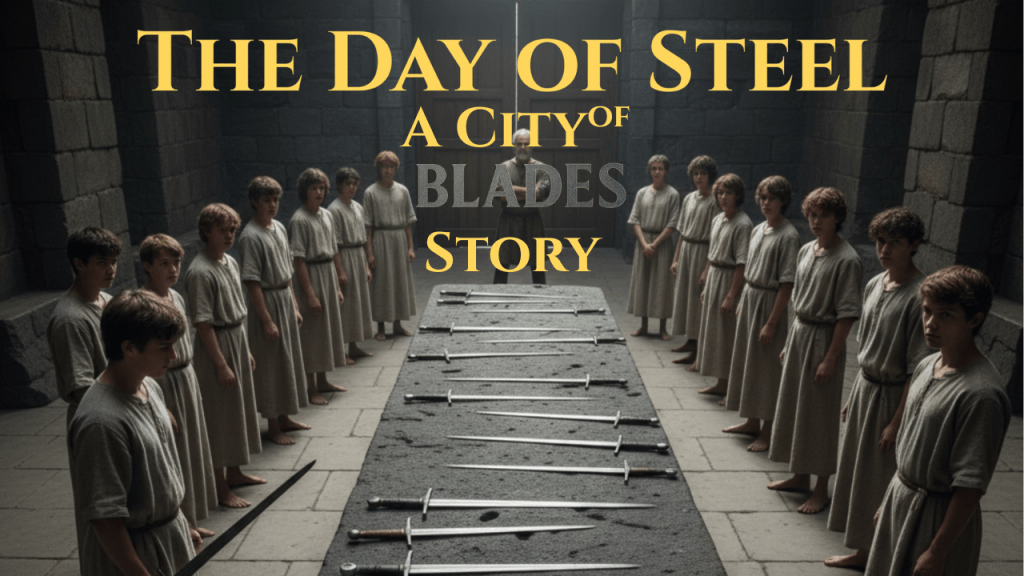
In the City of Blades, childhood did not end with celebration.
There was no feast, no speech, no marker cut into stone to remember the day. People woke, worked, argued, trained, and bled exactly as they had the day before.
Only those who had reached their sixteenth year were expected elsewhere.
The Hall stood just off one of the older thoroughfares, half-sunk into the bedrock. Most citizens passed it daily without looking. It was not impressive from the outside—thick doors, worn stone, no sigils or banners to draw the eye.
It did not need them.
Those approaching the Hall came without escort. Parents did not attend. Friends did not gather. This was not something meant to be witnessed.
Inside, the air was cool and dry, carrying the faint scent of oil and old metal. Sound behaved differently here. Footsteps echoed too long, then faded abruptly, as if swallowed.
The candidates entered together.
Bare feet on stone. Undyed robes that marked no district, no trade, no family. Some stood rigid, others restless. A few stared openly at the floor, following the familiar path worn smooth by centuries of crossings.
Every citizen of the City of Blades had stood here once.
No one spoke.
At the center of the Hall lay the table.
It was a single slab of dark stone, wide enough to require a conscious step to reach. Its surface bore scratches that were not decorative—marks left by steel set down without ceremony, by hands that had trembled or been careless or simply tired.
On the table lay the swords.
They were arranged with practical spacing, hilts aligned, points angled safely away from the edge. None were new. None were ornate. Each bore signs of maintenance and use: grips darkened by sweat, edges honed thin, guards worn smooth where thumbs had rested.
They were the City’s blades.
Not personal weapons. Not symbols of status. Tools entrusted to citizens who were no longer considered defenseless.
A single Master stood near the wall—not overseeing, not instructing. Merely present, as stone pillars were present.
When everyone had entered, the doors closed.
The sound was final but not dramatic.
The Master spoke.
“Today marks your first day carrying steel.”
No preamble. No explanation.
“In the City of Blades, this is not a privilege. It is an expectation.”
He paused, allowing the words to settle.
“You will approach the table when you are ready. You will take a sword. You will leave with it.”
That was all.
No order was imposed. No names were called. The City trusted habit more than authority.
After a moment—long enough to feel uncomfortable—someone stepped forward.
A boy from the outer districts. Broad-shouldered. Confident. He reached for a heavier blade without hesitation, lifted it, adjusted his grip with an instinctive movement learned through years of practice with weighted wood.
He nodded once, satisfied, and stepped away.
Others followed.
Some crossed the Hall quickly, as if eager to escape its quiet. Others slowed near the table, suddenly aware of the number of eyes—not watching, but present. The stillness made the smallest movement feel amplified.
Hands hovered.
Fingers curled, then withdrew.
A few candidates lifted a blade, felt the weight, and set it back down without embarrassment. This was expected. The City did not rush steel.
When it was Tarin’s turn, he realized his breathing had changed.
Shorter. Shallower.
He crossed the Hall deliberately, aware of the cold stone under his feet, the faint hum in his ears that came from standing in a place older than memory.
Up close, the swords seemed smaller than he’d imagined. Less heroic. More honest.
He reached for one almost out of reflex—and stopped.
He didn’t know why. Nothing was wrong with it. It simply didn’t feel like something he wanted beside him every day.
He tried another. This one pulled his wrist at an angle he didn’t like. He imagined training with it, correcting for it, compensating.
He set it down.
The third sword was plain. Shorter than some. Longer than others. Its grip was worn smooth, shaped by use rather than design.
When he lifted it, his body adjusted without conscious effort. His stance shifted. His shoulders relaxed.
Not because it was perfect.
Because it was workable.
He stood there longer than necessary, blade held low, feeling its weight—not imagining combat, not imagining glory, but imagining routine. Carrying it through crowded streets. Setting it beside his bed. Cleaning it after training.
Living with it.
That was when the realization came—not sudden, not dramatic.
This was not a moment of becoming something new.
It was the quiet acknowledgment that something had already changed.
Tarin stepped away from the table.
Around him, others were doing the same. Some held their swords carefully, unsure where to rest their hands. Others already moved as if the weight were familiar.
When the last blade was taken, the Master spoke again.
“You may go.”
No closing words. No instruction.
The doors opened.
Sound rushed back in—voices, metal, the endless motion of the City of Blades. The candidates paused briefly on the steps, blinking against the daylight, blades unfamiliar at their sides.
They were not warriors.
They had not been tested.
But they were no longer unarmed.
And in the City of Blades, that knowledge followed you everywhere.
 Maxfield Willow