Rian always chose the same bench.
Not the one under the departure board, with its flickering lights and cracked vinyl, and not the newer metal seats near the café, polished and practical. No, Rian chose the old wooden bench under the high arched window, where the plaster had cracked into faint riverways and the world outside blurred behind streaks of rain or frost.
It was the bench where they’d last sat together.
The station had changed in the years since—new kiosks, a different coffee place, digital screens where there had once been clacking boards—but that bench stayed. People hurried past it without looking, as if the peeling varnish made it invisible.
Rian suspected they came here for much the same reason.
The departure board hummed and shuffled. Announcements crackled overhead.
“Platform two, the 18:40 service, delayed by approximately—”
Rian tuned it out.
The ticket lay between their fingers, flimsy and already soft at the edges from years of being folded and unfolded. Same date. Same destination printed on the front. Same train that never actually came for them.
It was a ritual now. Every year, on this day, Rian bought the ticket and came to the bench and sat, as if time might apologize and rewind.
People flowed around them: commuters with tired shoulders, families juggling luggage and sticky hands, couples leaning in close and laughing into each other’s coats. A little pang tugged at Rian’s chest, familiar and dull. Envy, grief, habit—all tangled.
The station clock ticked on.
Outside, the evening pressed against the high windows, a heavy dark softened by the yellow halos of streetlights. Distant thunder muttered. The air smelled like wet stone and old coffee.
The anniversary storm, Rian thought. There had been one that night, too.
They closed their eyes, just for a moment, and the memory came as easily as breathing.
It had rained harder that night. The kind of sharp, stinging rain that made the streets shine like spilled ink. Leora had arrived late, hair soaked, curls plastered to her forehead, coat dripping on the station tiles.
“You look like a half-drowned cat,” Rian had teased, because that was easier than admitting how their hands shook with relief.
“And you,” Leora had answered, cheeks flushed, “look like someone who’s about to run away with a genius.”
“Arrogant, aren’t we?”
“Confident,” she’d said, grinning. “There’s a difference.”
They’d been leaving. Both of them. One suitcase each, passports and letters and a train that would take them to the city where Leora’s scholarship waited and Rian’s job offer held a door open. A different life, one not carved by the small-town expectations that had wrapped around them like vines.
One train. One chance. One shared seat on the future.
And then the announcement had crackled overhead. The words had seemed entirely disconnected, at first, like someone else’s bad news.
“All services east of Redbridge are suspended. Repeat, all services east of Redbridge are suspended due to—”
The rest blurred into static.
Emergency. Flooding. Tracks washed out. Bridges unsafe. The route was closed, indefinitely. No trains coming. No trains going.
Leora had stared up at the board, shoulders slowly curling inward as if the rain itself had pressed down.
“We’ll go tomorrow,” Rian had said quickly. “Or next week. It’s fine. We’ll get there.”
But Leora had already been shaking her head. “My deadline,” she’d whispered. “The scholarship. I have to check in on campus before the term starts or I lose it. The visa window…” Her eyes filled. “I needed this train, Rian.”
They’d gone home that night in a shared taxi that smelled of damp wool and frustration. The next day, all routes were still closed. Flights were cancelled. Roads washed out. Every path out seemed to snag on some impossible knot of timing and bureaucracy.
“Maybe it’s a sign,” Rian’s mother had said, too brightly. “Not everything is meant to be.”
Rian had bitten back a reply and walked away.
By the time the waters receded, the window had closed. The university’s email had been brisk and apologetic. The scholarship was gone.
Leora’s path had narrowed overnight. No city. No research program. No far-off lab filled with whiteboards and equations and the soft hum of machines. She stayed, because there were bills, and her father’s shop needed help, and the family was not rich in anything but stubbornness.
“It’s fine,” she’d said finally, weeks later, sitting on this same bench. “Really. It’s not your fault. It’s not anyone’s fault.”
But Rian had seen the crack in her voice, the way her fingers twisted her scarf.
Fate, the older women at the market called it. Bad luck. God’s will. A storm that chose the wrong night.
Whatever name it had, it had cleaved their shared path in two.
Years later, that split still echoed.
Rian opened their eyes. The station swam back into focus.
The ticket lay in their palm, accusingly blank.
They should stop coming here, they knew. Friends had said as much. Time to move on. Time to let go. Time, time, time—as if it were a thing you could simply set down like an old jacket.
But every year, when the air started to taste like wet autumn and the leaves skittered along the pavement like nervous mice, something in Rian pulled them back to the bench, to the maybe that had never happened.
I could have tried harder, they thought. Found a car. A bus. Called someone. Something.
They didn’t say it out loud—it felt too much like admitting guilt to a jury—but the thought stayed, a small, sharp stone in the shoe of their heart.
“Last call for the 18:12 service to—”
The announcements rolled on.
Rian rubbed their thumb along the edge of the ticket, then glanced around the station, not really seeing—
And paused.
There was a fox on the platform.
For a heartbeat, Rian assumed it was a dog. There were always a few animal stories about the station—strays, cats, that one pigeon that had learned to ride the train for crumbs. But this was no dog. It was too slender, too delicate, its ears pricked sharp and its tail a shifting arc of fur that looked almost like smoke.
It stood near the far pillar across the tracks, paws side by side on the yellow line. Dangerous, Rian thought automatically. Silly animal. The trains—
The thought died as the fox turned its head.
Its eyes caught the light and reflected gold, not the flat silver of animal eyes in headlights, but a deep, embered glow that made the hairs on Rian’s arms rise.
Something else glowed, too.
At the tip of the fox’s tail hung a small, golden lantern.
It shouldn’t have been possible; nothing should have been hanging there. But the lantern swayed gently as if caught in a wind that the station did not feel, casting a soft, warm light that pooled around the fox in a circle on the platform floor.
Rian blinked, sat up straighter, and then did the only reasonable thing: they looked around to see if anyone else had noticed.
No one had.
A woman scrolled on her phone near the coffee stand. A man argued with a ticket machine. Children bounced from tile to tile, invisible to the adults and, apparently, to whatever impossible creature stood across the tracks.
The fox watched Rian steadily.
Its lantern brightened, just a fraction, a deeper pulse of light.
Rian’s fingers tightened around the ticket. Their heart gave a short, startled kick.
They had never seen this fox before. And yet… there was something about it that made the word stranger feel wrong. As if they were looking at an old story they had once heard and half-forgotten, suddenly stepped out of the page.
The fox took a step forward.
Its paws did not clack on the tiled floor. They made no sound at all.
The lantern swung, and the light along the rails broke into long, soft lines.
“Okay,” Rian whispered under their breath. “Clearly I didn’t eat enough today.”
The fox tilted its head at them. Lantern-light slid across the bench, catching on the white rectangle of the ticket in Rian’s hand. For an instant, the text on the paper gleamed and shifted, as if the ink didn’t quite want to hold its shape.
Rian’s throat went dry.
“This is a dream,” they told themselves quietly. “Or I finally snapped.”
The fox, unconcerned with their assessment of mental health, stepped off the opposite platform and onto the tracks.
Rian’s breath caught. “Hey—!”
But the rails did not spark or bite. The fox walked between them as if the ground were just ground and not iron and gravel and danger. Lantern light spilled around its paws, washing the oil stains in honey-gold. For a moment, the rails themselves seemed less like metal and more like lines drawn on paper.
Right beneath the central crossing, where the two tracks briefly met, the fox paused.
The lantern bobbed up, warmth intensifying until the air shimmered.
With a soft sound like a candle being blown out in reverse, a third line appeared between the rails. A narrow path of stone where there had been nothing moments before, running straight across and under Rian’s bench.
The fox followed it, as if this had always been the most obvious thing to do.
By the time it stepped up onto Rian’s side of the tracks, the path looked as real as the station floor itself. The lantern’s glow dimmed again to a gentle steady light.
The fox padded right up to the edge of Rian’s boots and sat.
Close, Rian thought wildly. Too close. They could see individual hairs on its muzzle now, the slight damp at the tips from the evening air. The lantern at its tail gave off a warmth that was not quite heat; it felt more like the way a good memory felt when you wrapped your hands around it.
The fox looked up at them, eyes molten gold.
Rian realized they’d been holding their breath and let it out in a ragged laugh.
“Right,” they said hoarsely. “Of course. Magic fox. Lantern. Secret stone path. Why not.”
The fox’s ears flicked, as if amused.
It glanced pointedly at the hand clutching the ticket, then back to Rian’s face.
As gestures went, it was so human it hurt.
“You want my ticket?” Rian asked before they could stop themselves. “Sorry, I don’t think this train stops in fairyland.”
The fox did not dignify that with a reaction, but its gaze dropped again to the ticket. Then, slowly, it stood, turned, and trotted a few steps along the stone path that now led away from the bench and along the platform’s edge.
After a few strides, it paused and looked back, lantern swinging like an invitation.
Rian stared.
Somewhere above, an announcement droned about delays and apologies. A suitcase wheel rattled as someone hurried past. The everyday noises of the station washed over the moment like rain on wax paper, unable to properly soak in.
The path glowed faintly where the lantern’s light brushed it.
It did not exist a few minutes ago, Rian thought.
Neither did this fox.
Neither did…
They swallowed.
Leora would have followed, a small voice whispered in the back of their mind. Leora had always leaned toward the impossible with bright-eyed curiosity. What’s the worst that could happen? she would have said, laughing. We get a story out of it.
Rian had been the cautious one. The planner. The one who had double-checked tickets and scanned weather reports and believed that if they were careful enough, fate couldn’t get a proper grip.
They looked down at the ticket in their hand.
It crinkled faintly.
“All right,” Rian said softly. “One story, then.”
They stood.
The station did not so much as flicker. No music swelled. No one gasped. The fox simply waited, tail-lantern glowing, until Rian’s boots touched the first stone of the conjured path.
Warmth flowed up through the soles of their shoes, a pulse that matched the beat of their heart with uncanny precision.
Then, quite without ceremony, the world shifted.
It wasn’t a big shift. Not at first.
The station walls stayed where they were. The high arch of the ceiling held. The departure board continued to scroll names and numbers. But the colors… they deepened. The shadows between the pillars thickened and softened at once, like velvet instead of cold concrete.
The murmur of voices grew distant, as if someone had closed a door somewhere.
Rian glanced over their shoulder.
The bench where they had been sitting still stood beneath the cracked window. But the people were pale now, faintly translucent, movements slightly slowed, like reflections seen through moving water.
The fox flicked its tail and walked on.
Rian followed, heart pounding in their throat.
The stone path cut across the platform and slipped through a narrow service door that Rian was fairly certain had never been there before. It looked older than the rest of the station, its wood darkened by age and its brass handle worn dull by countless hands.
The lantern light pooled on the threshold.
The fox pushed it open with a practiced nudge of its shoulder.
On the other side, there was no maintenance corridor. No smell of cleaning supplies, no electrical hum.
There was a hallway.
Not a station hallway, either. Stone beneath Rian’s feet, worn smooth by time. Walls lined with niches where lanterns similar to the fox’s hung, unlit, waiting. The air tasted like old tea and the faintest hint of woodsmoke.
Rian hesitated.
The door behind them had already drifted shut. Its edges blurred, the way things seen just before waking blurred. When they laid their palm against it, the wood felt insubstantial, like pressing on the surface of a painting.
“You have got to be kidding me,” they muttered.
The fox, a few paces ahead, glanced back, eyes glowing in the dimness. It gave a small chuff. Not a bark, exactly. More like the sound of a log shifting in a fire.
Then it turned and padded on.
“I’m coming, I’m coming,” Rian said, and their voice echoed down the hallway, swallowed by its belly.
They followed.
Lanterns along the walls flickered to life as the fox passed, one by one. Their light was gentle, more like the glow of embers than the harshness of bulbs. As each lamp woke, the niches behind them seemed to deepen, showing brief impressions of doorways, windows, archways—
And scenes.
Rian slowed as the first one resolved into clarity.
Behind the hanging lantern: a street bench. Not this bench, but close enough. A different station, perhaps, or a park. A figure sat there, shoulders hunched, hands clasped, much like Rian themselves had sat countless times.
Leora.
Rian’s breath caught.
She looked just as she had on the night of the storm—hair damp and curling around her face, scarf twisted in nervous fingers, eyes fixed on a point far away. The glow of the lantern illuminated her profile.
“Leora,” Rian whispered, reaching out.
Their fingers met glass.
The niche was an alcove, not an opening. The scene behind it shimmered when Rian’s fingertips brushed it, like water disturbed by a pebble.
Leora did not look up.
Rian pressed their palm fully against the glass now, heart climbing into their throat. “Leora,” they said louder. “Leora, can you—”
The fox’s lantern light flared, drawing Rian’s gaze.
It stood a few paces ahead, watching them. Its eyes softened, gaze flicking between Rian and the alcove.
There was no accusation there. Only a quiet understanding. A reminder.
This is not a door, the fox’s posture seemed to say. Just a window.
A moment, distilled.
Rian swallowed hard and lifted their hand away.
“Okay,” they murmured. “All right.”
They kept walking.
Each lantern they passed lit up a different fragment. In one, Leora stood at a workbench, tools laid out neatly, her brows furrowed in concentration. In another, she laughed with a child on her shoulders, spinning in a circle. In another still, she argued animatedly with someone Rian didn’t recognize, gesturing with a pencil, whiteboards crowded with equations behind her.
Some scenes could never have happened. Not with the way their lives had gone.
Or maybe they were glimpses of the lives she’d wanted, branching paths that had never been.
Rian’s chest ached.
They wanted to stop at each lantern, to drink it in, to commit every impossible version of Leora to memory. At the same time, each alcove felt like pressing on a bruise.
The fox walked at a steady pace. It didn’t rush them, but it didn’t linger, either.
Rian followed, breathing in slowly through their nose and out through their mouth, the way they’d been taught in the kind of group where people said things like stages of grief and closure with kind eyes.
At last, the hallway opened into a broad, circular space.
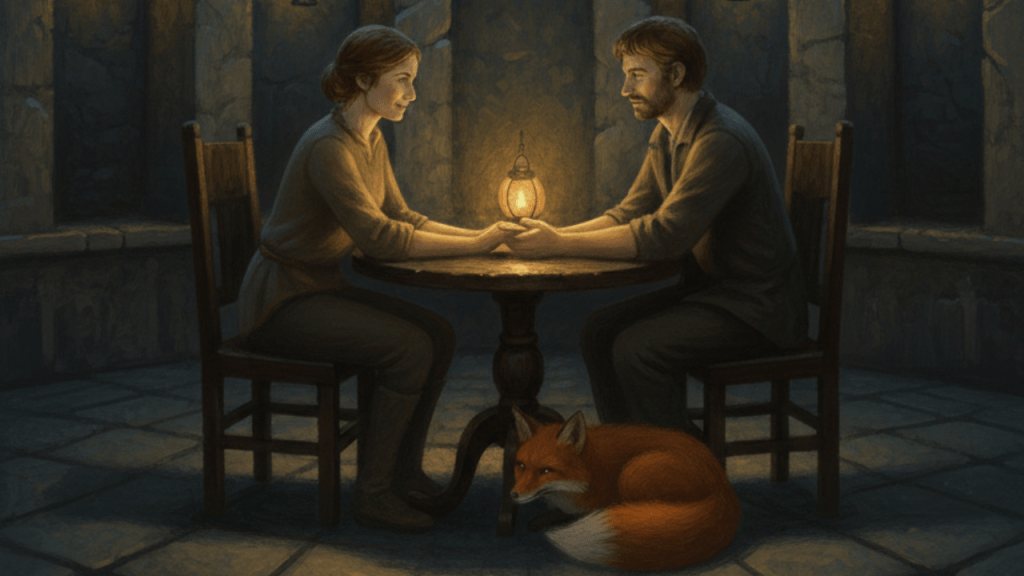
The ceiling was lost in shadow, beams arching overhead like the ribs of a great wooden ship. In the center of the room stood a single table and two chairs. One chair was empty.
The other held Leora.
Not a memory. Not a shadowy variant in a niche.
She sat with her elbows on the table, hands wrapped around a mug that sent up a faint ribbon of steam. The golden light from the fox’s lantern brushed the side of her face, picking out the tiny scar near her lip, the one she’d gotten trying to open a bottle with her teeth once.
She looked older than Rian remembered. Just a little. Lines at the corners of her eyes that hadn’t been there before. But her mouth was still soft, and her eyes—
Her eyes were fixed on Rian with a mix of wonder and something like apology.
Rian stopped dead. The stone path beneath their feet seemed to sway.
“Leora,” they breathed.
Her name tasted like honey and salt.
Leora smiled. It was a small thing, tremulous and genuine. “Hey,” she said quietly.
Her voice reached Rian as clearly as if she’d been standing next to them in the station, not… wherever this was.
“That’s not—” Rian shook their head. “You’re—this isn’t possible.”
“It’s not supposed to be,” Leora agreed. She glanced at the fox, who had settled near the table, tail-curled. The lantern’s light flickered, warm and steady. “But I’ve learned that ‘supposed to be’ doesn’t mean much here.”
“Here?” Rian echoed.
Leora looked around, taking in the vaulted ceiling, the ring of unlit lanterns overhead. In one shadowed corner, Rian thought they saw the faint outline of a sign, hanging crookedly as if not yet finished. Something about its shape stirred a memory they couldn’t quite place—of stories about a tavern at the edge of everything, a door that only opened for the lost.
“This is… somewhere between,” Leora said softly. “A waiting room. A crossroads. I don’t really have the right word. But he—” she nodded at the fox “—found me when I needed it most.”
Rian’s throat closed.
“When you…” They couldn’t say died.
Leora spared them having to. “When the river took the car,” she said gently. “When the bridge fell. I didn’t suffer. I promise.”
Images flickered unbidden: flooded roads, news reports, a bridge twisting like a broken rib. The phone call at 3 a.m. The numbness that followed, thick and choking and unreal.
“And you,” Leora added, eyes shining, “have been sitting on that bench for years.”
Rian flinched. “You saw?”
“Not every time.” A small, fond smile. “But enough.”
She gestured to the empty chair.
Rian’s legs carried them forward before their brain caught up. They sank into the seat, fingers wrapping around the edge of the table to stop their hands from shaking.
Up close, Leora was so vivid it hurt. The tiny freckle near her eye. The way her hair had always refused to be entirely tamed. The small crack in one front tooth from when she’d fallen off a bike at ten.
“What is this?” Rian whispered. “Some kind of… second chance?”
Leora’s gaze softened. “No,” she said, and the word was both knife and balm. “Not that. Our paths split that night, Rian. We don’t get that train back.”
Rian’s eyes blurred.
“But,” Leora continued, “we never got to say goodbye properly. The river took that too. And you’ve been carrying that… unfinishedness around so long it’s dug a groove in you.” She reached across the table.
Her fingers brushed Rian’s hand. Warm. Solid.
Rian’s breath hitched.
“So I asked,” Leora murmured. “I asked if I could see you, just once more. To tell you… it’s okay to step out of that groove.”
Rian shook their head, words tumbling.
“I should have done more. I should have pushed us to find another way out that night, or convinced you to leave earlier, or—”
“Rian.” Leora’s voice cut through the rising storm like a clear bell.
They fell silent.
Leora’s eyes held theirs, steady and kind and stubborn in the way they’d always been. “You can tie yourself in knots over what-ifs,” she said, “until you can’t move at all. But we didn’t control the storm. Or the bridge. Or how quick the river would rise. We were two people with suitcases and a shared dream. We did what we could with what we knew.”
Her thumb stroked over their knuckles, grounding.
“Fate didn’t punish us,” she said. “The world is just… messy. Sometimes cruel. But I don’t want your memory of me to be a chain that keeps you in that station.”
Rian blinked, tears spilling over.
“What do you want it to be?” they whispered.
Leora’s smile tilted. “A door,” she said. “That you can open when you need to, to remember that someone loved you fiercely once. Not a cage you sleep in every year.”
“Easy for you to say,” Rian muttered, trying for humor and failing.
Leora huffed a small, real laugh. “Oh, you think it’s easy for me? I had to watch you eat those terrible station sandwiches for three anniversaries before you switched cafés.”
Despite everything, a strangled chuckle escaped Rian.
“There it is,” Leora murmured. “I missed that.”
They sat in silence for a time, the kind that existed only between people who had shared too many mornings and late nights to count.
Rian found themselves tracing the grain of the tabletop. “Are you… happy?” they asked finally, hating how childish they sounded.
Leora’s gaze grew distant, soft. “It’s different here,” she said slowly. “Not happy like we imagined, not labs and shared flats and arguing over thermostat settings. But there is rest. There are stories. There are… other travelers.” Her eyes flicked toward that half-seen sign in the shadows again, the one that almost looked like a fox’s silhouette. “I’m not alone. And I’m not… stuck.”
She looked back at Rian.
“But you are,” she said gently. “Every year, sitting on that bench with your ticket to nowhere.”
“I don’t know how not to be,” Rian admitted, voice cracking. “Everyone says ‘let go’ like it’s just… opening your hand. But every time I try, it feels like I’m betraying you. Like I’m making peace with the universe killing you for being late to a train.”
Leora’s hand tightened on theirs.
“You’re not betraying me by living,” she said, each word deliberate. “You’d be betraying me if you didn’t.”
Rian’s vision blurred entirely.
“Hey,” Leora said softly, squeezing their fingers. “Remember what I said on that bench, when the scholarship email came?”
Rian sniffed. “You said a lot of things. Most of them rude about bureaucrats.”
“That too.” Her eyes crinkled. “But I also said… the world is bigger than one path.”
The words rose up from somewhere deep in Rian’s memory, worn smooth by time.
“‘If this one closed, we’ll find another,’” they murmured.
Leora nodded. “You still can,” she said. “I can’t walk it with you. Not in the way we planned. But I’d rather you walked it with someone, or someones, or even alone and curious, than kept circling that platform, waiting for a train that doesn’t go anywhere.”
Something in Rian’s chest, wound tight for years, gave a painful, trembling shudder.
“What if I forget you?” they whispered. “Not all at once, but… bit by bit. The way people fade. I’m already not sure if your scarf that night was blue or green.”
“Green,” Leora said, without hesitation. “The one your aunt said made me look ‘too clever for my own good.’”
Rian huffed a wet laugh.
“You’ll forget some things,” Leora said matter-of-factly. “That’s how minds make room. But the shape of us? The way we looked at each other when we thought no one noticed? That’s carved a groove in you that doesn’t vanish. It may soften. It may stop hurting every time you touch it. But it doesn’t erase.”
She leaned forward.
“And if you ever worry you’re forgetting too much,” she added, “you can just tell someone new about me. About us. That’s another kind of remembering.”
Rian closed their eyes.
A breath in. The faint scent of tea and woodsmoke. The warmth of Leora’s hand.
A breath out. The weight of years on that bench.
When they opened their eyes again, the fox was watching them steadily, tail-lantern glowing. In that golden light, they saw not just this room, but the echo of a hundred other spaces where someone sat with grief and a choice.
“What do I do?” Rian asked, voice small.
Leora smiled, and it was the smile she’d worn the first time she’d said I love you over a shared carton of cheap noodles.
“You stand up,” she said. “You walk back through that station. You throw away that ticket. And the next time someone asks if you’re free on this date, you say ‘yes’ instead of ‘sorry, I have plans with a ghost.’”
Rian snorted despite themselves.
Leora’s thumb brushed away a tear on their cheek. “You’re allowed to be happy again,” she whispered. “It doesn’t cancel what we were. It honors it.”
Rian nodded, because anything else would have dissolved them into pieces.
Leora squeezed their hand one last time and then, very gently, let go.
“Time’s weird here,” she said. “If you look back on that bench and it feels like it was only a blink… that’s okay.”
“Will I see you again?” Rian blurted.
Leora’s eyes softened. “That’s not for me to promise,” she said. “There are doors I don’t control. But if some fox with a lantern decides you need another nudge someday…” She glanced down, and the fox’s ears twitched in what might have been amusement. “Well. I won’t be far.”
Rian wanted to memorize her—the tilt of her head, the warmth in her eyes, the exact cadence of her voice. But the more they tried to hold on, the more the edges of the room seemed to glow, as if the light itself were gently nudging them toward the path.
The fox rose, lantern brightening.
“I love you,” Rian said, the words coming out in a rush, because there were never enough times to say them.
Leora’s smile was bright and sure and so utterly her that Rian felt something inside them go still, in the best way.
“I know,” she said. “Now go.”
The lantern’s light swelled.
Rian stepped back onto the station platform as if from a shallow pool, the air of the ordinary world closing around them with a rush of familiar sounds and smells.
The stone path under their feet faded, becoming once more just scuffed tile. The service door, when they glanced back, was nothing but a blank stretch of wall marked with an out-of-order vending machine.
People moved at normal speed. The announcements continued as if there had been no interruption at all.
“Platform three, the 18:40 service is now approaching—”
Rian stood there for a moment, swaying, like someone adjusting to solid ground after a long time at sea.
In their hand, the ticket crinkled.
They looked down.
The text was clear and solid again. Same date. Same destination.
But across the corner, in the tiniest handwriting, a new line had appeared. It was barely more than a suggestion, a shimmer of ink.
The world is bigger than one path.
Rian stared at it until their vision blurred.
When they looked up, the fox was standing in the middle of the platform, watching them. Its lantern glowed warm and steady.
“Thank you,” Rian whispered.
The fox dipped its head once, almost formally, then turned. As it walked, its lantern light dimmed, and with each step, it grew less substantial. By the time it reached the far pillar, it was little more than a streak of gold.
Then it was gone.
Just the station remained. Just the bench under the cracked window, the departure board, the commuters, the coffee smell.
Rian’s chest ached, but it was… different now. The pain had lost one of its sharpest edges, like a thorn sanded down. Beneath it, something else stirred—small and scared and stubborn.
They walked back to the bench.
Their body remembered the way, the steps worn in by years of repetition. But this time, they did not sit. They stood in front of it, looking down at the worn wood.
“Thank you too,” they murmured. “For holding me when I needed it.”
The bench, unsurprisingly, did not answer.
Rian took a breath.
Then, with hands that still shook a little, they walked to the nearest trash bin.
The ticket felt heavy. Heavier than paper had any right to be.
“This is going to feel awful,” they told Leora, wherever she was. “Just so you know.”
They smiled, a crooked, watery thing.
Then they dropped the ticket into the bin.
For a second, the tiny printed letters caught the light and shone. Then they vanished, buried beneath coffee cups and old wrappers. The world did not crack. No thunder rolled. No ghostly hand reached out to snatch the ticket back.
Rian’s heart, however, did something strange. It hurt, and then, like a joint finally slid back into place, it eased.
They stood there, hand still hovering over the bin, breathing.
“Okay,” they said softly. “All right.”
Their phone vibrated in their pocket.
They pulled it out, thumb swiping on autopilot, and saw a message near the top of their notifications. A friend from work, someone who had patiently invited them to trivia nights and movie marathons and small board game evenings for months, always met with the same: Sorry, that’s the night I visit the station.
Hey, no pressure, but we’re doing board games tonight if you’re free. We could really use your terrible geography knowledge on our team.
Rian stared at the message.
Then they typed, slowly, deliberately.
I’m free.
Where and when?
Three dots appeared almost immediately.
7pm at the café across from the station. You know the one. You sure?
Rian glanced at the bench one last time.
“Yeah,” they whispered.
Their fingers moved.
I’m sure. See you there.
They slid the phone back into their pocket and started toward the exit. The station doors hissed open, and the cool evening air rushed in, smelling of wet stone and a future that was, at last, not entirely shaped by absence.
Far above, clouds bruised the sky, but in a gap between them, a single star flickered.
If anyone had been looking closely, they might have sworn that, just for a heartbeat, its light shivered gold, like a lantern swinging at the tip of a fox’s tail.
Then it settled, quiet and constant, as someone stepped out of a long-held grief and onto a new, unwritten path.
 Maxfield Willow