Tag: Lantern Fox Tavern

  • Chapter 8 – The Soldier Who Wouldn’t Come Home

    Chapter 8 – The Soldier Who Wouldn’t Come Home

    The war had ended three months ago.

    That was what the posters said, anyway—peeling on brick walls, flapping on lamp posts, fluttering over the market like tired flags.

    Teren ran his fingers over one of them, tracing the bold letters announcing Peace Declared as if they belonged to someone else’s story.

    Behind him, the town breathed like a single vast creature. Laughter spilled from taverns and doorways, thin music threaded through the streets, and somewhere a drum beat slow and steady, calling people to celebration.

    Teren’s heart answered with a different rhythm entirely: too fast, then too slow. Like a soldier out of step with the rest of the line.

    He turned away from the poster and the noise. Away from the smell of roasting meat and spilled ale. Away from the steady, inevitable drum that reminded him of marching—of boots in mud, of shouted orders, of the hollow thump of bodies hitting the ground.

    He shoved his hands into his coat pockets and walked until cobblestones gave way to packed earth, and the lamps thinned and then vanished.

    He didn’t bother watching where he was going.

    He had already been lost for a very long time.


    The night at the edge of town was cold, and honest about it. No music, no laughter—just the rasp of dry grass, the creak of bare branches, the hiss of the river dragging itself over stones.

    Teren followed the sound of water. It had always helped, once. Long before the uniform. Long before the weight in his chest.

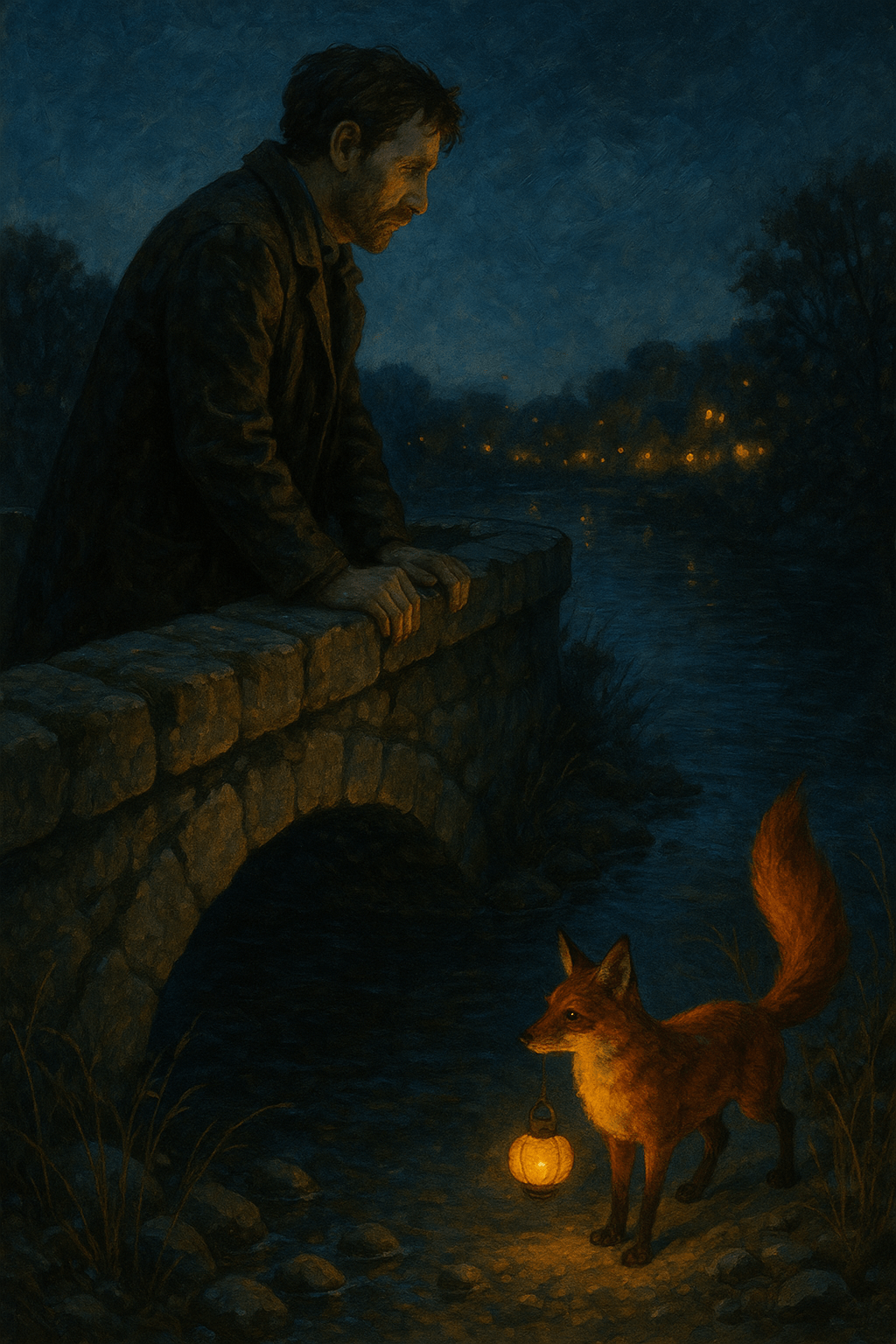
    He came to the old stone bridge, the one that arched over the Blackwater like a crooked spine. Moss grew between its blocks, and lichen shaved years from its surface.

    He leaned against the rough stone, listening to the river and to the faint drumbeat of celebration carried faintly from behind him.

    You should be there, he told himself. Your name’s on the wall. You came back. You’re one of the lucky ones.

    His jaw clenched until his teeth ached.

    “Lucky ones,” he whispered into the dark, the words bitter and small. “Tell that to Jorran.”

    The name landed between him and the river like a stone.

    Jorran’s laugh, Jorran’s hand on his shoulder, Jorran’s eyes turning surprised and then empty. Teren squeezed his eyes shut, but the images were etched on the inside of his eyelids. He could see them whether he wanted to or not.

    He had pulled so many men back behind the line. He had dragged bodies, living and dead, through mud and smoke. That was what he had been good at: hauling, carrying, enduring.

    Except that one time. The one that mattered.

    He pressed the heels of his hands into his eyes until colors sparked against the darkness.

    When he pulled his hands away, something else was there.

    A light—a small one—hung in the air a short distance down the riverbank. Not high like a lantern on a pole. Low, close to the ground, as if someone had dropped a candle and forgotten it.

    It flickered once, twice.

    Then it moved.

    Teren straightened, frowning. The light bobbed along the edge of the reeds, weaving between stones with a peculiar deliberate grace. It did not sway like something carried by a person. It glided, bright and steady, at the height of a child’s eyes.

    “…Hello?” he called, because habit and training had taught him to announce himself, even when he wanted to vanish.

    The light paused.

    Then it turned toward him.

    For a second, nothing else existed. Just the river’s hiss, the distant thud of celebratory drums, and that small, unwavering glow.

    It brightened, just a little, as if answering.

    Teren swallowed. He had seen strange things on the field—flares, tracer fire, the red bloom of artillery across the horizon—but none of them had ever made the air feel like this: sharp and thin, like a breath held too long.

    “Right,” he muttered to himself. “Either I’m tired enough to be seeing lights… or someone actually needs help.”

    The second thing hurt less than the first, so he chose it.

    He slid down the slope from the bridge, boots skidding on damp earth. The light retreated a pace, just enough to stay out of reach, then waited like a patient guide.

    “Fine,” Teren said under his breath. “Lead on, then.”

    The light bobbed once, as though it understood.

    And moved.


    At first he thought it was a lantern, suspended by some trick of wire. But as he drew nearer, he saw the shape behind it.

    A fox, no larger than any that skulked on the edge of fields—except for the way its fur caught the night, ember-bright along its back and cheeks, and the way its tail curved upward like a hook.

    From the tip of that tail, a lantern hung. Not iron and glass, but a globe of soft golden flame, contained and impossible, suspended without chain or handle.

    The creature watched him with eyes like polished amber. Its paws were silent on the earth. The lantern’s glow warmed his face, cutting the chill.

    Teren stopped, breath caught halfway.

    The fox tilted its head, studying him the way a scout studies a stranger at the edge of camp.

    “I’m… I’m not drunk,” Teren said to it, mostly to convince himself. “And I’m not asleep.”

    The fox blinked once, very slowly.

    Then it turned and trotted along the riverbank, pausing only when it realized he wasn’t yet moving.

    It looked back, lantern swaying gently. The light caught the deep lines etched into his face, the few silver threads starting at his temples, the tiredness pulling down his shoulders.

    “This is ridiculous,” he muttered.

    He followed.


    The river narrowed and deepened to his right, a black ribbon in the night. To his left, the land rose in uneven humps and tangled bushes, dotted with the skeletal remains of summer’s trees.

    The fox led him along a path he would have sworn wasn’t there whenever he’d walked this way by day. The ground underfoot was too smooth, the turns too natural, like worn stone in the threshold of an old doorway.

    The lantern’s glow chased the worst of the shadows away, but Teren’s mind filled them in easily enough.

    A figure slumped against a broken wall. The faint shape of a rifle. The echo of someone calling his name through smoke.

    He dragged in a breath. The air here smelled of damp earth and fallen leaves, tinged with something else—oak smoke, maybe, and the ghost of spilled ale. It prickled at the back of his memory in a way that made him more uneasy than comforted.

    “Where are you taking me?” he asked the fox, knowing he wouldn’t get an answer.

    He was right. No voice answered. The fox just kept moving, tail-lantern swaying side to side in a calm, patient arc, the light laying down a narrow line for him to walk.

    He realized after a while that he could no longer hear the town.

    No drums. No laughter. No music.

    Just the river, and the sound of his own breath, and the faint, soft click of the fox’s paws on stone.

    They crested a low rise, and the world spilled open.


    The clearing below them should not have been there.

    Teren knew this stretch of land. Or thought he did. By day it was nothing more than scrub and a few gnarled trees, good for nothing but giving children a place to dare each other to climb.

    Now, though—

    Now the clearing held ghosts.

    Not the translucent, whispering kind. These were made of memory and shape.

    He saw a field churned to mud, pitted with craters. He saw torn banners whipping in a wind he could not feel. He saw the silhouettes of men and women in armor and in patched jackets, some kneeling, some standing, all watching something near the center of the space.

    His own breath fogged in front of him. He could smell cordite, and blood, and wet wool. His stomach lurched.

    “No,” he said. “No. We don’t come back here. I did my time.”

    The fox’s lantern brightened, its glow widening until it brushed the edge of the vision below. The shapes sharpened. One of them moved in a way that hit Teren like a fist to the chest.

    Wide shoulders. Lopsided gait. The way the man pushed his hair back with two fingers when he was trying to think.

    Jorran.

    Teren’s throat closed.

    He stood frozen on the edge of the rise, watching his younger self—mud-streaked, eyes too wide—running toward the sound of gunfire, shouting Jorran’s name. Watching Jorran turn, relief breaking across his face.

    Then the sharp, bitter crack of a shot. The way Jorran’s body jerked, then folded like someone had cut his strings.

    Teren staggered back a step, fingers digging into his hair. It felt like the first time all over again. Weightless, stunned, unable to move fast enough as his memory-self dove for Jorran, hands pressing uselessly against the spreading red.

    “I know how this ends,” he rasped.

    The fox padded to his side, close enough that its fur brushed his trousers. The lantern swung forward, spilling warm light over the scene below, softening the edges of the worst of it.

    The vision did not stop. It played on—his frantic hands, the medics arriving too late, the wild, pointless scream he never remembered making until someone told him later.

    And then, as abruptly as a curtain falling, the sound dropped away.

    The figures in the clearing froze. Jorran lay still on the ground, eyes half-open, expression caught midway between surprise and something else.

    Teren realized he was breathing like he’d run a mile. His fingers hurt where nails dug into palms.

    The fox stepped forward.

    It did not speak. It did not explain.

    It simply walked down the slope, light steady, until it reached the still form of Jorran in the frozen memory. It circled once, twice, then looked up at Teren, lantern casting long shadows across the ground.

    Come, the gesture said. Not in words, but in the way its body angled, the way the light pooled in a path between them.

    He didn’t want to.

    He wanted to turn around, to walk back to the bridge, to pretend he had never seen any of this.

    But he had been running from this exact moment for so long that his legs knew the path without him. They remembered the feel of mud and blood and the weight of his friend’s body.

    He walked down into the clearing.

    With every step, the ghosts grew less solid, like they were made of mist. The sounds did not come back. Only the soft chime of the lantern flame and the whisper of dry grass against his boots.

    He reached Jorran’s side and dropped to his knees. His fingers hovered over the same place they had pressed once, long ago, trying to keep a heart beating that had already decided to stop.

    The body beneath his hand was not real. His palm passed through fog and left it unruffled.

    Teren’s chest hurt anyway.

    “I tried,” he said, voice cracking. “I tried. I swear to you, I—”

    He had said those words in his head so often that they had become a rhythm, a litany. They had never escaped his mouth before now.

    “I should have been faster. I should’ve pulled you back sooner. I should’ve seen the sniper. I should have—”

    The words tangled, choked. His shoulders shook.

    The fox sat, folding its legs neatly beneath it. The lantern swayed gently, casting a circle of gold that pushed the worst shadows further back.

    It watched him without judgment. Without pity. Just presence.

    Somewhere in the silence, the drumbeat from town tried to intrude, but it sounded very far away.

    After a long time, Teren scrubbed his face with the heel of his hand. His eyes felt raw. His ribs ached like he’d been in a fight.

    “I don’t know how to do this part,” he admitted, not sure who he was talking to. The fox. Jorran. The river. Himself. “They told us how to march. How to shoot. How to stitch a man up and send him back out. Nobody ever told us how to come home.”

    The fox’s lantern flared, then narrowed, as if breathing.

    Jorran’s frozen face softened very slightly, the rigid lines easing. Perhaps it was a trick of the light. Perhaps not.

    Teren reached out, hand shaking, and set his fingers lightly against the outline of his friend’s shoulder. The fog of the memory rippled under his touch.

    “I’m sorry,” he whispered. “You shouldn’t be here in my head like this, stuck on the worst day. You deserved better.”

    The words felt strange and heavy. As they left his mouth, the clearing seemed to exhale.

    The ghosts in the distance blurred further, dissolving into shadows that looked more like trees than soldiers. The churned mud smoothed into earth, dotted with hardy grass. The smell of smoke thinned, replaced by damp leaves and distant rain.

    Jorran’s outline shimmered.

    “Rest,” Teren said. His voice was steadier now. “You did your part. You can… you can stand down, all right? I’ll carry the rest.”

    Something loosened beneath his sternum, a knot he hadn’t known had a beginning.

    The figure at his feet dissolved like breath on a mirror.

    The clearing was just a clearing again.

    Teren sank back on his heels, chest rising and falling. The fox came to his side, brushing lightly against his arm. The lantern’s glow settled, no longer flaring bright, just a steady, warm presence at the edge of his vision.

    “Is this what you do?” he asked it quietly. “You drag people back through their nightmares and… sit with them until it hurts less?”

    The fox’s ears flicked. It tilted its head as if considering his question, then turned away, tail swinging.

    There was more to see.


    The path out of the clearing led upward, through thinner trees. The fox took a different route than the one they had used to enter; Teren was almost sure of it. The land didn’t match any map in his mind.

    They crested another hill, higher than the last. Here, the night sky opened fully above them, pierced by hard white stars. The river’s voice was faint now, distant but still loyal.

    At the top of the hill stood a single stone.

    It was not a grave marker, not exactly. No name had been carved into it. Moss clung to its base, and lichen painted pale sigils across its face. But there was a hollow in the earth before it, as if people had stood there before and wept, and their tears had worn a small depression into the ground.

    The fox padded to the stone and sat, lantern shining against its weathered surface. It looked back at Teren.

    He understood.

    “I don’t even have his tags,” he said, throat thick again. “They sent them to his family. I don’t… I don’t have anything of his.”

    Except memory, and guilt, and the way Jorran had made terrible jokes when everyone needed them most.

    He reached into his coat pocket anyway, more out of habit than hope. His fingers brushed something metal.

    He frowned, pulling it out.

    It wasn’t Jorran’s tags, no. But it was a small disc of dull steel, stamped with Teren’s own number and name. A spare he’d kept without thinking, because that was what soldiers did.

    He weighed it in his palm, the metal slick and cold with sweat.

    “You want me to leave this?” he asked the fox.

    The lantern’s glow brightened fractionally, catching the stamped letters, turning them momentarily gold.

    He snorted softly. “You’re very free with other people’s belongings, you know that?”

    Still, his feet carried him forward. He knelt before the stone. The earth there was softer than it should have been, welcoming.

    He turned the disc over once, thumb brushing his own name.

    Then he pressed it into the moss at the base of the stone.

    “For Jorran,” he said. “And for everyone else who stayed, when I didn’t.”

    It felt like confession. Like surrender. Like laying down a rifle he’d been carrying far too long.

    The fox rose and circled the stone, tail lantern tracing a slow ring of light around it. For a heartbeat, Teren saw other shapes at the stone’s base: bits of ribbon, a button, a feather, a child’s carved toy horse. Offerings from other people, on other nights.

    Then the image was gone, as if it had never been.

    The wind shifted.

    On that wind came music—not the rough tavern songs from town, but something lower and warmer. A fiddle, maybe, and the murmur of voices, and the clink of mugs on wood.

    Teren turned, heart stuttering.

    Far below the hill, where there should have been only trees and the far edge of town, a glow pulsed.

    It was not the sharp yellow of gas lamps or the thin blue of electric light. It was a deep, steady amber, like the heart of a fire that had been burning for a very long time.

    He could see the suggestion of a roofline, the faint outline of door and windows. Smoke rose from a chimney that faded into the stars. For a moment, he swore he saw a sign swinging above the doorway, catching the light in a way that suggested painted metal and old wood.

    He leaned forward, squinting.

    The details refused to resolve. Every time he thought he caught hold of them, they slid out of focus, like a half-remembered dream.

    He could hear laughter, though. Not the raucous, brittle kind. The rich, quiet sort people make when they are finally safe.

    His chest ached with a surprising, almost painful desire to be inside that light. To feel warmth at his back and a solid mug in his hands, and to sit with others who understood what it cost to keep standing.

    He took a step down the hill.

    The fox stepped gracefully in front of him, blocking the path.

    It didn’t growl. Didn’t bare its teeth.

    It simply looked up at him, lantern reflecting in its eyes, and shook its head—just once.

    Not yet.

    Teren swallowed.

    “Not for me, then?” he asked, voice rough.

    The fox blinked slowly. The distant glow pulsed, just for a heartbeat, as if in answer. The music curled around his ears, a promise more than a presence.

    Then, like a candle snuffed under a cupped hand, it vanished.

    The hillside below was only dark again. Trees and shadows. Ordinary night.

    Teren stood very still.

    The fox touched its nose lightly to his knuckles. The lantern’s warmth soaked into his skin, sinking up his arm, settling somewhere beneath his ribs.

    The place that had been all stone and ache was… not empty now. But different. Like a room where the furniture had been rearranged, and you weren’t entirely sure where everything stood, only that there was breathing space again.

    “Right,” he said after a moment, scrubbing at his face. “Right. I hear you.”

    He looked down at the stone one last time, at the disc half-hidden in the moss.

    “I’ll go home,” he promised Jorran, and the stone, and the quiet fox, and himself. “Properly, this time.”

    The fox’s lantern dipped in a small, solemn bow.


    The path back to the bridge felt shorter.

    They walked in silence. The night seemed to have softened—still cold, still wide, but less like a set of teeth waiting to close and more like a cloak settled around his shoulders.

    By the time the murmur of the town reached his ears again, the drumbeat no longer sounded like marching. It sounded like dancing. Like hearts finding a common rhythm, instead of grinding against each other.

    They reached the slope below the bridge. The stones were slick with river mist. Teren climbed up first, then turned back.

    The fox stood at the bottom, golden lantern reflected in the dark water.

    “Will I remember this?” Teren asked.

    He already knew the answer. He had heard stories, growing up—half-remembered tales told in winter about lights that led the lost through snowstorms and fog, about a fox with a lantern on its tail that guided people where they needed to go.

    Sometimes people said they dreamed it all later. Sometimes they swore they had simply walked, and walked, and walked, and found themselves exactly where they needed to be, with no memory of the in-between.

    The fox’s lantern dimmed slightly, its edges softening. The air around it shimmered.

    “Yeah,” he said. “All right. Maybe that’s for the best.”

    He hesitated, then added, “Thank you. For… sitting with me. For not making me do it alone.”

    The fox’s ears flicked. For an instant, the lantern brightened again, so bright it threw his shadow long across the bridge stones.

    Then the glow collapsed inward, like fire curling around itself.

    When his eyes cleared, the fox was gone.

    Only the ordinary night remained. The river. The bridge. The faint call of someone laughing, carried from town.

    Teren looked at his hand.

    His knuckles were warm, as if a small coal had been pressed there and then removed. When he closed his fist, the warmth settled deeper, a quiet ember inside his chest.

    He turned toward the town.

    The posters would still be on the walls. His name would still be on the plaque. The taverns would still be loud. People would clap him on the back and tell him he was a hero, and some part of him would still flinch.

    But for the first time since he’d stepped off the transport, he felt like the road ahead led somewhere other than back to that moment in the mud.

    He walked toward the lights.

    Behind him, unnoticed, a tiny glimmer flickered once at the edge of the trees—like a fox’s lantern, watching, waiting, ready for the next broken heart that needed help finding its way home.
  • Chapter 4 – The Scholar Who Forgot the Question

    Chapter 4 – The Scholar Who Forgot the Question

    Serin did not notice the sun had gone down again.

    The light in the tower study was always the same now: tired candles guttering in iron brackets, the faint amber glow of charmed globes long past their prime, the grey smear of evening through the narrow window slit. Day and night had blurred into one long, ink-stained hour.

    Pages covered the desk. Pages covered the chair beside the desk. Pages had colonized the floor, spilling in drifts around the legs of shelves that were themselves sagging under the weight of more pages.

    Serin stared at the latest sheet, the ink still damp.

    The Convergence of Liminal Topographies: A Taxonomy.

    It said nothing else. No text, no argument, no spark. Just another impressive-sounding title, written in neat, controlled hand.

    Serin set the quill down and realized, with a sudden hollow swing in their chest, that they did not know what they had meant to write under it.

    The word “Convergence” had once meant something exciting. It had tasted like thunder on their tongue, like the edge of a discovered map. Now it was just one more stone in a long wall of words they no longer believed.

    They dragged both hands over their face. Their fingers smelled of old ink and tallow.

    “What was the question?” Serin whispered to the empty room.

    The tower answered with creaks and the muffled sigh of the wind between stones.

    Somewhere above, a book shifted on a shelf with a soft scrape. Dust sifted down in lazy spirals.

    Serin ignored it. They forced their gaze back to the page and tried to drag up the thread of thought.

    Thin places. Crossroads that didn’t fit on maps. Doors that only opened once.

    They’d chased those ideas for years. Collected stories of vanishing roads and wayhouses that appeared only in storms. Interviewed travelers who swore they had drunk with strangers from other eras. Wound those accounts into theories fine enough to impress committees.

    In all that time, with all those treatises and lectures and citations, the feeling underneath—the aching, childlike certainty that there had to be a place where lost people could go and rest—had been buried under footnotes.

    “What did I want to know?” Serin asked the air, and this time their voice cracked.

    A candle near the window guttered, flared—then went out completely.

    The brief darkness that followed was deeper than it had any right to be.

    Serin blinked, waiting for their eyes to adjust. The other candles still burned, but their light felt narrow and thin, as if something just beyond the circle of illumination had thickened.

    Another sound from higher up in the room. A slow, grinding shift, as if a shelf that had not moved in years was suddenly reminded that gravity existed.

    Serin frowned and half-rose from the chair.

    “Not now,” they muttered, to the shelf or the tower or themselves, they weren’t sure. Fatigue hung from their limbs like chains. “Tomorrow. I’ll… I’ll fix it tomorrow.”

    Something fell.

    It was not the soft flutter of a single volume slipping from its place. It was the heavy, meaty thump of a book that had no business coming down from that height unless pushed by a determined hand.

    It landed near Serin’s boots, rebounded once, and lay splayed open on the floor.

    Serin stared at it for a few seconds, brain sluggish. Then they sighed.

    “All right,” they said, and pushed themselves to their feet.

    Their knees complained. Their spine popped. They shuffled around the desk, avoiding teetering stacks of paper with the unconscious grace of long practice.

    The book that had fallen was an ugly thing: a bound miscellany of old lectures and committee notes, thick with marginalia. Its spine was cracked, its corners chewed. It lay open on a page that held nothing but an ink blot and the faint, ghostly impression of erased writing.

    Beyond it, in the shadow beneath the nearest shelf, something watched Serin.

    At first they thought it was just the way the candlelight hit the darkness—two glints like coins or drops of dew. Then the glints blinked.

    Serin went very still.

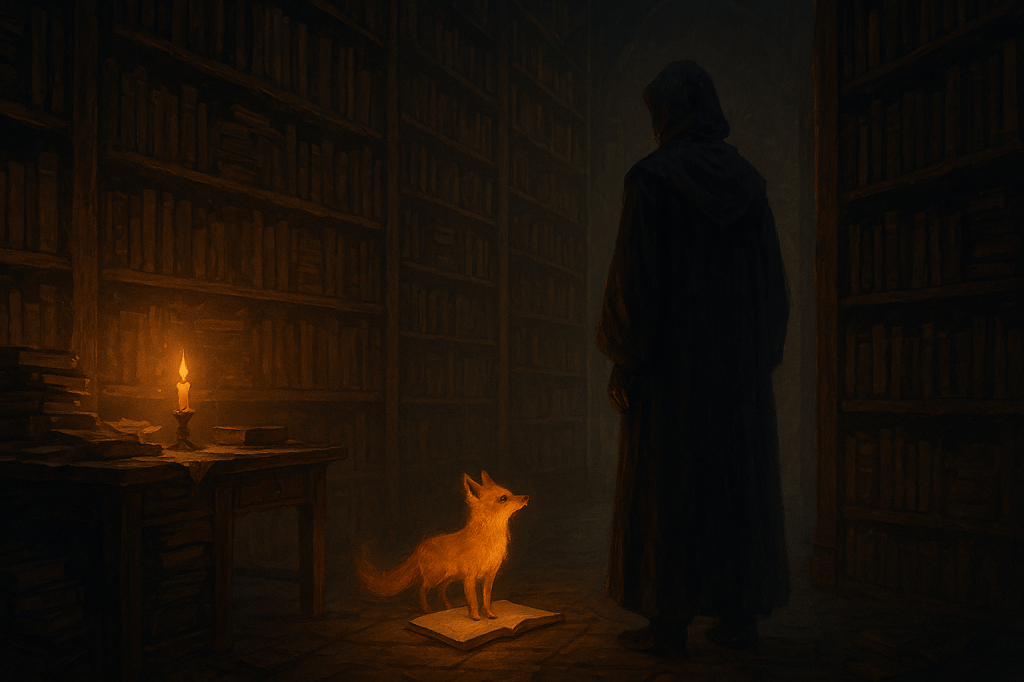
    From the deeper dark, a shape stepped forward: small, low to the ground, the size of a fox. Its fur was the color of autumn leaves and cinders, except that no fur should catch the light like that. It shimmered faintly, as if lit from within by a hidden lantern.

    Long ears pricked forward. A fine-boned muzzle, whiskers catching light in silver filaments. A tail, full and sleek, the tip glowing brighter than the rest, like a coal banked in ash.

    Serin’s breath hitched. Their mind went scrambling uselessly through catalogues of known spirits and illusions.

    The creature tilted its head. In the reflected candlelight of its eyes, Serin saw their desk: papers, abandoned quill, cold tea, and—jutting out from a precarious stack—a battered little notebook with a cracked leather cover.

    The fox’s gaze lingered on the notebook.

    It did not speak. It did not make a sound at all. Its tail tip brightened, just enough to draw Serin’s eye, then dimmed.

    Serin swallowed.

    “You shouldn’t be here,” they said, more to see what the creature would do than from any belief that it would listen. “This tower is warded. The library—”

    The fox stepped daintily over the fallen book, ignoring it completely. Its paws disturbed no dust. It walked right past Serin, crossing the floor with the casual, unhurried confidence of something that had been here before and would, with or without permission, be here again.

    It leapt lightly onto the chair beside the desk, then onto the desk itself, where it threaded its way between stacks of pages without so much as stirring a crumb.

    Serin’s heart pattered against their ribs. They followed on stiff legs.

    “Careful,” they blurted, as the creature passed near a tower of notes balanced on the edge of the inkstand. “Those are— I mean, I spent—”

    The fox ignored the warning. Of course it did. It had never asked to be included in Serin’s priorities.

    It reached the battered notebook and paused. For a moment, its outline blurred; the inner light pulsed gently, like someone cupping a lamp and then slowly revealing it again.

    Serin stood on the other side of the desk, pulse thudding, hands pressed flat to the wood as if to steady them.

    The fox lowered its head and nudged the notebook. Not enough to send it flying—just enough to shift it by a finger-width, to make it undeniably the center of the scene.

    Then it looked up at Serin.

    Those eyes were not human. They were too clear, too old. But in them Serin saw a reflection that hurt: a younger version of themselves, ink-smudged and bright-eyed, clutching that very notebook like a treasure.

    Serin let out a shaky breath and reached.

    The leather was dry and cracked under their fingers. The little tie strap broke as soon as they pulled, but the book opened willingly.

    The first page held a title written in an untidy hand that had never imagined a committee’s red ink:

    Questions No One Has Answered Yet.

    Serin’s throat tightened.

    The pages beyond were full of scrawls and sketches. No elegant structure, no polished thesis. Just bursts:

    • Why do the same stories appear in different lands?
    • Where do lost roads go when they vanish?
    • Is there a place where people who don’t fit anywhere else can rest?
    • A drawing of a tavern at a crossroads, lanterns hanging from its eaves, tiny foxes playing in the yard. Above the door, something like a signboard, left unfinished, as if the younger Serin hadn’t decided what to call it yet.

    The memory hit like sunlight through a long-shuttered window.

    They had been young when they wrote these. An apprentice in a drafty dormitory, half-frozen fingers gripping a cheap quill, staying up by contraband candlelight to record every question that wouldn’t leave them alone. The world had felt wide and strange, full of holes where impossible light leaked through.

    They had not been interested in tenure or reputation then. Only in finding that place—the one from the stories. The welcoming room between storms.

    Now they were here, in a tower filled with proofs and procedures, and they could not even remember why the word “Convergence” had once made their heart race.

    Serin’s eyes stung. They blinked hard, breath coming short.

    “You…” They looked up at the fox. “Did you bring this? Did you—”

    The fox had not moved. It sat with its front paws neatly together, tail wrapped around them, ears forward. The light inside it burned soft and steady.

    It blinked once, slowly. Then it turned its head toward the shelves.

    When Serin did not move, the fox hopped down, its paws silent on the desk, and—without knocking over a single page—leapt to the floor. It trotted toward the nearest aisle between towering bookcases, its glowing tail trailing a faint afterimage.

    At the threshold of the aisle, it looked back over its shoulder.

    Serin felt the invitation as clearly as if it had spoken.

    Their gaze flicked back to the notebook. They hesitated only a moment before tucking it into the inside pocket of their robe, close to their chest.

    Then, heart pounding in a way that had nothing to do with deadlines or appointments, they followed.

    The aisle between the shelves was not especially long. It had never been especially long.

    Now it stretched.

    The further Serin walked, the more the world narrowed to the smell of parchment and ink, to the soft gleam of fox-light ahead. The tower walls fell away; the ceiling climbed until the shelves vanished into shadow.

    They looked back once.

    The study was still there, a warm square of light and cluttered safety. But it seemed small now, like a painting on distant stone, not a place one could easily step back into.

    The fox trotted on.

    Shelves loomed higher. Some of the books here were familiar: monographs Serin had read or cited, treatises that had occupied whole seasons of their life. Others were strange, bound in materials they did not recognize, titles in scripts that pricked at the edges of their memory.

    They reached a junction where the aisle split in two.

    Without slowing, the fox veered left.

    Serin started after it—then stopped, struck by a peculiar detail on the right-hand path.

    There, row upon row, were identical books. Same color, same size, same stamped lettering on every spine. Only the titles shifted:

    The Convergence of Liminal Topographies: A Taxonomy.
    The Convergence of Liminal Topographies: A Reappraisal.
    The Convergence of Liminal Topographies: Collected Lectures.
    Supplemental Addenda to the Convergence of Liminal Topographies.

    And on, and on, and on.

    Each spine bore Serin’s name, growing larger with each new variant, while the subtitles shrank into cramped, illegible script.

    The nearest copy shuddered. Without any visible force, it slid from its place and fell at Serin’s feet, bouncing once on the floorboards that should have been stone.

    The cover snapped open.

    There was nothing inside.

    Blank pages, edge to edge. Not even a publisher’s mark.

    Serin felt sudden nausea. They backed away a step.

    The fox had paused at the corner, looking back. The light in its fur dimmed, as if they had turned down the wick of an unseen lamp. It stood there, watching, until Serin tore their gaze from the empty book and stumbled after it.

    The aisle twisted.

    They passed another run of shelves, these labeled in a script that seemed to shift whenever Serin tried to read it: Impact Metrics, Committee Minutes, Grant Justifications. The books here were heavy as bricks. Some bore chains instead of titles.

    Serin’s shoulders hunched.

    They had thought they were walking away from that burden.

    The fox’s path turned again, and suddenly the narrow corridor opened into a circular room Serin had never seen before.

    It should not have existed inside the tower. The dimensions were wrong; the proportions made their skin prickle.

    A round reading table stood in the middle, surrounded by shelves rising like the walls of a well. High above, no ceiling—just a dim haze.

    Six chairs ringed the table.

    Five of them were occupied.

    Serin froze on the threshold, breath catching in their throat.

    They were all Serin.

    Nearest on the left sat a child, legs too short to comfortably reach the floor, boots scuffed and ink on their nose. Their hair stuck up in an unruly mess; their eyes burned with a feverish brightness. The battered notebook lay open in front of them, half full of sketches of crossroads and a tavern under strange stars, its name left blank.

    Next to the child, an older apprentice version hunched over field notes, cloak still dusted with road grit, fingers tapping eagerly as if they could barely keep up with the stories spilling from their memory. A little wooden fox charm dangled from their belt.

    Beside them, a young scholar in fresh robes argued with someone invisible across the table, hands slicing the air, eyes hard with the sharp-edged certainty of the newly published.

    The fourth Serin was middle-aged, shoulders starting to stoop, ink stains ground into their cuffs, lips pressed thin. Letters of refusal and “regrets to inform” surrounded them like fallen leaves.

    The fifth was the one Serin recognized too well: present-day, hollow-eyed, a smear of candle soot on one cheek, staring at a blank page under a title that had lost its meaning.

    The sixth chair stood empty.

    The fox walked into the room, paws soundless on the floor. It hopped onto the table with an ease that paid no mind to the ghost-selves seated there.

    None of the other Serins looked up. They flickered, slightly transparent, like reflections in disturbed water.

    The fox moved slowly around the circle.

    It passed the older scholar, whose fingers trembled from too much coffee and too little sleep. The light under its fur dimmed as it went by, the air seeming to grow colder.

    When it reached the youngest Serin—the child with the notebook—it paused.

    The little Serin’s hand, holding a stub of a quill, hovered over the page. Their lips moved as they whispered words only they could hear. The notebook lay open to a drawing: a door with a lantern above it, and beside the door, the outline of a fox, hastily sketched but unmistakable.

    The fox lowered its head and touched the drawn fox with the tip of its nose.

    For a heartbeat, the ink lines glowed.

    The child Serin looked up, eyes wide. For the first time, one of the echoes saw something beyond its own memory. Their gaze met the real Serin standing in the doorway.

    Accusation. Longing. Disbelief. All of it flickered there at once.

    Serin’s chest felt too small.

    “I didn’t—” they rasped, though there was no breath to carry those words across time. “I just… I thought I had to… I had to make it respectable. Serious. No one listens if—”

    The child’s mouth moved. Their voice did not reach Serin’s ears, but the shape of the words did.

    Then why did you stop asking?

    The air shuddered.

    One by one, the other echoes blurred. The field scholar dissolved into a flurry of leaves, the ambitious lecturer into drifting pages, the middle-aged worrier into thin smoke. The present-day echo lingered longest, a hollow specter at the sixth chair, then folded inward and vanished.

    The chairs sat empty.

    Only the fox remained on the table, tail curled around its paws.

    It looked at Serin.

    For a long, ringing moment, nothing moved.

    Then the shelves around the room shifted.

    Labels seared themselves into being along their edges, changing even as Serin watched:

    Published Works became Proof I Deserve to Exist.

    Committee Decisions became Fear of Being Cast Out.

    Field Notes became Lives I Chose Not to Stay With.

    Questions became Why I Started.

    Serin swayed where they stood. The notebook in their pocket felt like it weighed as much as the tower.

    “I don’t want to be here anymore,” they whispered. “Not like this.”

    The fox stood.

    It padded to the edge of the table and leapt down, landing without a sound. As it walked toward Serin, its fur brightened, until the room seemed lit mostly by that inner glow. It brushed against Serin’s leg, the touch warm through the fabric of their robe.

    For the first time in years, Serin felt something inside them loosen. Not entirely—there were still knots, still grief—but something gave.

    The fox turned away and walked to the far side of the round room, where there had been only more shelves.

    Now there was a doorway.

    No—two.

    The first stood to the left: a stout, perfectly ordinary door of dark wood, brass handle polished by imaginary hands. Above it, neatly carved, was a plaque:

    TENURE & SECURITY.

    Behind its frosted panes Serin saw the suggestion of a tidy office: a desk, a window, the vague movement of people who would ask the same questions, year after year. Everything was softened, safe, slightly blurred, as if the world beyond were wrapped in cotton.

    The second “door” was nothing but a simple wooden frame standing alone. Beyond its threshold, there was no wall—only darkness pricked by a low, reddish light. The smell of woodsmoke drifted through, threaded with the savour of something cooking and the faint brightness of citrus and spice.

    Somewhere in that unseen space, voices rose and fell. Laughter here, a murmur there—never quite distinct, as if heard through a wall of rain or across a long, echoing hall. It felt like overhearing a life Serin had not yet lived, stories circling a place their research had tried to describe but never quite reached.

    The fox padded up to the plaque over the left-hand door.

    It stretched, set one delicate forepaw on the word SECURITY, and dragged its claws across the carved letters.

    They blackened at once. Cracked. Flaked away like burnt paper. The frosted glass behind them clouded, whatever lay beyond sinking into a dull, undifferentiated grey.

    The fox dropped back to the floor and shook its paw once, as if flicking away ash.

    Then it walked to the bare wooden frame and sat just inside the threshold, half its body swallowed by shadow, half outlined in that warm, unseen glow. Its tail-tip burned brighter, a small, steady star.

    Serin let out a breath that bordered on a laugh and a sob at once.

    “I’ve spent fifteen years chasing the safest answer to every question,” they said hoarsely. “And now you want me to walk into a door with no name.”

    The fox did not nod. It did not speak.

    It simply watched them and gave one slow, deliberate sweep of its tail against the frame, the gentle tap as clear as any answer.

    Serin slid a hand into their robe and drew out the battered little notebook.

    It felt smaller here. More honest.

    They flipped to the last blank page.

    The words came easier than they had on any title page in years:

    Proposal: To find the place where lost paths meet, and to listen.

    No methods. No committee-friendly phrasing. Just the old question, put back in its proper place.

    They tore the page out and folded it once, twice, until it fit neatly in their palm. Then they tucked it into their inner pocket alongside all the earlier, messier questions.

    The paper crinkled against their chest.

    “All right,” Serin whispered. “No plaque. No guarantees.”

    They stepped past the door marked TENURE & SECURITY without touching its handle.

    The closer they came to the empty frame, the clearer the other scents became: damp stone after rain; smoke curling from some great unseen hearth; yeast and spice; metal and leather; a faint bite of something like apple and something like pine. It smelled like stories. It smelled, absurdly, like the little drawing in the notebook had been trying to remember.

    On the very edge of the threshold, fear tightened around Serin’s ribs.

    “What if I’m nothing, out there?” they asked the space between. “What if all I am without these books is… no one at all?”

    The fox stood.

    It pressed its shoulder firmly against Serin’s leg, not pushing, only grounding. The warmth of it bled through fabric and skin. For a moment, Serin could feel its heartbeat—a quick, sure rhythm, utterly unconcerned with committees or titles.

    Then the fox stepped forward and passed through the frame.

    For a heartbeat, the light inside its fur flared, filling the doorway with a glow like lanterns seen through mist. Shadows of beams, tables, hanging shapes—bottles, charms, a signboard with some small fox-shaped emblem—sketched themselves in the brightness and vanished again before they resolved.

    Serin took a breath that tasted of smoke and unknown places, and followed.

    The tower, the shelves, the circular room, the safe door with its half-burnt plaque—they did not fall away so much as fold, like pages closing. For an instant, Serin walked between one step and the next, between inhale and exhale, balanced on the thin edge of choice.

    Their foot came down on something that was not the library floor.

    Stone, perhaps. Or worn wood. The surface was solid under their boot.

    Warmth washed over them. Voices swelled, still indistinct but closer now. Light—not the steady, sour light of study lamps, but something softer, alive with flicker and movement—pressed against their closed eyelids.

    Serin did not open their eyes yet.

    They rested a hand over the pocket where the folded page lay and, for the first time since they could remember, allowed themselves to stand in the not-knowing without flinching.

    The fox’s presence brushed against their awareness like the lift of a tail around their ankles. An invitation. A promise.

    Somewhere ahead, just beyond the reach of their senses, a room waited that countless stories had circled around but never quite named.

    “Where lost paths meet,” Serin murmured.

    The words slipped into the warm air and vanished.

    When they opened their eyes, whatever lay beyond the frame belonged to another story—and another chapter.

    Behind them, the tower of empty titles and forgotten questions was gone.

    Ahead, in the unseen place the fox had led them to, the next lost path was already on its way.

  • Chapter 2 – The Runaway Noble

    Chapter 2 – The Runaway Noble


    The first thing Elira of House Varn learned about running away was that silk was a terrible choice of travel clothing.

    By the time the city walls were a smudge of grey behind her, the embroidered hem of her gown looked as though it had narrowly survived a small, determined war with every bramble in the kingdom. Mud streaked up past her boots, her lungs burned, and her carefully pinned dark hair had given up and fallen into her eyes.

    It felt glorious.

    Wind rushed at her cheeks, tasting of rain and river stones instead of incense and old stone halls. Her heart hammered, not with the measured, polite dread she carried at court, but with wild, raw fear that didn’t bother pretending it was anything else.

    They’ll be after you already.

    The thought came with the memory of her father’s face—ashen, controlled, the way it always was when he was more angry than he dared show. There had been the letter sealed with golden wax, the crest of House Meron impressed too deeply, as if the signet carrier had leaned hard on purpose.

    An alliance. A marriage. A man she had never met, except in whispered rumors of how he crushed rebellions with the same calm hand with which he poured wine.

    “Duty,” her father had called it.

    “Prison,” Elira had answered, though only in the privacy of her own mind.

    So she had done the unforgivable thing.

    She had waited until the castle settled into its nighttime hush. She had donned riding boots beneath her gown, hidden a plain cloak under the formal mantle, and slipped from her chamber into passageways she knew better than the bloodlines of her own house.

    The stables had been easy. The stablemaster loved her; she’d tended the foals herself when she was younger. He’d questioned her only when she saddled a quieter, sturdier mare rather than her usual hot-tempered favorite.

    “Road’s poor,” she’d said, voice steady. “Going out to see the flood damage at the lower farms for Father.”

    He’d believed her. Or pretended to.

    Now, hours later, the mare was a dark, solid warmth beneath her, snorting clouds into the cooling air as they picked their way down a narrow game trail through the forest that clothed the foothills.

    Elira slowed to a walk and finally to a halt. She slid down from the saddle, legs trembling with the effort of keeping the horse at a run so long. The forest wrapped around her in shadowed greens and blacks, the last light of evening threading through branches.

    She tied the mare’s reins loosely to a low branch. The horse nudged her shoulder in quiet complaint.

    “I know,” Elira murmured, stroking the damp neck. “I’m tired too. But if we stay on the road they’ll catch us. We just need one night. Just one.”

    One night to get beyond her father’s reach. One night to become something other than a bargaining piece on a ledger.

    She’d thought it all through. She had coins sewn into the hem of her shift, a small knife strapped to her thigh, a bundle of dried meat and cheese tied behind the saddle. She’d memorized the map: two days’ ride through back ways to the river town of Brellin, where no one cared who you were if you paid, and from there… a boat, maybe. A job as a scribe. She was good with numbers, with words. She would find something.

    All she needed was time.

    The forest, however, did not seem particularly interested in her plans.

    Mist began to gather between the trees, a thin, pale veil that crept along the ground. The last light died more quickly than it should have. Elira frowned and tilted her head back.

    The sky had gone from bruised violet to a uniform slab of grey. Clouds had rolled in from nowhere, swallowing the last hint of stars.

    Of course. “Why would the world make this easy?” she muttered.

    Thunder grumbled, distant but moving closer.

    She untied the mare and led her deeper beneath the trees, hoping the canopy would blunt the worst of the rain. The path narrowed, then disappeared entirely. Roots grabbed at her boots, damp leaves slipped beneath her soles.

    “This is still fine,” she told herself. “You grew up riding the forest ring. You’ve snuck out more nights than anyone ever knew.”

    Except this forest wasn’t the well-groomed hunting preserve of her childhood. The trees here were older, their trunks thicker, bark furrowed like ancient faces. Moss draped from branches. The undergrowth was a tangle of thorns and ferns, unbothered by gardeners with pruning hooks.

    The first heavy drops fell a heartbeat later—thick, cold coins of water that splashed her face and soaked through her cloak. The mare shied, ears swiveling, eyes rolling white.

    “Easy,” Elira soothed, though her own heart lurched. The storm came down as if some unseen hand had upended a bucket over the world. Rain hammered on leaves, turned the ground to slick mud underfoot.

    Within moments, she was drenched. Her cloak clung, heavy and cold. Her carefully planned escape began to feel less like a daring story and more like the moment in a tale where the foolish noble is punished by the uncaring wild.

    Lightning split the sky, close enough to turn the forest silver-blue for a blinding instant. The mare squealed and jerked away, ripping the reins from Elira’s hand. Before she could grab them, the horse bolted, thrashing through wet undergrowth, hooves pounding away into the storm.

    “No!” Elira shouted. “Come back!”

    Her voice vanished in the roar of rain.

    She stumbled after, branches whipping at her face, mud sucking at her boots. In seconds, she could no longer see the mare—only the fading flares of movement between trees, then nothing at all.

    Elira stopped, chest heaving, hair plastered to her cheeks. Her thigh burned where a branch had raked it. The world around her had dissolved into shades of dark and darker, the shapes of trees blurring as rain sheeted down.

    The smart thing would have been to stop and think. To mark a tree, set a direction, remember where she’d been.

    Instead, she did what every terrified creature does when the world becomes too loud: she ran.

    Branches reached for her like fingers. Roots rose suddenly to catch her feet. Once, she slipped to one knee, palms slamming into cold, slick earth. She pushed herself up, cursing, and ran again.

    By the time the storm finally began to ease, the last of her frantic momentum died with it.

    She staggered into a small clearing and nearly went to her knees again. Instead she braced herself, hands on thighs, and tried to force her breathing into some kind of order.

    Silence fell slowly. The rain retreated to a whisper in the leaves. Water dripped from branches in a steady, mocking rhythm.

    Elira straightened, turning in a slow circle.

    The clearing was ringed with trees she didn’t recognize. That wasn’t particularly unusual; trees rarely introduced themselves. But nothing looked familiar. No trail. No hoofprints. No broken branches that might show where the mare had crashed through.

    Her stomach dropped in a way that had nothing to do with hunger.

    “You’re fine,” she told herself. The word sounded thin. “You’re not far from the road. You just… need to pick a direction and walk.”

    The problem was that every direction looked exactly the same.

    She picked one anyway. Pride could still be louder than fear, if you fed it well enough.

    For what might have been an hour—or five minutes, or three days; time warped strangely when one was drenched, cold, and stubborn—she pushed through undergrowth. The forest grew denser, not thinner. A fog crept in low, curling around her boots, rising slowly to her knees.

    At some point she realized she was shivering too hard to think properly. Her teeth clicked when she tried to clench her jaw. The knife at her thigh might as well have been a decoration. The coins sewn into her shift felt like stones dragging at her.

    Elira stopped walking because stopping was the only choice left.

    “This is ridiculous,” she whispered. Her voice sounded very small in the muffled forest. “I am Elira Varn, heir of—”

    Her throat closed around the words.

    Heir of a house she’d abandoned.

    Daughter of a man she had betrayed.

    Future wife of a man she refused to meet.

    The titles tangled in her mouth. Out here, none of them meant anything. The forest did not care whose ring she wore or whether her dowry could fund a war.

    Out here, she was just lost.

    “I did the right thing,” she said, more fiercely. “I won’t marry a man who crushes people like ants. I won’t be traded like grain. I won’t—”

    Her voice broke, not from conviction this time, but from the simple, crushing weight of exhaustion.

    What if you’ve only traded one prison for another? whispered a quieter thought. What if you die here and no one ever even knows where your bones lie?

    The idea slid through her like ice.

    Elira sank down with her back against a tree, knees drawn up, cloak dripping a dark pool around her. She pressed her forehead to her arms and let herself, for the first time since she’d left her chamber, admit the truth.

    She was lost.

    Not in the harmless way of a girl who took the wrong hallway in a castle she’d grown up in.

    Not in the romantic way of a noble who wanted to “find themselves” and had the money to get safely lost and safely found again.

    Truly lost, in a place that might never give her back.

    “Please,” she whispered, to no one in particular. “I need help. Impossible help.”

    She had never been much for prayer. The gods she’d been taught to honor had always felt distant and political, more interested in oaths and offerings than in scared girls in wet cloaks.

    Still, alone and shivering in the dark forest, she closed her eyes and let the words fall out anyway.

    “I don’t want to go back,” she said. “Not to them. Not to that life. But I don’t… I don’t know where to go instead. If anyone is listening—anyone at all—show me a path that isn’t a cage. Please.”

    Silence answered.

    For a long breath, two, three, the world held itself very still.

    Then, somewhere in the mist-veiled trees to her left, something flickered.

    Elira lifted her head, breath catching.

    At first she thought it was a trick of exhausted eyes—a remnant lightning flash, or the pale glow of fungus on old logs. But this light was warm, not cold; a steady, gentle amber, pulsing faintly as though it had a heartbeat.

    It floated at the edge of the fog, bobbing softly. As she watched, it moved closer, then paused, as if considering her.

    A lantern, she thought, before her mind had time to add any rational objections. Someone has a lantern.

    “Hello?” Her voice wobbled. “Is someone there?”

    The light brightened, then dimmed again, a slow exhale.

    Something stepped out of the fog.

    It was not a person.

    At least, not the kind she was used to.

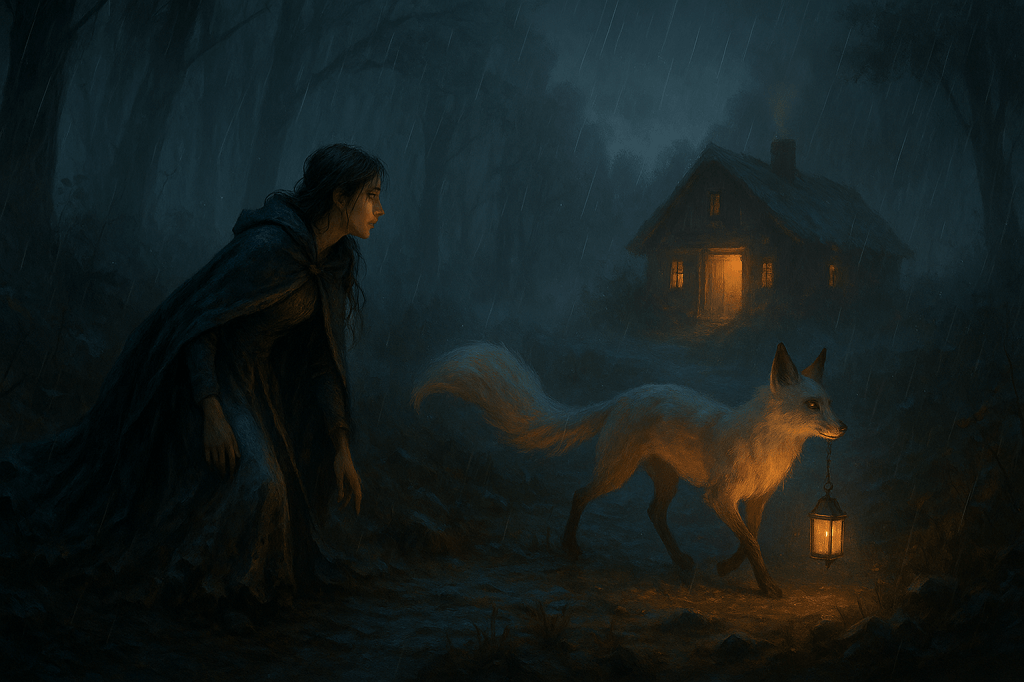
    A fox, she thought at first—about the size of a hound, with a long, bushy tail and narrow, clever face. Its fur was a pale, silvery white, tipped in ember-gold at the ears and paws, as if it had walked through the last light of sunset and carried it away with it.

    But no fox she had ever seen had eyes like that.

    They glowed—not with the cold, hard shine of a predator in the dark, but with the same soft amber as the light it carried. And carried it did, for dangling from the end of its tail, by a thin chain that seemed made only of light, was a small lantern.

    The lantern’s glow washed the fog in warm color. Its glass panes were etched with tiny, intricate runes that shifted when she tried to focus on them.

    Elira stared.

    The fox tilted its head, studying her in turn. Its tail swayed once, the lantern swinging gently. Then, without drama, it turned and padded away a few steps. After a moment, it stopped and looked back over its shoulder.

    “Of course I finally go mad out here,” she muttered. “Why not?”

    The fox waited.

    Elira pushed herself, creaking, to her feet. Everything hurt. She was cold enough that the thought of movement felt impossible—and yet the idea of sitting back down in the dark and letting herself slowly freeze felt worse.

    “Are you… real?” she asked.

    The fox blinked slowly, as if to say: real enough.

    Then it flicked its tail. The lantern chimed once like a tiny bell and flared brighter, casting a slender path of light between roots and stones.

    Elira hesitated only a heartbeat longer.

    “If this is a trap,” she told the fox, “I will be very irritated.”

    The fox’s ears twitched. Then it turned again and slipped into the trees, lantern dancing.

    She followed.

    The path it wove was not one she would have chosen. At times the ground dropped away into shallow ravines and they had to pick their way along slick, narrow ledges. At others, they waded through knee-high ferns that slapped damp fronds against her legs.

    Whenever she faltered, the fox would pause and look back, tail swaying in patient encouragement.

    And always, the lantern light stayed just bright enough to show what lay directly before her, and no more.

    “You couldn’t make it easier?” she complained, half to herself.

    The fox’s ears flicked again, as if in dry amusement.

    “Fine,” she muttered. “Teach the lost noble a lesson in humility. Very wise.”

    Despite herself, she felt the faint ember of a laugh somewhere deep in her chest. It was small, and easily smothered, but it was there.

    They walked for what felt like hours, though the forest around them slowly changed. The trees grew a little farther apart. The underbrush thinned. The bitter, icy edge of the storm wind softened, replaced by the earthy scent of wet soil and something else—smoke?

    Elira sniffed the air more sharply.

    Yes. Smoke. Not the wild, sprawling smoke of wildfire, but the straight, disciplined thread of a single chimney.

    Hope flared so suddenly it almost hurt.

    The fox veered slightly left. The mist ahead began to glow, not from the lantern’s light, but from a broader, softer brightness.

    They stepped out of the trees onto the edge of a narrow dirt road. Elira blinked against the change in space. The road ran left and right, rutted with wagon tracks, puddles reflecting the dim sky.

    Directly ahead, not fifty paces away, hunched a building.

    It was not big; no grand inn with painted signboard and stableyard. It was a cottage, really, squatting low against the wind, its slate roof patched in places. Smoke rose from a crooked chimney. Light leaked from shutters that didn’t quite close, and from the cracks around a heavy wooden door.

    The door itself bore no sign, no crest or mark.

    Yet as Elira looked at it, something in her bones answered with a sensation very like recognition.

    She had never seen this place before in her life.

    And yet… and yet.

    The fox padded to the center of the road and sat, tail curling gracefully around its paws. The lantern settled beside it, light steady.

    Elira stepped up beside the creature, staring at the cottage.

    “I… don’t understand,” she said quietly. “I thought there was nothing on this road for miles except—”

    Except, apparently, whatever this was.

    The fox looked up at her. For a moment, its gaze felt very old, older than the forest, older than the stones of her family’s hall. It wasn’t unkind. If anything, it held a sort of weary fondness, like a teacher watching a student finally grasp a simple truth.

    It dipped its head once, then flicked its tail. The lantern chimed again. The sound was soft, but it carried—straight to the cottage.

    The door opened.

    Warm light spilled out, honey-gold and inviting. A figure stood in the doorway—broad-shouldered, apron-smudged, hair pulled back. Elira could not see their face clearly at this distance, only the outline of someone solid and real.

    “Storm’s easing!” a voice called, rough with ordinary life rather than polished court. “If you’re out there, you’d best get inside before it thinks better of it.”

    Elira swallowed.

    Choice lay in front of her like a simple line.

    Back into the forest—into cold, and fear, and her own limited understanding of the world.

    Forward into something unknown that, at least for the moment, smelled of bread and fire and the soft murmur of other voices.

    She glanced down.

    The fox was already watching her. Lantern light painted its fur in shades of warm silver. The strange runes on the glass panes shifted again, rearranging themselves into patterns she could almost, but not quite, read.

    “Is this… for me?” she asked.

    The fox’s tail brushed her ankle, a brief, gentle touch. Then it rose in one fluid movement, trotted to the edge of the road, and, with a last backward look, vanished into the trees.

    The lantern remained.

    It did not fall.

    It hung in the air for a heartbeat, then swung slowly toward the cottage door, as if anchored to a path that wasn’t entirely in this world.

    Elira stood alone on the road.

    Alone, except for the echo of her own whispered plea in her ears.

    Show me a path that isn’t a cage.

    She took a step forward.

    The lantern bobbed ahead of her, lighting the way.

    By the time she reached the cottage, she was shaking again, but for a different reason. The figure in the doorway stepped back to let her pass, and as she crossed the threshold, warmth wrapped around her like an embrace.

    Behind her, though she didn’t see it, the lantern’s light flickered once, twice, then streamed in after her, tucking itself neatly into a hook on the beam above the door.

    Its glow settled, filling the small room with a gentle, steady light that had very little to do with oil or wick.

    Outside, the forest watched. The path she had taken was already fading, roots and leaves rearranging themselves over her footprints as though they had never been.

    Far between the trees, a pair of amber eyes blinked once, satisfied.

    The Lantern Fox turned and slipped away into the night, lantern swaying at its tail once more, searching for the next heart foolish and brave enough to ask for impossible help.

  • Chapter 1 – The Lost Path

    Chapter 1 – The Lost Path

    (A lost explorer)


    The first thing the explorer lost was the trail.


    The second thing was the map.


    The third thing, inconveniently, was the certainty that there had ever been a trail in the first place.


    He stood on the edge of a ravine that hadn’t been there ten minutes ago, boots grinding in pale dust that looked suspiciously like powdered marble. A moment ago there had been pine needles underfoot and the comfortable loam of a forest floor. Now the trees ended in a sharp line behind him, and ahead yawned a canyon of broken columns and carved stone, as if some ancient temple had been dropped from the sky and shattered on impact.


    “Okay,” he muttered. “That’s… new.”


    The explorer’s name—at least the one he used these days—was Rowan Cairn. “Rowan” fit on travel documents and didn’t make bureaucrats nervous. “Cairn” was a private joke; a pile of stones to mark where someone had been, or where someone had vanished.


    Rowan tightened the strap of his pack and checked his pockets for the seventeenth time. Compass. Multi-tool. Crumpled transit card from a city that no longer existed on any map. Phone with no signal, as usual in this place. No physical map, of course. Because the path had been “so obvious” at the start.


    He turned In a slow circle.


    Behind: a dense evergreen forest under a sky of bruised violet cloud, the air smelling of resin and cold. Ahead: a ruin-filled ravine that glowed faintly from within its fractures, as if the stone remembered fire. To the left, the forest broke and became city—tower blocks and alleyways jutting out at impossible angles, their windows lit with the warm gold of distant apartments. To the right, the trees thinned into steel ribs and gantries, the skeletal framework of a starship cradle under construction, cranes frozen mid-swing.


    It was alwayss like this here: borders soft as breath. Places rubbing up against each other like pages not quite aligned.


    “Right,” Rowan said. “You’re definitely lost.”


    His voice came out too loud in the strange quiet. No birdsong. No hum of traffic. Just the faint, glassy sound of the wind threading through broken pillars and antenna masts.


    He checked his phone anyway. No bars. The lock screen still displayed the last normal thing he remembered: a weather app promising “light showers” for a city that had slipped behind him hours—or days?—ago.


    The sky overhead wavered. For a heartbeat, the clouds were not clouds but carved ceiling panels painted with constellations; then they blinked back to stormy violet. A fine drizzle began, cold as disappointment.


    Rowan dragged in a breath, tasting rain and dust and a metallic tang like old coins.


    “I should’ve stayed with the survey team,” he said to no one. “Filled out expense reports. Complained about coffee. Died of boredom at forty-five.”


    The memory of the argument rose unbidden: the project lead saying Your job is to map new transit corridors, not wander into anomalies, and Rowan saying My job is to see where things could go.


    The anomaly had obliged by opening under his feet.


    He looked again at the ravine. There was a way down, technically—broken steps carved into fallen blocks, narrow ledges between splintered columns. It screamed “ancient curse” in every language.


    “Yeah, that’s a no,” Rowan said. “Forest it is.”


    He turned his back on the ravine and stepped toward the trees.


    On the second step the forest pulled away like a curtain.


    Rowan stumbled forward onto cobblestones. Streetlamps arched overhead, their bulbs glowing with a soft amber that was not electricity. The air smelled of wet stone and frying food, and somewhere a radio played a song he almost remembered.


    He froze.


    Behind him, the ravine. In front of him, a narrow street between tall, crooked houses of brick and timber. To the side, in the gap between a doorway and a drainpipe, something moved.


    Light flickered there—not quite flame, not quite glass. It drew itself into the shape of a fox.


    Rowan stared. The fox stared back with eyes like two tiny lanterns, steady and warm.


    Its body was a delicate tangle of light and shadow, its fur made of glowing threads as if someone had woven fireflies into the outline of an animal. Along its sides and tail, small panes of something like paper or glass shifted and clicked, each one etched with symbols that refused to resolve into any script Rowan recognized. The fox’s paws touched the ground without disturbing the damp, leaving no prints.


    “…Right,” Rowan said slowly. “This is new, even for you, Rowan.”


    The fox inclined its head, as if acknowledging the observation.


    “You’re not real,” he muttered. “I hit my head on the way down. Or up. Or sideways. Or—”


    The fox stepped fully out of the shadows, and its light pushed the drizzle back. Where the glow reached, the raindrops turned into tiny floating lanterns for an instant, drifting downward like seeds before winking out.


    Rowan swallowed.


    “Okay. Counterpoint: maybe you’re very real.”


    The fox blinked. One of its side-panels—no, not a panel, more like a hanging charm made of thin horn and translucent paper—flipped over with a soft click. On its surface, lines rearranged themselves until they made an image Rowan could read.


    It was a little drawing of a person standing at a crossroads, arms spread in helpless confusion.


    Rowan stared at the dangling charm. Then at himself. Then at the fox.


    “Rude,” he said. “Accurate, but rude.”


    The fox’s tail swished, scattering sparks of pale gold. Without further ceremony, it turned and trotted down the narrow street, lantern-light paws splashing through puddles that did not ripple.


    “Hey!” Rowan called. “Where do you think you’re—”


    The fox paused and glanced back.


    The warmth in its small bright eyes held no impatience, only a quiet expectation. It felt uncomfortably like the look his grandmother used to give him when he was young and staging ten separate rebellions at once: Have you finished being dramatic, or shall I put the kettle on first?


    “You’re a hallucination with attitude,” Rowan decided. “Fine. Lead on, ghost-lantern-fox-thing. I’m out of better ideas.”


    He followed.


    The street bent like a question mark, and with each curve the world changed. A few steps took him past a café whose sign was written in a language of dots and dashes of light; a few more, and he was walking beside a high hedge in which birds made of folded paper hopped and sang in soft rustles. The fox padded ahead, the glow from its body painting the stones in warm amber.


    “Any chance you know where ‘home’ is?” Rowan asked.


    The fox’s ear twitched. Another charm at its side flipped. This one showed a circle with a dot off-center, an arrow pointing away from the dot.


    “That’s not helpful,” Rowan grumbled. “You don’t even know what I mean by home, do you?”


    The fox did not reply. Of course it did not reply. Rowan kept talking anyway, because silence gave his thoughts too much room.


    “I mean, I had a home. Once. Just… kept moving. New cities. New contracts. New transit lines to chart. Figured if I mapped enough roads, eventually I’d find the one that felt like it was mine.”


    He sidestepped a puddle that reflected not the sky above, but a vaulted ceiling of stained glass. Colors rippled over his boots.


    “Or maybe I thought if I never stopped, I wouldn’t have to admit I was lost. Joke’s on me, I guess.”


    The fox slowed. The street opened into a wide square that belonged to no single time.


    On one side stood a subway entrance, its railings slick with rain, escalators frozen halfway up. On the opposite side rose the jagged bones of a starship hull under assembly, cranes locked mid-swing. Between them, a ring of standing stones shouldered up through the cobbles, each one carved with symbols worn almost smooth.


    In the center of the square, the ground dropped away into darkness—a perfectly circular pit, too round to be natural, too deep to see the bottom.


    The fox sat at the edge of it, lantern-eyes reflecting the void.


    Rowan stopped well back.


    “Nope,” he said. “Not a chance. I’ve played this game. That’s a bottomless metaphor pit if I’ve ever seen one.”


    Another charm on the fox’s side flipped. This time the drawing showed a tiny figure standing at the lip of a dark circle, a hesitant foot extended over the edge. Beside it, another little figure walked calmly around the circle instead, following a faint, dotted line.


    The fox tilted Its head toward the second figure, then looked up at Rowan.


    “So there’s a way around,” he said slowly. “And I get to choose whether to jump or take the long path.”


    The fox’s tail made a small approving flick. Sparks drifted off and circled the pit, sketching a faint bridge of light that arched from one side to the other before fading.


    Rowan exhaled, tension he hadn’t realized he was carrying loosening from his shoulders.


    “My entire life in three pictures from a walking lantern,” he muttered. “Great.”


    He circled the pit, giving it a wide berth. The fox padded along the rim, staying just ahead, never pushing, never falling behind. Just… there.


    After a while, Rowan said, quieter, “I walked away from a lot of things. Jobs. Cities. People. Every time the road forked, I picked the direction that kept me moving. I told myself that was bravery.”


    A charm turned, revealing a simple symbol: a heart with a tiny door drawn in its center, closed, laced with a comically large padlock.


    Rowan winced. “Okay, now you’re just being mean.”


    The fox gave what might have been a tiny snort. Its light brightened for a heartbeat, then softened again.


    They reached the far side of the square. The pit ended; the cobblestones became compressed dirt, then gravel. Ahead, rows of metal rails spread like fingers, leading into a mist where station platforms, ship berths, and forest paths all seemed to knot together.


    It looked like a place between departures.


    The fox halted.


    “Is this it?” Rowan asked.


    Several charms flipped at once, clicking like distant windchimes.


    On one: a train, stylized and simple, its windows glowing.


    On another: a path vanishing between trees.


    On a third: a narrow alley with hanging lights and something that might’ve been a wooden sign in the shape of a tankard.


    The fourth charm was blank.


    Rowan frowned. “You’re saying…?”


    The fox shook itself, and all the charms settled. Then one, and only one—the blank one—slowly inked over with fresh lines. They curled and curved, resolving into something like a doorway outlined in light, standing alone in empty space.


    Not a command. An invitation.


    Rowan’s throat tightened.


    “No more maps,” he said softly. “No more someone else’s routes. You’re not here to show me where to go. Just that… there is a way. That I can pick it.”


    The fox’s eyes warmed like coals in a hearth. Its head dipped once, solemn as a bow.


    Rowan looked out over the rails and paths.


    On the tracks to the left, a sleek train waited, doors open. Through its windows, he saw a city of neon and wet asphalt, the kind of place where you could disappear into crowds and late-night diners and never be asked where you’d come from.


    Down the forest path, he glimpsed cabins and lanterns, the glow of fires, and the sound—faint but real—of laughter and clinking cups. The air from that direction smelled of pine and roasting meat.


    The alley with the hanging lights promised cramped tables, handwritten notes pinned to walls, old stories told over new drinks. The wooden sign in the shape of a tankard swung gently, though no wind moved.


    Something in his chest twisted toward that alley, quick and fierce. A place of pause. A place between.


    His hand went to his chest, as if to physically steady the sudden ache.


    “How far ahead are you playing this game?” he asked the fox.


    The lantern-fox did not answer. Instead, it stepped close enough that its light touched Rowan’s boots and jacket, warm and steady. Up close, he saw that the “fur” was not fur at all, but hundreds of tiny lanterns, some lit, some dark, each containing a fragment of image: doorways, bridges, faces, cups, keys.


    Not futures, exactly. Possibilities.


    “I don’t know if I can ever go back,” Rowan whispered, surprising himself with the admission. “To the old work. The old cities. The old me.”


    The fox’s tail brushed his calf, a touch like the edge of a candle-flame—there and gone, not burning, just reminding.


    A new charm flipped. On it was drawn a figure walking forward, leaving behind a tangled scribble, stepping toward a horizon that curved slightly like the spine of a book.


    Rowan laughed, the sound half a hiccup. “You’re really committed to the bit, huh?”


    He hesitated one last time. Then he faced the crossing of paths, the knot of tracks, the invitation of worlds.


    “I’ll find it,” he said. “A place that feels… not just like a waypoint. Not just a pit stop between assignments. A place to arrive. Even if I haven’t seen it yet.”


    The fox’s eyes brightened. Every lit lantern along its body pulsed in agreement, like a soft chorus of yes.


    Rowan took a step forward.


    The world shivered.


    For a heartbeat, all the paths overlapped—the train, the forest, the alley, starship gantries and old roads and something that looked like a tavern door carved with a fox and a lantern crossed together. Warm light spilled from that door, voices rising in welcome, the scent of spiced cider and woodsmoke curling out like an embrace.


    Rowan’s heart reached for it with a longing so sharp it was almost pain.


    Then the vision blurred. The tavern door dimmed and slid sideways, becoming just another maybe, one of a thousand lanterns that hadn’t yet been lit.


    “Not yet,” he breathed.


    Not yet. But someday.


    He chose a direction—not at random, not in reaction, but because something quiet inside him leaned that way and did not flinch.


    As his boot came down on the gravel, the path steadied. The mist thinned. Ahead, the way unrolled, uncharted but walkable.


    Rowan did not look back.


    If he had, he would have seen the lantern-fox watching from the edge of the crossing, its charms folding flat, its tiny images dimming one by one. He would have seen the fox lift its head toward the unseen tavern-that-wasn’t-yet, as if checking a lantern on an invisible hook. He would have heard, perhaps, the soft chiming laugh that wasn’t sound at all but the shimmer of a promise made to no one and to everyone:


    I will find the lost. I will guide the weary. When the door is built, they will already know the way.


    But Rowan only felt a warmth at his back, like a hand resting there in blessing. It faded slowly as he walked, leaving behind something steadier: a thread of courage stitched where fear had been.


    The drizzle eased. The sky brightened to a cool, clear twilight in which no one clock held authority. Ahead, a signpost appeared where none had been, its arrows blank, waiting.


    Rowan smiled.


    “Fine,” he said. “We’ll write the map as we go.”

      He adjusted his pack and walked on into the place between worlds, the echo of lantern-light still glowing faintly at his heels