(The Lost Path)
By the time anyone realized Eli was missing, the fairground had already become another world.
Daylight drained out of the sky in streaks of pink and copper, and all the coloured lights along the booths seemed too bright, too loud, as if someone had turned the whole evening up a notch. Voices blurred into a single rolling roar. Music from three different rides tangled into something that wasn’t quite a song.
Eli stood in the middle of it, small and alone, clutching the crumpled corner of a map he’d been so proud to carry.
“Stay by us,” Mum had said.
“Don’t wander off,” Dad had added.
And he hadn’t meant to. He’d only stepped aside to see the wooden dragon on the carousel up close, just for a second, because its emerald eye had seemed to be looking right at him. Then the crowd surged, somebody bumped his shoulder, and when he turned around his parents were gone.
Not “a few steps away, scanning the crowd.”
Not “right there if he just pushed through.”
Gone.
He tried to do what they’d told him. Go back to where you last saw us. Stay put and we’ll come find you.
Except “where he’d last seen them” no longer existed.
The booth with the stuffed bears was now selling glass stars. The truck with the hot chocolate had somehow become a tiny stage where a magician pulled scarves from nowhere. Even the path under his shoes looked wrong, the gravel crunching into something finer, smoother, more like the pressed stone of an old street.
His heart thudded in his ears.
“Dad?” he called, voice swallowed by the fair. “Mum?”
No answer. Just the cheer from a ride spinning somewhere out of sight, and the distant crack of fireworks test-firing.
He swallowed the hot knot in his throat. He was nine, almost ten. Too old to cry about getting separated. Too old to be scared of the dark that was rolling in like a slow wave over the horizon.
The map in his hand fluttered. He looked down at it, hoping for a miracle.
The bright lines of rides and food trucks and exits had smudged. The little icon of a smiling fox advertising “Funnel Cakes!” had stretched impossibly long, its tail curling around the edge of the paper like it was trying to slip away.
He blinked hard.
The fox lifted its head.
Not on the paper. In front of him.
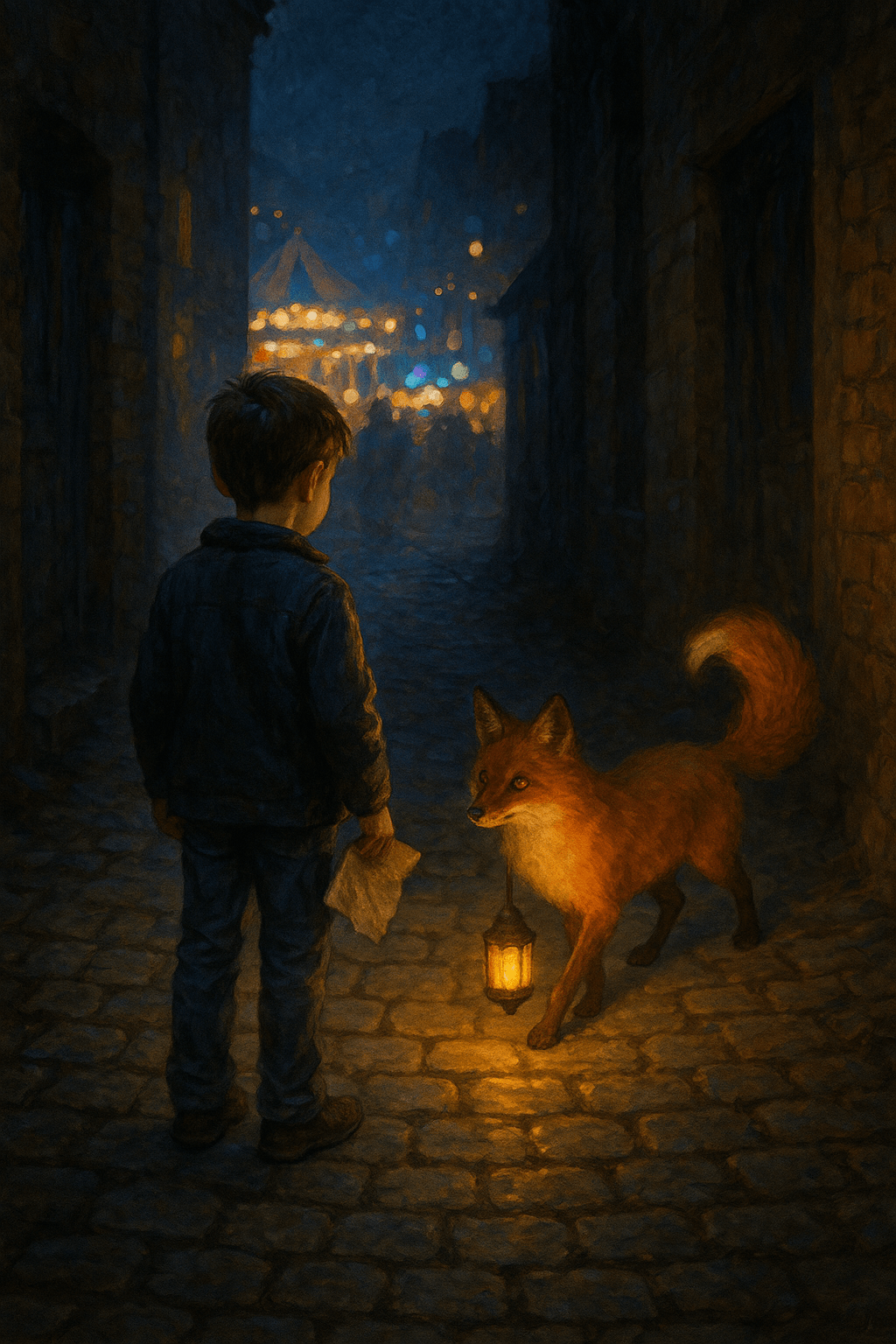
Lantern-light bloomed where there had been nothing a heartbeat ago. A small shape stepped out of a crack between two stalls that shouldn’t have been large enough for anything bigger than a cat.
The fox’s fur was the colour of embers at midnight, dark at the roots, burning brighter toward the tips. Its eyes were molten amber, reflecting the fairground lights and something deeper beneath. A lantern hung from its tail, light swaying gently, casting little ripples of gold across the gravel.
Eli forgot how to breathe for a moment.
The fox tilted its head, studying him. No one else seemed to notice it. People drifted past, laughing, brushing close enough that Eli had to edge aside, but no one glanced down at the glowing creature at his feet.
“Hey,” he whispered, because it felt wrong to raise his voice. “Are you—are you real?”
The fox didn’t answer. It simply stepped closer until the lantern light wrapped around Eli’s shoes and soaked into his jeans and skin, warm as a hand around his fingers.
The panic loosened its grip on his chest, just a little.
A soft gust of warm air rustled his hair, smelling faintly of woodsmoke and something sweet, like toasted sugar. For a moment he could hear—beneath the roar of the fair—another sound entirely: low conversation, clink of mugs, the murmur of a hearth.
Then it was gone, as if someone had turned down a volume slider inside his head.
The lantern fox turned away and trotted a few steps, then glanced back over its shoulder. The lantern on its tail swung, a gentle beckoning.
Eli looked over his shoulder, in case some sensible grown-up had appeared to take charge.
No one.
He was lost. The exits kept moving. The map had turned strange.
And yet… he wasn’t alone.
He took a careful step toward the fox.
It waited.
Another step. Another. The fairground around them seemed to blur at the edges, booths stretching a little taller, lights smearing into long streaks of colour. Each step away from where he’d been felt like walking off the edge of something familiar and into a picture book you weren’t supposed to fall into.
“Where are we going?” he muttered.
The fox’s ears twitched. It didn’t speak, but the lantern flared a fraction brighter, as if answering: Somewhere you need to be, not somewhere you expect.
They slipped between two stalls that had not been there a moment before: one selling glass bottles that glowed softly from inside, the other hung with wind chimes that made no sound. People moved past like shadows, a little slower now, a little less distinct.
Eli realized the noise had changed. The roar of the fair had softened, receding like tidewater. He could hear his own breathing again, and the faint pad of the fox’s paws.
Ahead, the chaos of booths and rides thinned. A narrow lane appeared, cobbled stones pressed into the earth, running away into the deepening dusk. Old brick walls rose on either side, patched and mismatched, doors tucked between them where no doors should have been.
This wasn’t part of the fairground. This wasn’t part of his town at all.
He stopped. “This… this isn’t right.”
The fox stopped too, turning back toward him. For the first time, it closed the distance between them completely and pressed its forehead lightly against his knee.
Heat poured through the fabric of his jeans, spreading up into his chest. Not burning, but a deep, steady warmth that seemed to push out the cold knot of fear. Images flickered at the edges of his thoughts: a little boy at a different crossroads, a woman on a ship staring at too many stars, a man in a forest with no path… all of them wrapped in the same lantern glow.
Then, clearer than any of those, he saw his mother’s face as she’d looked at him earlier that day when he’d made a joke about “getting lost on purpose so no one could make him do chores.” She’d laughed, but her eyes had softened in that way they did when she was worried and trying not to show it.
“Never on purpose,” she’d said, ruffling his hair. “You belong with us, you hear? If you ever feel lost, you yell loud enough for me to find you.”
Eli’s throat tightened again, but now it wasn’t only fear; something else tangled there too. Regret. The sudden sharp knowledge that he had wished, just a little, to disappear. To step sideways from all the bickering and noise and rules.
The fox leaned back, watching him.
“I didn’t really mean it,” he whispered. “I don’t want to vanish. I just… I don’t like it when they fight. Or when they’re tired and forget I’m there.”
The lantern’s light shifted, shadows tucking themselves neatly away, as if the world were listening politely. The fox turned and padded down the lane.
This time, Eli followed without hesitation.
The further they went, the more the air changed. The sharp scent of frying food faded, replaced by cool stone and distant rain, even though the sky above remained clear. The cobbles under his shoes were damp and old, moss peeking between them. The buildings on either side leaned inward like they were listening in.
Doors lined the alley. Some were plain wood. Others had carvings: waves, leaves, stars, symbols Eli couldn’t name. A few were cracked open, warm light seeping through.
They passed one doorway where voices murmured, fragments of words curling out into the lane.
“…thought I’d lost it all, but then…”
“…found my way back…”
“…a lantern, like a fox’s tail, of all things…”
Eli slowed, peering through the thin gap. For a heartbeat he saw a room that could have been in any storybook tavern: low beams, a stone hearth with fire painting the room in amber, people in travelling cloaks and modern jackets both, gathered around chipped mugs. A sign hung over the hearth, emblazoned with the stylized outline of a fox wrapped around a lantern.
His heart gave a little jump of recognition, though he couldn’t have said why.
The fox brushed against his leg, drawing him on. When he looked back at the doorway, the crack had closed. The sign over the hearth was gone, as if it had never been.
“Was that… a pub?” he asked, reflexively. “Like in old movies?”
The fox didn’t answer, but the lantern’s glow shivered with something like amusement.
They walked on until the alley opened up into a small square.
It wasn’t big—more like the space in the middle of four old houses that had agreed to share a backyard. A dry fountain stood at its center, stone basin carved with little foxes chasing one another’s tails. The world beyond the square was a haze, as if someone had forgotten to finish painting it.
The lantern fox padded to the fountain and hopped gracefully onto its rim. It turned to face Eli and lowered its tail so the lantern hung just above the basin.
Light spilled down like liquid.
Water rose to meet it.
At first it was empty, clear. Then shapes surfaced beneath the glow: waves of colour, fragments of moving scenes.
He saw himself, only minutes ago, standing by the wooden dragon, map in hand. He watched as a knot of teenagers pushed past, watched his parents carried away on the tide of bodies, unaware he had stopped. He saw his own face, a little stubborn, a little curious, as he stepped toward the dragon instead of clinging to Mum’s sleeve.
“It’s my fault,” he whispered.
The fox’s ears flicked. The light in the lantern dimmed, and the image shifted.
Now he saw his parents. Not from his eyes this time—from somewhere above. His mother’s face was pale, lips pressed tight as she scanned the crowd, calling his name. His father spoke to the nearest staff member, gesturing sharply, trying very hard not to look as scared as he was.
They circled the fair, again and again, their paths looping, almost touching the spot where Eli had stood and then missing it by a single step, a single breath, as if the fairground itself were twisting to keep them apart.
He watched his mother’s shoulders shake once when she thought his father wasn’t looking, saw his father’s jaw clench as he pretended not to notice.
The knot in Eli’s throat loosened into something else entirely.
“They’re… they’re looking so hard,” he said. “I thought…”
He had thought, in a small, secret part of himself, that maybe if he disappeared they would shrug eventually and keep going, like when a toy broke and no one had time to fix it. But this—this frantic searching, this fear—this was something else.
The lantern fox lifted its head slightly. The scenes in the water folded and collapsed like pages turning.
Eli saw flashes of other people then, only glimpses: a figure on a cliff-edge, staring into fog; a woman in a starship corridor with panels flickering; a scholar surrounded by books and yet completely lost. In each picture, the fox’s lantern light gleamed somewhere close, never forcing, only offering.
Then the fountain went still. The water lay flat as glass, reflecting only the lantern above.
Eli stepped closer until he could see his own face in the surface. Freckles, wide eyes, hair sticking up in three directions. He looked small. He also looked… present. Solid. Like he belonged here, in this strange in-between square, at least for a moment.
“I don’t want to disappear,” he said quietly, more to himself than to the fox. “I want to go home. Even when it’s noisy. Even when they’re tired. I want to be where they are.”
The fox hopped down from the fountain. The lantern swung close to Eli’s chest, brightening until he had to squint. Warmth wrapped around his ribs, his heart, like someone was fastening a button deep inside him that had come undone.
He felt, clearly and simply, a sense of agreement.
Then the world tilted.
The square, the fountain, the doors around it—all stretched away like reflections sliding off glass. Lantern light became the sharp glare of the fairground bulbs. The damp cobbles under his shoes turned back into gravel dusted with dropped popcorn.
He staggered, catching his balance.
He stood exactly where he’d first realized he was alone: between the game booth and the carousel. The dragon still circled, its emerald eye shining. The map in his hand was just a map again, crumpled and slightly sweaty.
But the warmth in his chest remained.
“Eli!”
His mother’s voice cracked over the noise, raw and sharp. He spun.
She shoved through the crowd, hair a mess, jacket half-zipped, Dad close behind her. The moment she saw him, she broke into a run. He thought he’d be in trouble, or at least scolded, but instead she crashed into him in a hug that knocked the breath out of his lungs.
“Oh thank God,” she whispered against his hair. “Oh, Eli, we couldn’t find you, everything kept looking the same, I thought—”
His father’s hand landed on his shoulder, squeezing hard enough to hurt in a good way. “You alright, kiddo?” His voice was rough. “You hurt? You scared us half to death.”
“I’m okay,” Eli said, the words muffled by his mother’s jacket. He swallowed. “I was… lost. Really lost. But…”
He hesitated. How did you explain cobbled alleys and silent tavern doors and a fox made of lantern light?
He pulled back enough to look up at them. “I’m sorry,” he said instead. “For the joke earlier. I don’t want to get lost on purpose. I want to stay with you. Even when everything’s… kinda loud.”
His mother’s eyes filled, a complicated mix of relief and guilt and love. His father ruffled his hair, too hard, the way he always did when he didn’t know what else to do.
“We’re going home,” his dad said. “Fair’s over for us tonight.”
Eli nodded, slipping one hand into his mother’s and one into his father’s, anchoring himself left and right. For a moment, walking between them felt like the safest place in the universe.
As they headed toward the exit, he glanced back over his shoulder.
Between two stalls, where the shadows pooled thickest, a small shape moved. A tail tipped with light curled briefly into view, the lantern swinging in a slow arc. The fox’s eyes met his across the distance—warm, watchful, amused.
Eli smiled, a quick, fierce little smile that felt too old for his face and exactly right at the same time.
“Thank you,” he whispered.
The fox dipped its head once. Behind it, for the barest heartbeat, he thought he saw a door outlined in warm gold, and beyond it the glow of firelight on old beams and the suggestion of a sign shaped like a fox coiled around a lantern.
Then the crowd shifted. A man walked between them, pushing a stroller. When he passed, the door and the fox were gone. Only the ordinary dark remained.
Except, of course, it wasn’t entirely ordinary anymore.
Eli walked out of the fairground holding his parents’ hands, the warmth of lantern light still tucked under his ribs like a secret. The world felt a little bigger than it had that morning—stranger, maybe—but also kinder.
Somewhere, not yet fixed in any one place, a tavern waited to be fully real, its hearth ready, its doors not quite settled on which street they belonged to. For now, it lived in glimpses and echoes and the paths the lantern fox walked.
Eli didn’t know that. Not yet.
He only knew that when he closed his eyes on the backseat ride home, the darkness wasn’t empty. It was filled with the soft glow of a lantern swinging in time with his breath, keeping pace with the beat of his heart, leading on—quietly, patiently—whenever he felt lost.
 Maxfield Willow