The first thing Elira of House Varn learned about running away was that silk was a terrible choice of travel clothing.
By the time the city walls were a smudge of grey behind her, the embroidered hem of her gown looked as though it had narrowly survived a small, determined war with every bramble in the kingdom. Mud streaked up past her boots, her lungs burned, and her carefully pinned dark hair had given up and fallen into her eyes.
It felt glorious.
Wind rushed at her cheeks, tasting of rain and river stones instead of incense and old stone halls. Her heart hammered, not with the measured, polite dread she carried at court, but with wild, raw fear that didn’t bother pretending it was anything else.
They’ll be after you already.
The thought came with the memory of her father’s face—ashen, controlled, the way it always was when he was more angry than he dared show. There had been the letter sealed with golden wax, the crest of House Meron impressed too deeply, as if the signet carrier had leaned hard on purpose.
An alliance. A marriage. A man she had never met, except in whispered rumors of how he crushed rebellions with the same calm hand with which he poured wine.
“Duty,” her father had called it.
“Prison,” Elira had answered, though only in the privacy of her own mind.
So she had done the unforgivable thing.
She had waited until the castle settled into its nighttime hush. She had donned riding boots beneath her gown, hidden a plain cloak under the formal mantle, and slipped from her chamber into passageways she knew better than the bloodlines of her own house.
The stables had been easy. The stablemaster loved her; she’d tended the foals herself when she was younger. He’d questioned her only when she saddled a quieter, sturdier mare rather than her usual hot-tempered favorite.
“Road’s poor,” she’d said, voice steady. “Going out to see the flood damage at the lower farms for Father.”
He’d believed her. Or pretended to.
Now, hours later, the mare was a dark, solid warmth beneath her, snorting clouds into the cooling air as they picked their way down a narrow game trail through the forest that clothed the foothills.
Elira slowed to a walk and finally to a halt. She slid down from the saddle, legs trembling with the effort of keeping the horse at a run so long. The forest wrapped around her in shadowed greens and blacks, the last light of evening threading through branches.
She tied the mare’s reins loosely to a low branch. The horse nudged her shoulder in quiet complaint.
“I know,” Elira murmured, stroking the damp neck. “I’m tired too. But if we stay on the road they’ll catch us. We just need one night. Just one.”
One night to get beyond her father’s reach. One night to become something other than a bargaining piece on a ledger.
She’d thought it all through. She had coins sewn into the hem of her shift, a small knife strapped to her thigh, a bundle of dried meat and cheese tied behind the saddle. She’d memorized the map: two days’ ride through back ways to the river town of Brellin, where no one cared who you were if you paid, and from there… a boat, maybe. A job as a scribe. She was good with numbers, with words. She would find something.
All she needed was time.
The forest, however, did not seem particularly interested in her plans.
Mist began to gather between the trees, a thin, pale veil that crept along the ground. The last light died more quickly than it should have. Elira frowned and tilted her head back.
The sky had gone from bruised violet to a uniform slab of grey. Clouds had rolled in from nowhere, swallowing the last hint of stars.
Of course. “Why would the world make this easy?” she muttered.
Thunder grumbled, distant but moving closer.
She untied the mare and led her deeper beneath the trees, hoping the canopy would blunt the worst of the rain. The path narrowed, then disappeared entirely. Roots grabbed at her boots, damp leaves slipped beneath her soles.
“This is still fine,” she told herself. “You grew up riding the forest ring. You’ve snuck out more nights than anyone ever knew.”
Except this forest wasn’t the well-groomed hunting preserve of her childhood. The trees here were older, their trunks thicker, bark furrowed like ancient faces. Moss draped from branches. The undergrowth was a tangle of thorns and ferns, unbothered by gardeners with pruning hooks.
The first heavy drops fell a heartbeat later—thick, cold coins of water that splashed her face and soaked through her cloak. The mare shied, ears swiveling, eyes rolling white.
“Easy,” Elira soothed, though her own heart lurched. The storm came down as if some unseen hand had upended a bucket over the world. Rain hammered on leaves, turned the ground to slick mud underfoot.
Within moments, she was drenched. Her cloak clung, heavy and cold. Her carefully planned escape began to feel less like a daring story and more like the moment in a tale where the foolish noble is punished by the uncaring wild.
Lightning split the sky, close enough to turn the forest silver-blue for a blinding instant. The mare squealed and jerked away, ripping the reins from Elira’s hand. Before she could grab them, the horse bolted, thrashing through wet undergrowth, hooves pounding away into the storm.
“No!” Elira shouted. “Come back!”
Her voice vanished in the roar of rain.
She stumbled after, branches whipping at her face, mud sucking at her boots. In seconds, she could no longer see the mare—only the fading flares of movement between trees, then nothing at all.
Elira stopped, chest heaving, hair plastered to her cheeks. Her thigh burned where a branch had raked it. The world around her had dissolved into shades of dark and darker, the shapes of trees blurring as rain sheeted down.
The smart thing would have been to stop and think. To mark a tree, set a direction, remember where she’d been.
Instead, she did what every terrified creature does when the world becomes too loud: she ran.
Branches reached for her like fingers. Roots rose suddenly to catch her feet. Once, she slipped to one knee, palms slamming into cold, slick earth. She pushed herself up, cursing, and ran again.
By the time the storm finally began to ease, the last of her frantic momentum died with it.
She staggered into a small clearing and nearly went to her knees again. Instead she braced herself, hands on thighs, and tried to force her breathing into some kind of order.
Silence fell slowly. The rain retreated to a whisper in the leaves. Water dripped from branches in a steady, mocking rhythm.
Elira straightened, turning in a slow circle.
The clearing was ringed with trees she didn’t recognize. That wasn’t particularly unusual; trees rarely introduced themselves. But nothing looked familiar. No trail. No hoofprints. No broken branches that might show where the mare had crashed through.
Her stomach dropped in a way that had nothing to do with hunger.
“You’re fine,” she told herself. The word sounded thin. “You’re not far from the road. You just… need to pick a direction and walk.”
The problem was that every direction looked exactly the same.
She picked one anyway. Pride could still be louder than fear, if you fed it well enough.
For what might have been an hour—or five minutes, or three days; time warped strangely when one was drenched, cold, and stubborn—she pushed through undergrowth. The forest grew denser, not thinner. A fog crept in low, curling around her boots, rising slowly to her knees.
At some point she realized she was shivering too hard to think properly. Her teeth clicked when she tried to clench her jaw. The knife at her thigh might as well have been a decoration. The coins sewn into her shift felt like stones dragging at her.
Elira stopped walking because stopping was the only choice left.
“This is ridiculous,” she whispered. Her voice sounded very small in the muffled forest. “I am Elira Varn, heir of—”
Her throat closed around the words.
Heir of a house she’d abandoned.
Daughter of a man she had betrayed.
Future wife of a man she refused to meet.
The titles tangled in her mouth. Out here, none of them meant anything. The forest did not care whose ring she wore or whether her dowry could fund a war.
Out here, she was just lost.
“I did the right thing,” she said, more fiercely. “I won’t marry a man who crushes people like ants. I won’t be traded like grain. I won’t—”
Her voice broke, not from conviction this time, but from the simple, crushing weight of exhaustion.
What if you’ve only traded one prison for another? whispered a quieter thought. What if you die here and no one ever even knows where your bones lie?
The idea slid through her like ice.
Elira sank down with her back against a tree, knees drawn up, cloak dripping a dark pool around her. She pressed her forehead to her arms and let herself, for the first time since she’d left her chamber, admit the truth.
She was lost.
Not in the harmless way of a girl who took the wrong hallway in a castle she’d grown up in.
Not in the romantic way of a noble who wanted to “find themselves” and had the money to get safely lost and safely found again.
Truly lost, in a place that might never give her back.
“Please,” she whispered, to no one in particular. “I need help. Impossible help.”
She had never been much for prayer. The gods she’d been taught to honor had always felt distant and political, more interested in oaths and offerings than in scared girls in wet cloaks.
Still, alone and shivering in the dark forest, she closed her eyes and let the words fall out anyway.
“I don’t want to go back,” she said. “Not to them. Not to that life. But I don’t… I don’t know where to go instead. If anyone is listening—anyone at all—show me a path that isn’t a cage. Please.”
Silence answered.
For a long breath, two, three, the world held itself very still.
Then, somewhere in the mist-veiled trees to her left, something flickered.
Elira lifted her head, breath catching.
At first she thought it was a trick of exhausted eyes—a remnant lightning flash, or the pale glow of fungus on old logs. But this light was warm, not cold; a steady, gentle amber, pulsing faintly as though it had a heartbeat.
It floated at the edge of the fog, bobbing softly. As she watched, it moved closer, then paused, as if considering her.
A lantern, she thought, before her mind had time to add any rational objections. Someone has a lantern.
“Hello?” Her voice wobbled. “Is someone there?”
The light brightened, then dimmed again, a slow exhale.
Something stepped out of the fog.
It was not a person.
At least, not the kind she was used to.
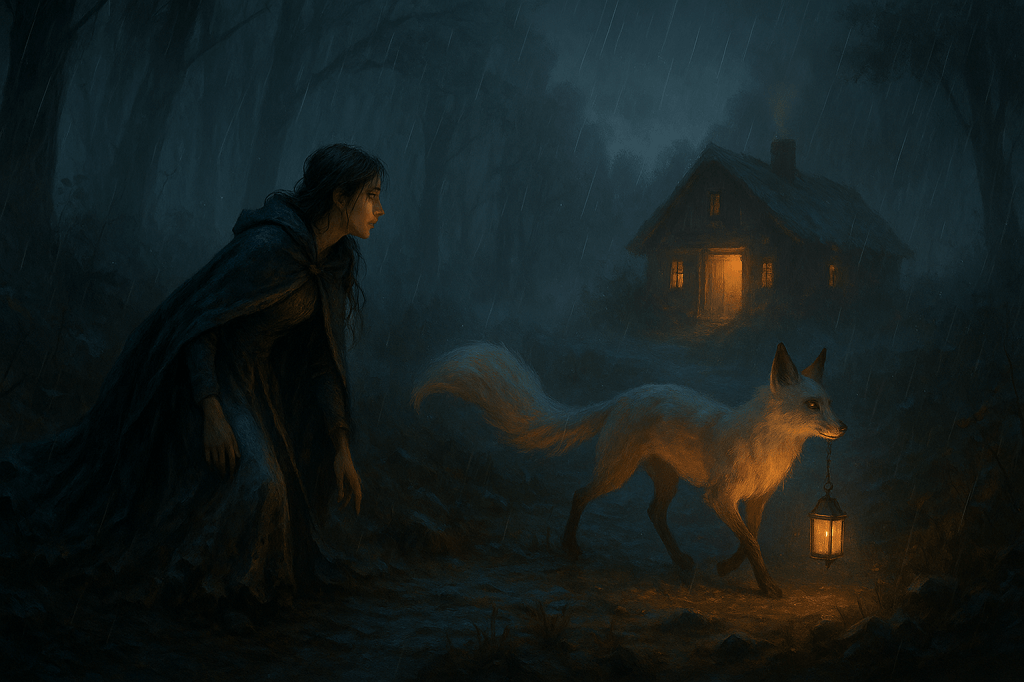
A fox, she thought at first—about the size of a hound, with a long, bushy tail and narrow, clever face. Its fur was a pale, silvery white, tipped in ember-gold at the ears and paws, as if it had walked through the last light of sunset and carried it away with it.
But no fox she had ever seen had eyes like that.
They glowed—not with the cold, hard shine of a predator in the dark, but with the same soft amber as the light it carried. And carried it did, for dangling from the end of its tail, by a thin chain that seemed made only of light, was a small lantern.
The lantern’s glow washed the fog in warm color. Its glass panes were etched with tiny, intricate runes that shifted when she tried to focus on them.
Elira stared.
The fox tilted its head, studying her in turn. Its tail swayed once, the lantern swinging gently. Then, without drama, it turned and padded away a few steps. After a moment, it stopped and looked back over its shoulder.
“Of course I finally go mad out here,” she muttered. “Why not?”
The fox waited.
Elira pushed herself, creaking, to her feet. Everything hurt. She was cold enough that the thought of movement felt impossible—and yet the idea of sitting back down in the dark and letting herself slowly freeze felt worse.
“Are you… real?” she asked.
The fox blinked slowly, as if to say: real enough.
Then it flicked its tail. The lantern chimed once like a tiny bell and flared brighter, casting a slender path of light between roots and stones.
Elira hesitated only a heartbeat longer.
“If this is a trap,” she told the fox, “I will be very irritated.”
The fox’s ears twitched. Then it turned again and slipped into the trees, lantern dancing.
She followed.
The path it wove was not one she would have chosen. At times the ground dropped away into shallow ravines and they had to pick their way along slick, narrow ledges. At others, they waded through knee-high ferns that slapped damp fronds against her legs.
Whenever she faltered, the fox would pause and look back, tail swaying in patient encouragement.
And always, the lantern light stayed just bright enough to show what lay directly before her, and no more.
“You couldn’t make it easier?” she complained, half to herself.
The fox’s ears flicked again, as if in dry amusement.
“Fine,” she muttered. “Teach the lost noble a lesson in humility. Very wise.”
Despite herself, she felt the faint ember of a laugh somewhere deep in her chest. It was small, and easily smothered, but it was there.
They walked for what felt like hours, though the forest around them slowly changed. The trees grew a little farther apart. The underbrush thinned. The bitter, icy edge of the storm wind softened, replaced by the earthy scent of wet soil and something else—smoke?
Elira sniffed the air more sharply.
Yes. Smoke. Not the wild, sprawling smoke of wildfire, but the straight, disciplined thread of a single chimney.
Hope flared so suddenly it almost hurt.
The fox veered slightly left. The mist ahead began to glow, not from the lantern’s light, but from a broader, softer brightness.
They stepped out of the trees onto the edge of a narrow dirt road. Elira blinked against the change in space. The road ran left and right, rutted with wagon tracks, puddles reflecting the dim sky.
Directly ahead, not fifty paces away, hunched a building.
It was not big; no grand inn with painted signboard and stableyard. It was a cottage, really, squatting low against the wind, its slate roof patched in places. Smoke rose from a crooked chimney. Light leaked from shutters that didn’t quite close, and from the cracks around a heavy wooden door.
The door itself bore no sign, no crest or mark.
Yet as Elira looked at it, something in her bones answered with a sensation very like recognition.
She had never seen this place before in her life.
And yet… and yet.
The fox padded to the center of the road and sat, tail curling gracefully around its paws. The lantern settled beside it, light steady.
Elira stepped up beside the creature, staring at the cottage.
“I… don’t understand,” she said quietly. “I thought there was nothing on this road for miles except—”
Except, apparently, whatever this was.
The fox looked up at her. For a moment, its gaze felt very old, older than the forest, older than the stones of her family’s hall. It wasn’t unkind. If anything, it held a sort of weary fondness, like a teacher watching a student finally grasp a simple truth.
It dipped its head once, then flicked its tail. The lantern chimed again. The sound was soft, but it carried—straight to the cottage.
The door opened.
Warm light spilled out, honey-gold and inviting. A figure stood in the doorway—broad-shouldered, apron-smudged, hair pulled back. Elira could not see their face clearly at this distance, only the outline of someone solid and real.
“Storm’s easing!” a voice called, rough with ordinary life rather than polished court. “If you’re out there, you’d best get inside before it thinks better of it.”
Elira swallowed.
Choice lay in front of her like a simple line.
Back into the forest—into cold, and fear, and her own limited understanding of the world.
Forward into something unknown that, at least for the moment, smelled of bread and fire and the soft murmur of other voices.
She glanced down.
The fox was already watching her. Lantern light painted its fur in shades of warm silver. The strange runes on the glass panes shifted again, rearranging themselves into patterns she could almost, but not quite, read.
“Is this… for me?” she asked.
The fox’s tail brushed her ankle, a brief, gentle touch. Then it rose in one fluid movement, trotted to the edge of the road, and, with a last backward look, vanished into the trees.
The lantern remained.
It did not fall.
It hung in the air for a heartbeat, then swung slowly toward the cottage door, as if anchored to a path that wasn’t entirely in this world.
Elira stood alone on the road.
Alone, except for the echo of her own whispered plea in her ears.
Show me a path that isn’t a cage.
She took a step forward.
The lantern bobbed ahead of her, lighting the way.
By the time she reached the cottage, she was shaking again, but for a different reason. The figure in the doorway stepped back to let her pass, and as she crossed the threshold, warmth wrapped around her like an embrace.
Behind her, though she didn’t see it, the lantern’s light flickered once, twice, then streamed in after her, tucking itself neatly into a hook on the beam above the door.
Its glow settled, filling the small room with a gentle, steady light that had very little to do with oil or wick.
Outside, the forest watched. The path she had taken was already fading, roots and leaves rearranging themselves over her footprints as though they had never been.
Far between the trees, a pair of amber eyes blinked once, satisfied.
The Lantern Fox turned and slipped away into the night, lantern swaying at its tail once more, searching for the next heart foolish and brave enough to ask for impossible help.
Tag: Maxfield Willow
-
Chapter 2 – The Runaway Noble
-

Chapter 1 – The Lost Path
(A lost explorer)
The first thing the explorer lost was the trail.
The second thing was the map.
The third thing, inconveniently, was the certainty that there had ever been a trail in the first place.
He stood on the edge of a ravine that hadn’t been there ten minutes ago, boots grinding in pale dust that looked suspiciously like powdered marble. A moment ago there had been pine needles underfoot and the comfortable loam of a forest floor. Now the trees ended in a sharp line behind him, and ahead yawned a canyon of broken columns and carved stone, as if some ancient temple had been dropped from the sky and shattered on impact.
“Okay,” he muttered. “That’s… new.”
The explorer’s name—at least the one he used these days—was Rowan Cairn. “Rowan” fit on travel documents and didn’t make bureaucrats nervous. “Cairn” was a private joke; a pile of stones to mark where someone had been, or where someone had vanished.
Rowan tightened the strap of his pack and checked his pockets for the seventeenth time. Compass. Multi-tool. Crumpled transit card from a city that no longer existed on any map. Phone with no signal, as usual in this place. No physical map, of course. Because the path had been “so obvious” at the start.
He turned In a slow circle.
Behind: a dense evergreen forest under a sky of bruised violet cloud, the air smelling of resin and cold. Ahead: a ruin-filled ravine that glowed faintly from within its fractures, as if the stone remembered fire. To the left, the forest broke and became city—tower blocks and alleyways jutting out at impossible angles, their windows lit with the warm gold of distant apartments. To the right, the trees thinned into steel ribs and gantries, the skeletal framework of a starship cradle under construction, cranes frozen mid-swing.
It was alwayss like this here: borders soft as breath. Places rubbing up against each other like pages not quite aligned.
“Right,” Rowan said. “You’re definitely lost.”
His voice came out too loud in the strange quiet. No birdsong. No hum of traffic. Just the faint, glassy sound of the wind threading through broken pillars and antenna masts.
He checked his phone anyway. No bars. The lock screen still displayed the last normal thing he remembered: a weather app promising “light showers” for a city that had slipped behind him hours—or days?—ago.
The sky overhead wavered. For a heartbeat, the clouds were not clouds but carved ceiling panels painted with constellations; then they blinked back to stormy violet. A fine drizzle began, cold as disappointment.
Rowan dragged in a breath, tasting rain and dust and a metallic tang like old coins.
“I should’ve stayed with the survey team,” he said to no one. “Filled out expense reports. Complained about coffee. Died of boredom at forty-five.”
The memory of the argument rose unbidden: the project lead saying Your job is to map new transit corridors, not wander into anomalies, and Rowan saying My job is to see where things could go.
The anomaly had obliged by opening under his feet.
He looked again at the ravine. There was a way down, technically—broken steps carved into fallen blocks, narrow ledges between splintered columns. It screamed “ancient curse” in every language.
“Yeah, that’s a no,” Rowan said. “Forest it is.”
He turned his back on the ravine and stepped toward the trees.
On the second step the forest pulled away like a curtain.
Rowan stumbled forward onto cobblestones. Streetlamps arched overhead, their bulbs glowing with a soft amber that was not electricity. The air smelled of wet stone and frying food, and somewhere a radio played a song he almost remembered.
He froze.
Behind him, the ravine. In front of him, a narrow street between tall, crooked houses of brick and timber. To the side, in the gap between a doorway and a drainpipe, something moved.
Light flickered there—not quite flame, not quite glass. It drew itself into the shape of a fox.
Rowan stared. The fox stared back with eyes like two tiny lanterns, steady and warm.
Its body was a delicate tangle of light and shadow, its fur made of glowing threads as if someone had woven fireflies into the outline of an animal. Along its sides and tail, small panes of something like paper or glass shifted and clicked, each one etched with symbols that refused to resolve into any script Rowan recognized. The fox’s paws touched the ground without disturbing the damp, leaving no prints.
“…Right,” Rowan said slowly. “This is new, even for you, Rowan.”
The fox inclined its head, as if acknowledging the observation.
“You’re not real,” he muttered. “I hit my head on the way down. Or up. Or sideways. Or—”
The fox stepped fully out of the shadows, and its light pushed the drizzle back. Where the glow reached, the raindrops turned into tiny floating lanterns for an instant, drifting downward like seeds before winking out.
Rowan swallowed.
“Okay. Counterpoint: maybe you’re very real.”
The fox blinked. One of its side-panels—no, not a panel, more like a hanging charm made of thin horn and translucent paper—flipped over with a soft click. On its surface, lines rearranged themselves until they made an image Rowan could read.
It was a little drawing of a person standing at a crossroads, arms spread in helpless confusion.
Rowan stared at the dangling charm. Then at himself. Then at the fox.
“Rude,” he said. “Accurate, but rude.”
The fox’s tail swished, scattering sparks of pale gold. Without further ceremony, it turned and trotted down the narrow street, lantern-light paws splashing through puddles that did not ripple.
“Hey!” Rowan called. “Where do you think you’re—”
The fox paused and glanced back.
The warmth in its small bright eyes held no impatience, only a quiet expectation. It felt uncomfortably like the look his grandmother used to give him when he was young and staging ten separate rebellions at once: Have you finished being dramatic, or shall I put the kettle on first?
“You’re a hallucination with attitude,” Rowan decided. “Fine. Lead on, ghost-lantern-fox-thing. I’m out of better ideas.”
He followed.
The street bent like a question mark, and with each curve the world changed. A few steps took him past a café whose sign was written in a language of dots and dashes of light; a few more, and he was walking beside a high hedge in which birds made of folded paper hopped and sang in soft rustles. The fox padded ahead, the glow from its body painting the stones in warm amber.
“Any chance you know where ‘home’ is?” Rowan asked.
The fox’s ear twitched. Another charm at its side flipped. This one showed a circle with a dot off-center, an arrow pointing away from the dot.
“That’s not helpful,” Rowan grumbled. “You don’t even know what I mean by home, do you?”
The fox did not reply. Of course it did not reply. Rowan kept talking anyway, because silence gave his thoughts too much room.
“I mean, I had a home. Once. Just… kept moving. New cities. New contracts. New transit lines to chart. Figured if I mapped enough roads, eventually I’d find the one that felt like it was mine.”
He sidestepped a puddle that reflected not the sky above, but a vaulted ceiling of stained glass. Colors rippled over his boots.
“Or maybe I thought if I never stopped, I wouldn’t have to admit I was lost. Joke’s on me, I guess.”
The fox slowed. The street opened into a wide square that belonged to no single time.
On one side stood a subway entrance, its railings slick with rain, escalators frozen halfway up. On the opposite side rose the jagged bones of a starship hull under assembly, cranes locked mid-swing. Between them, a ring of standing stones shouldered up through the cobbles, each one carved with symbols worn almost smooth.
In the center of the square, the ground dropped away into darkness—a perfectly circular pit, too round to be natural, too deep to see the bottom.
The fox sat at the edge of it, lantern-eyes reflecting the void.
Rowan stopped well back.
“Nope,” he said. “Not a chance. I’ve played this game. That’s a bottomless metaphor pit if I’ve ever seen one.”
Another charm on the fox’s side flipped. This time the drawing showed a tiny figure standing at the lip of a dark circle, a hesitant foot extended over the edge. Beside it, another little figure walked calmly around the circle instead, following a faint, dotted line.
The fox tilted Its head toward the second figure, then looked up at Rowan.
“So there’s a way around,” he said slowly. “And I get to choose whether to jump or take the long path.”
The fox’s tail made a small approving flick. Sparks drifted off and circled the pit, sketching a faint bridge of light that arched from one side to the other before fading.
Rowan exhaled, tension he hadn’t realized he was carrying loosening from his shoulders.
“My entire life in three pictures from a walking lantern,” he muttered. “Great.”
He circled the pit, giving it a wide berth. The fox padded along the rim, staying just ahead, never pushing, never falling behind. Just… there.
After a while, Rowan said, quieter, “I walked away from a lot of things. Jobs. Cities. People. Every time the road forked, I picked the direction that kept me moving. I told myself that was bravery.”
A charm turned, revealing a simple symbol: a heart with a tiny door drawn in its center, closed, laced with a comically large padlock.
Rowan winced. “Okay, now you’re just being mean.”
The fox gave what might have been a tiny snort. Its light brightened for a heartbeat, then softened again.
They reached the far side of the square. The pit ended; the cobblestones became compressed dirt, then gravel. Ahead, rows of metal rails spread like fingers, leading into a mist where station platforms, ship berths, and forest paths all seemed to knot together.
It looked like a place between departures.
The fox halted.
“Is this it?” Rowan asked.
Several charms flipped at once, clicking like distant windchimes.
On one: a train, stylized and simple, its windows glowing.
On another: a path vanishing between trees.
On a third: a narrow alley with hanging lights and something that might’ve been a wooden sign in the shape of a tankard.
The fourth charm was blank.
Rowan frowned. “You’re saying…?”
The fox shook itself, and all the charms settled. Then one, and only one—the blank one—slowly inked over with fresh lines. They curled and curved, resolving into something like a doorway outlined in light, standing alone in empty space.
Not a command. An invitation.
Rowan’s throat tightened.
“No more maps,” he said softly. “No more someone else’s routes. You’re not here to show me where to go. Just that… there is a way. That I can pick it.”
The fox’s eyes warmed like coals in a hearth. Its head dipped once, solemn as a bow.
Rowan looked out over the rails and paths.
On the tracks to the left, a sleek train waited, doors open. Through its windows, he saw a city of neon and wet asphalt, the kind of place where you could disappear into crowds and late-night diners and never be asked where you’d come from.
Down the forest path, he glimpsed cabins and lanterns, the glow of fires, and the sound—faint but real—of laughter and clinking cups. The air from that direction smelled of pine and roasting meat.
The alley with the hanging lights promised cramped tables, handwritten notes pinned to walls, old stories told over new drinks. The wooden sign in the shape of a tankard swung gently, though no wind moved.
Something in his chest twisted toward that alley, quick and fierce. A place of pause. A place between.
His hand went to his chest, as if to physically steady the sudden ache.
“How far ahead are you playing this game?” he asked the fox.
The lantern-fox did not answer. Instead, it stepped close enough that its light touched Rowan’s boots and jacket, warm and steady. Up close, he saw that the “fur” was not fur at all, but hundreds of tiny lanterns, some lit, some dark, each containing a fragment of image: doorways, bridges, faces, cups, keys.
Not futures, exactly. Possibilities.
“I don’t know if I can ever go back,” Rowan whispered, surprising himself with the admission. “To the old work. The old cities. The old me.”
The fox’s tail brushed his calf, a touch like the edge of a candle-flame—there and gone, not burning, just reminding.
A new charm flipped. On it was drawn a figure walking forward, leaving behind a tangled scribble, stepping toward a horizon that curved slightly like the spine of a book.
Rowan laughed, the sound half a hiccup. “You’re really committed to the bit, huh?”
He hesitated one last time. Then he faced the crossing of paths, the knot of tracks, the invitation of worlds.
“I’ll find it,” he said. “A place that feels… not just like a waypoint. Not just a pit stop between assignments. A place to arrive. Even if I haven’t seen it yet.”
The fox’s eyes brightened. Every lit lantern along its body pulsed in agreement, like a soft chorus of yes.
Rowan took a step forward.
The world shivered.
For a heartbeat, all the paths overlapped—the train, the forest, the alley, starship gantries and old roads and something that looked like a tavern door carved with a fox and a lantern crossed together. Warm light spilled from that door, voices rising in welcome, the scent of spiced cider and woodsmoke curling out like an embrace.
Rowan’s heart reached for it with a longing so sharp it was almost pain.
Then the vision blurred. The tavern door dimmed and slid sideways, becoming just another maybe, one of a thousand lanterns that hadn’t yet been lit.
“Not yet,” he breathed.
Not yet. But someday.
He chose a direction—not at random, not in reaction, but because something quiet inside him leaned that way and did not flinch.
As his boot came down on the gravel, the path steadied. The mist thinned. Ahead, the way unrolled, uncharted but walkable.
Rowan did not look back.
If he had, he would have seen the lantern-fox watching from the edge of the crossing, its charms folding flat, its tiny images dimming one by one. He would have seen the fox lift its head toward the unseen tavern-that-wasn’t-yet, as if checking a lantern on an invisible hook. He would have heard, perhaps, the soft chiming laugh that wasn’t sound at all but the shimmer of a promise made to no one and to everyone:
I will find the lost. I will guide the weary. When the door is built, they will already know the way.
But Rowan only felt a warmth at his back, like a hand resting there in blessing. It faded slowly as he walked, leaving behind something steadier: a thread of courage stitched where fear had been.
The drizzle eased. The sky brightened to a cool, clear twilight in which no one clock held authority. Ahead, a signpost appeared where none had been, its arrows blank, waiting.
Rowan smiled.
“Fine,” he said. “We’ll write the map as we go.”
He adjusted his pack and walked on into the place between worlds, the echo of lantern-light still glowing faintly at his heels
 Maxfield Willow